
How to get to Tusheti, when to go and what to see and do in Georgia’s most remote and beautiful region? I’ll share it all with you in this complete travel guide to Tusheti National Park in Georgia!
Georgia is an ancient Eastern European country situated on the southern slopes of the Caucasus mountains.
Regardless of its rich culture and history, diverse nature, amazing folklore, and delicious cuisine, the country is still emerging as a popular tourist destination and is often referred to as the “hidden gem” of Europe.
Everyone who visits Georgia for the first time wants to return. It’s hard not to fall in love with a country that is so diverse and has so many amazing and unique places!
The best places to discover Georgia’s unique history, culture, and nature would be the mountain regions such as Svaneti, Khevsureti, Pshavi, and Tusheti.
I considered Svaneti for a long time as my favorite region in Georgia because of its magnificent landscapes, medieval stone houses, and authentic culture. But now that I have seen the even more majestic highlands of Tusheti, I changed my opinion and vote for Tusheti as the most beautiful region of Georgia!
I’m glad that I got the chance to visit this picturesque and fascinating mountain area and I would highly recommend you to visit Tusheti too if you’re planning a trip to Georgia!
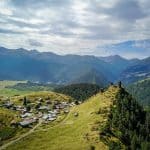

While all the mountainous regions in Georgia are pretty remote, Tusheti is the hardest one to access. That’s why I’m sharing with you all the practical travel info about how to visit, what to do, and get to Tusheti National Park!
Disclaimer: This posts might contain affiliate links, meaning that if you make a purchase through these links, I may earn an affiliate commission. Thank you for helping to support this website!

1. Where is Tusheti and why you should visit this remote region
Tusheti is a historical region of Georgia, scattered on the southern slopes of the Caucasus mountains up to 4800 meters above sea level.
The region is bordered by Dagestan and Chechnya in the north and surrounded by Pshavi, Khevsureti and Kakheti from the Georgian side.
There used to be four communities living in Tusheti: Prikiti, Gometsari, Sovata, and Chagma. They were separated from each other by the four gorges dividing the region.
Chagma, also called Chachakovani, is the only community that is still densely populated. It consists of the villages Diklo, Shenako, and Omalo. Omalo is also the main village of Tusheti, located at an altitude of 1,880 meters.

Higher up in the mountains you can find a series of ancient villages such as Dartlo, Chesho, Parsma, Bochorna, …
Some of these villages like Parsma aren’t accessible by car and you’ll have to walk or go on horseback to visit these fairy-tale-like places.
The region is distinguished by its unique culture, folklore, crafting, and traditions. Just like Svaneti, Tusheti and its people managed to preserve them the best due to its isolated location.
Inscribed in the Unesco World Heritage tentative list, Tusheti is named “one of the most ecologically unspoiled regions in the Caucasus.”
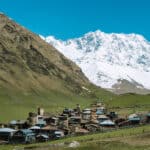
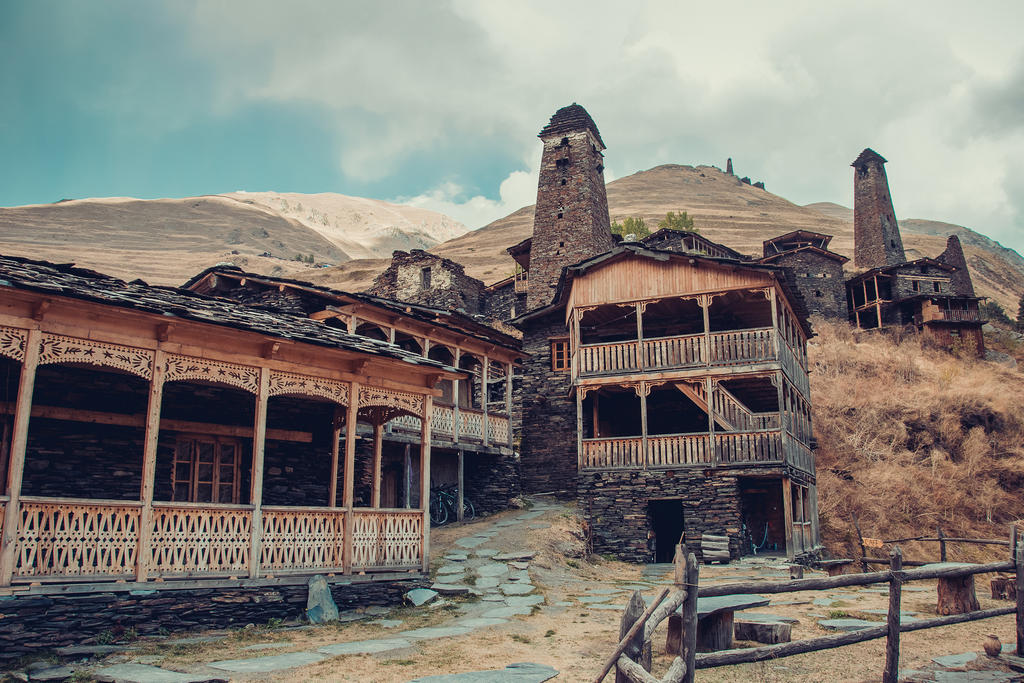
2. Interesting cultural and historical facts about Tusheti, Georgia
1. Bochorna- the highest village in Europe
Many think Ushguli in Svaneti, located at 2119 meters altitude, is the highest continuously inhabited settlement in Europe. This was true until 2014 when doctor Irakli Khvedaguridze moved back to Bochorna, a village in Tusheti located at 2345 meters altitude. Bochorna is 10 km or a 36-minute drive from Omalo.
The 78-year-old Irakli is the only dweller of the village and the only person able to provide first aid medical help across 1000 sq. km to the Tushetians who remain in the region, even throughout the harsh 8 winter months during which the road to Tusheti is closed.
Irakli Khvedaguridze rides his horse Bichola to see patients, but in heavy snowfall, when horseback riding becomes impossible, he has to cover tens of kilometers on foot.
2. The historical purpose of the Tusheti Towers
You’ll notice a lot of centuries-old tower fortresses, named koshkebi, between the villages. These are known as the “Tusheti towers”.
They were built on a high hill and were used for communication between the villages during times of invasions or other catastrophes. It was also a great place to attack hostile forces by throwing stones and firing guns at them.

3. Tusheti “house-castles” and dwellings
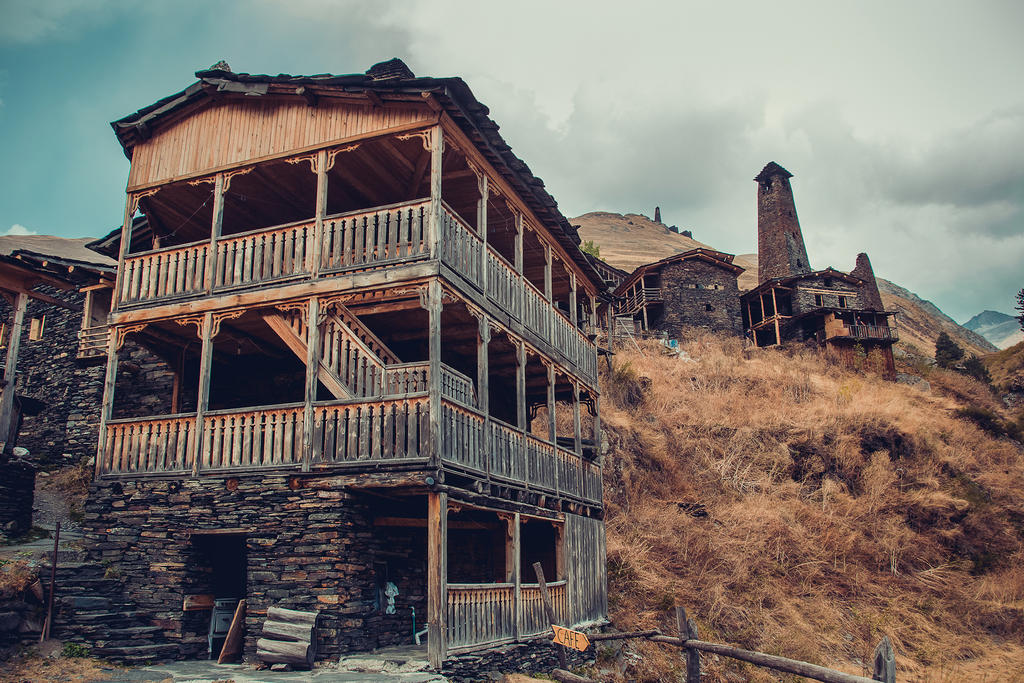
Only 10 villages in the region preserved the Tusheti “house-castles”, houses hanging on rocks. They served defense, economic and residential purposes.
The old Tush house has three functionally different parts: the first floor was for the women. It’s where they took care of the cattle, gave birth, and so on … The second floor was the residence of a family.
The houses had at least 3 floors but there were many 6- and 7-story houses where big families lived together.
Most people in Tusheti had winter and summer houses. The 3- and more-story houses were for summer and the 1-story houses predominated in the winter settlement.
4. Who are the Tushs?
The locals of Tusheti are ethnic Georgians called Tushs or Tushebi in the Georgian language.
The Tushs are traditionally shepherds. The cheese and high-quality wool they produce are very famous and gets even exported to Europe and Russia.
The women are very talented at knitting and pressing felt. They make socks with some beautiful ornaments, woven carpets, and fabrics for clothes.
Sheep and cattle breeding is still the leading branch of the economy in the highlands of Tusheti. The shepherds spend the summer months in the highlands but move their cattle and sheep back to the lowland villages in the wintertime. The Tushs are therefore known as nomadic people.

5. Gender roles and legislation in Tusheti
The ancient institute of 12 judges in Tusheti also included women. This institute functioned until Russia conquered Georgia and the whole Caucasus.
Elders, who were distinguished with their wisdom, and deep knowledge of the customs and the law, ruled the court. Even the king did not interfere in the internal affairs of the community…
If the thief was found guilty, he had to return 7x more of the stolen goods. Adultery was not taken to the court, it was more of a family affair.
Tusheti is infamous for its strong female characters. The women were taught martial arts, horseback riding, hunting, etc. from a very early age. One of the Tushi hero women was known for her sharp wit, and knowledge, so the elders elected her and she became the chairman of the council for 10 years.
6. Interesting Local traditions in Tusheti
- A horseman must descend near the village and should not get back on the horse until he leaves the village again. This rule is still practiced today by locals and guests are expected to respect that too.
- Crossing the village on horseback was associated with a violent enemy in traditional society and meant insulting the village. This custom later lost its original meaning and took on the meaning of a wordless expression of kindness towards the village.
- Tush people believed that a guest’s footsteps were followed by an angel and therefore sent by God. As soon as a guest crosses the threshold of the door, they wish their hosts peace and bless the angels of the base, hearth, and ceiling of the house.
- A guest is untouchable in Tusheti. They enjoy complete safety and protection at their host’s home. However, if the guest behaves inappropriately and his behavior is contrary to the moral and traditional norms of the Tusheti, he may soon feel excluded and neglected.
- The sons weren’t allowed to move out of their parental home as long as their parents were alive. Whenever a man married, his wife was obliged to move in with him and his parents.
- When someone passed away, the family would lit candles for 40 days non-stop. They would get “professional criers”, women who would cry over the head of the deceased and create both a dramatic as uplifting mood during the time of mourning.
- The Tush drink to honor the soul of the deceased with the first toast dedicated to him or her. The second toast is dedicated to the parents and siblings of the deceased as it was believed they’d be the first to greet the soul after passing over. The third toast is for the poor and vulnerable.
- After one year, they would have one last ritual in honor of the dead soul. The ritual included making Aludi, a traditionally brewed beer and helped letting go of the soul. Not making Aludi for a dead person was considered as if they left him or her without being buried.
- Archeological excavations in the tombs showed that cremation in Tusheti was widespread. Jewelry and personal belongings were scattered in the graves, together with traces of ashes. This is quite unique as cremation was not practiced anywhere else in Georgia.
- You’ll also find evidence of both Christian and Pagan religions in the different corners of this spectacular region. Very interesting are the stone shrines or little piles of stones arranged in a ritual design. They are called khati and it’s the place where the family’s guardian angel used to live.
- The khati can be found in every village and is often decorated with the horns of sacrificed goats or sheep and white stones. I came across a khati in Omalo by accident, had no idea what it was and only found out later that visitors and women are not permitted to approach the khatebi (plural for khati) as they are sacred places.
3. When is the best time to visit Tusheti?
The best time to visit Tusheti is during the summer months of July and August. You might be able to visit Tusheti in late May, June, or maybe September, depending on the weather conditions.
Unlike Svaneti, which is pretty much accessible all around the year to visitors, Tusheti is more of a “hard-to-get” type.
There is only one road that goes to the area over the treacherous 2900m Abano Pass. It’s a beautiful mountain pass but it’s also considered one of the most dangerous roads in the world. The Tusheti Road even made it to the BBC TV series “World’s Most Dangerous Roads”!

You won’t have to fight 9 dragons to get to Tusheti, but you’ll need nerves of steel while driving on the narrow curvy, and unpaved road. It definitely won’t make you feel any less of a hero once you reach Omalo!
Once the snow starts to cover the road in late September, this beautiful region of Georgia becomes inaccessible for the next 8 months until the harsh winter decides to surrender to the summer warmth.
That’s why most of the Tushs nowadays only go up there during summer to graze their cattle, organize traditional festivals, provide accommodation and tours for tourists and reconnect with their roots. In winter they live in the lowland villages of Alvani and Akhmeta in Kakheti.
The Roads Department of Georgia starts the intensive work of clearing the Tusheti road in late spring but the speed of this job very much depends on the weather conditions.
In 2022, the road to Tusheti only opened on the 20th of June but in the past years, Tusheti was accessible as early as May.


4. How to get to Tusheti (and back)
4.1 The Tusheti Road, aka “Death Road”
The only connection to Tusheti is an unpaved road that starts at Kakheti. Locals name it the“death road”, which is partly understandable: 70 kilometers of mountain serpentine that starts in Pshavelli in Kakheti to the high remote village of Omalo, which is the “capital” of the Tusheti region. The drive takes 5 to 6 hours one-way.

The road on its own is already a good reason why you should visit Tusheti. It goes up along the Abano mountain pass to about 3000 meters over the 4 gorges of Tusheti.
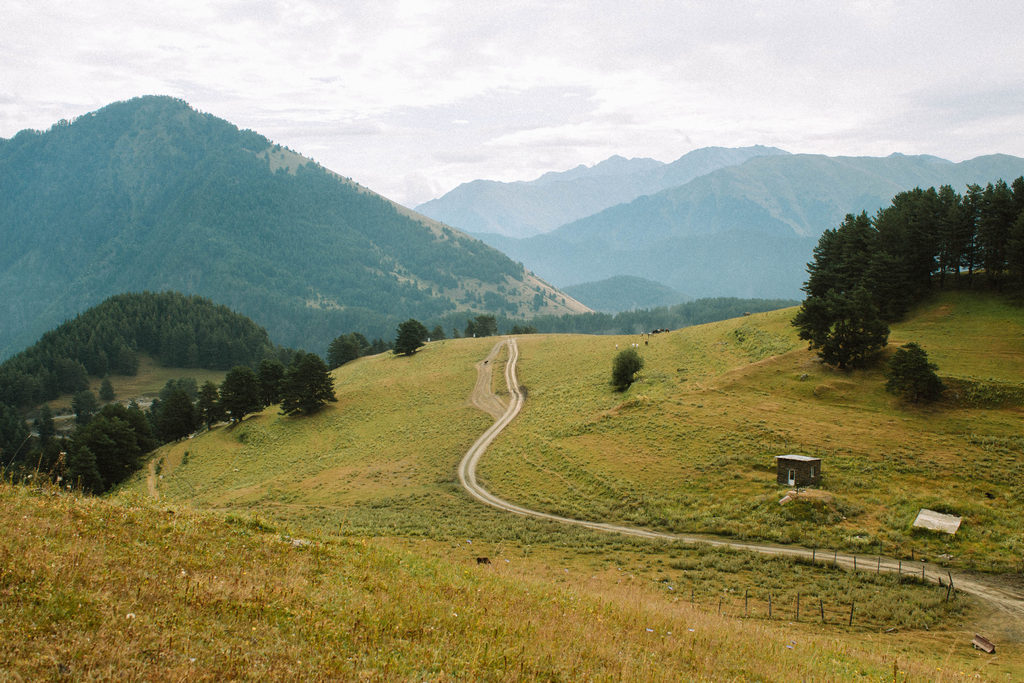
The views along the pass are just incredible! You’ll drive along rivers, pine forests, and alpine meadows and you might even spot a few eagles along the way!

It can be scary to drive right next to the steep cliffs, especially when there are oncoming vehicles. The road is predominantly narrow and it requires some great maneuvering skills!
Every year there are cars that tumble into the canyons so it’s important that the state of the car’s brakes and tires is in optimal condition and that you or your driver have experience with these types of roads.
I hitchhiked to Tusheti and got a ride in a Kamaz, a Russian brand of truck, that was transporting construction materials to Omalo. The driver was very skilled and maneuvered the big truck like a boss!

He had to take this road three to four times a week and it was very obvious that he was used to it. Not once did I feel unsafe, not even when I saw the steep cliffs right next to me but I can imagine that if you’re not used to this kind of driving, it can be nerve-jangling! Especially when there’s a lot of fog and mist due to the Alpine climate. I was lucky that it was a bright and sunny day.
There was only one moment when I was aware of the hazards that this road brings. On the way towards Omalo, we passed a small group of people standing helplessly around their car. The hood was completely smashed by a big boulder that had rolled down from one of the mountain slopes.
They were incredibly lucky that the boulder didn’t hit the roof or they wouldn’t have been standing there anymore. Looking at their baffled faces, they realized the same thing. So don’t only pay attention to the road itself but also look out for falling boulders!
I can imagine that you might not feel super inspired now to visit Tusheti because of the possible dangers. The chances that something will happen are low. I even saw some brave cyclists on this road!
Trust me when I say that it is worth the thrill! When driving carefully without overspeeding or taking unnecessary risks, the journey will be one of the most beautiful experiences of your trip to Georgia!

4.2 How to get to Tusheti by rental car
Only a 4×4 vehicle can handle this crumbling mountain road. If you are a confident and experienced off-road driver, you can rent an SUV in Tbilisi for your big adventure. Bring enough petrol as there are no petrol stations in Tusheti.
If you want to navigate by using Google Maps, don’t type “Tusheti”. Google will direct you towards Dusheti, a town near Tbilisi and that’s NOT where you want to go (I saved a couple of travelers from making this mistake).
The destination you need is Omalo. From there you can reach the other villages such as Dartlo, Diklo,…
The Abano pass starts in the small village of Pashvilli and it’s around 70 km to Omalo. It’ll take you about 5 hours to get there but don’t be in a rush! As I mentioned already a few times, it’s a dangerous road!
Leave as early as possible so you don’t end up driving in the dark (you really wouldn’t want to do this!!!).
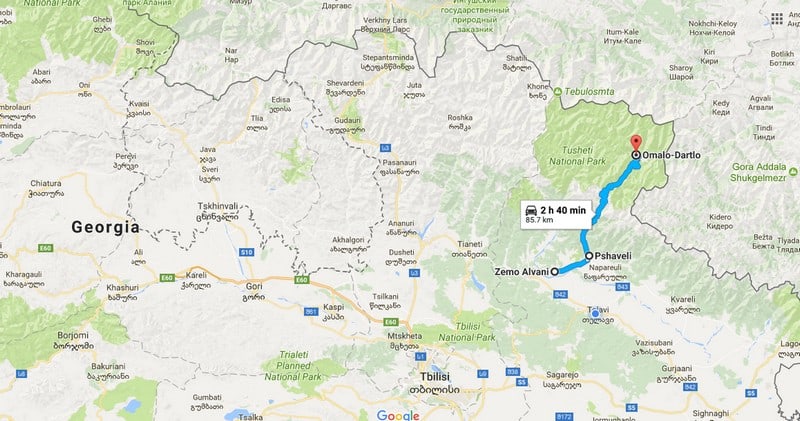
Google Maps says ‘2h 40’. Google has never been on this road before…
You could explore Kakheti, the main wine region of Georgia, on your way to or from Tusheti. Telavi, the main town of Kakheti, could be your first stop. It’s a bit of a detour but Pashvelli is a pretty easy and short drive from Telavi.

4.3 How to get to Tusheti from Tbilisi by public transport
If you want to take public transportation and/or you don’t feel skilled enough to drive on this road yourself, it’s not a bad idea to rely on local drivers to get you safely to Tusheti.
Most of these drivers have been driving daily on this tricky road daily for years and they know every turn and stone. As long as they drive carefully and responsibly, their experience makes them reliable. Don’t be shy to ask numerous questions about the condition of their vehicle.
You can find the drivers and their Delica’s – 4×4 Mitsubishi mini-vans – in the village of Kvemo Alvani (around 22km from Telavi).

To get to Kvemo Alvani from Tbilisi, you can take a marshrutka – mini-van at the following 2 bus stations in Tbilisi:
- Ortachala bus station: daily departure at 9.00 and 16.20, the price for a ticket is 7 Gel
- Navtlugi bus station (next to metro station “Kvemo Samgori” ): daily departure at 15.20, the price for a ticket is 7 Gel
You can also take a shared taxi from Tbilisi to Kvemo Alvani. They leave from Isani metro station and usually depart when they are full. Taking a shared taxi to Kvemo Alvani from Tbilisi costs 12 Gel per person.
The distance from Tbilisi to Kvemo Alvani is 115 km through the Gombori pass and the journey takes about 2 hours.
Note: As most 4×4 taxis leave Kvemo Alvani by noon, you should catch a marshrutka or shared taxi in Tbilisi at the latest by 9 am if you want to be certain of a ride to Omalo!
Once you reach Kvemo Alvani, you’ll easily find the 4×4 Delica taxis. They usually wait for passengers at the main square/junction of the village, which is impossible to miss. You can ask the marshrutka or shared taxi driver to drop you off there.
It costs 70 Gel per person for a seat in the 4×4 van. You could also rent the whole car with a driver for about 350-400 Gel (USD$120 – $140). Please, keep in mind that, due to the current events and inflation, prices are increasing weekly – if not daily – in Georgia.
There might be a slight difference in price by next week (you’re always welcome to share updates in the comments below!). However, if the driver tries to charge you a lot more than what is mentioned here, negotiate or find another driver.
The distance from Kvemo Alvani to Omalo (Tusheti) is pretty short, just 75km. Though the speed limit on this road is 50km/h, realistically you’ll drive much slower than that so it will take at least 4 to 5 hours to get there.

4.4 How to get to Tusheti from Telavi
Take a (shared) taxi or marshrutka from Telavi bus station to Kvemo Alvani. It’s a short 30-minute drive to get there and ask the driver to drop you off at the main junction of the village. You’ll see the 4×4 Delicas upon arrival.
For the continuation of the journey from Kvemo Alvani, follow the instructions in the section above.
4.5 How to hitchhike to Tusheti
Hitchhiking to Tusheti can be pretty tricky and it’s not something many people do. I wasn’t even sure if I would make it. But… I did!
So if you want to hitchhike, you should get to Pshaveli, the last village until reaching Tusheti. You can expect a long waiting time as there isn’t much traffic, aside from private cars that are usually packed with passengers and Delica’s who rarely stop for free ride seekers.
There might be an exception, but it’s not very common. If you’re patient and lucky enough, a local or truck driver might give you a ride.
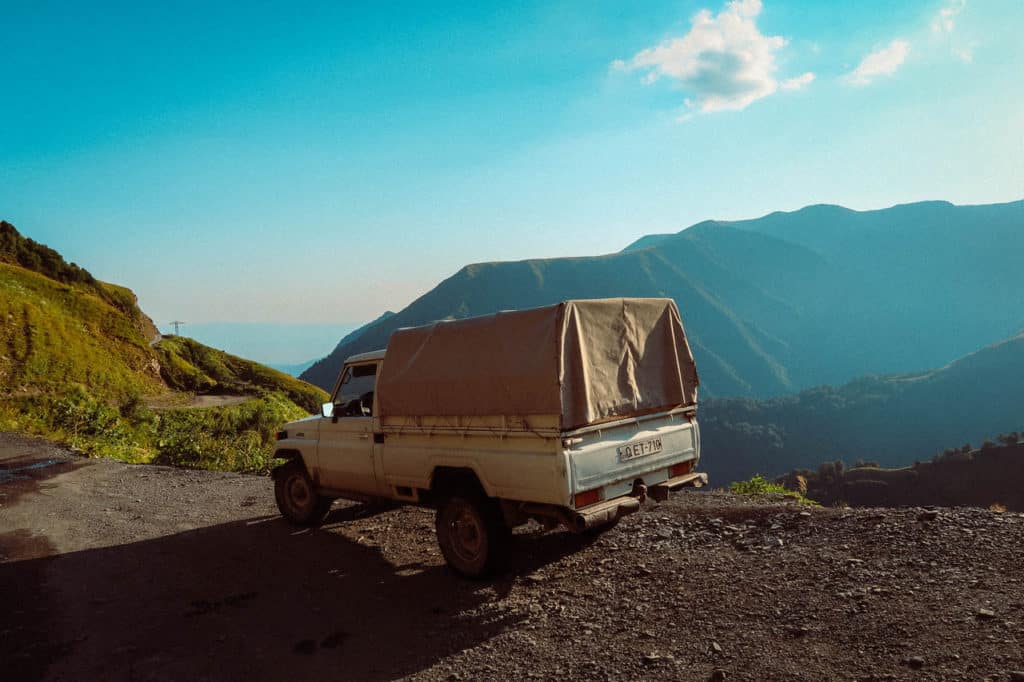
After a very long waiting time, my friend and I got a ride from a friendly Kamaz truck driver on the way to Omalo. On our way back, we had to wait a very long time again until an elderly local gave us a ride in his small pick-up truck.
t’s also not so easy to hitchhike from Omalo to the upper villages such as Dartlo and Diklo. You can definitely try but it was the first time that I felt limited by not having a car. You could always pay for a Delica to bring you there (see below: 5. How to get around Tusheti).
4.5 How to get from Tusheti to Tbilisi or Telavi
You’ll first have to take a shared 4×4 taxi from Omalo to Khemo Alvani. As there is no regular transport from Tusheti to Tbilisi or Telavi, you should arrange your return at least a couple of days in advance.
You can ask your driver, once you arrive safely in Omalo, from where and at what time he or other 4×4 taxis leave on the day of your planned return.
You can also ask your host at the guesthouse if he or she could help you with organizing your return trip.
If none of the above works, you can go to the Tusheti National Park Visitor Centre in Omalo and ask them to help you.
Once you’re in Khemo Alvani, take a taxi or marshrutka to the New Bus Station in Telavi. The drive takes around 30 minutes.
If you’re planning on going to Tbilisi, there are hourly marshrutkas leaving between 9 am and 9 pm from the New Bus Station in Telavi to the Ortachala Bus Station in Tbilisi. Tickets cost around 10 GEL, and the trip takes 2 to 3 hours.
4.6 Tusheti Tours
Tusheti offers a lot of outdoor activities such as mountain climbing, hiking, horseback riding, bike tours,… You can book these tours via the visitor center in lower-Omalo.
What you also could do is book a multiple-day tour to Tusheti that includes transportation from and to Tbilisi.
Here are a few tours I recommend:
5. How to get around Tusheti
Once you reach Omalo, the main village of Tusheti, you might want to further explore the region. To do this, you’ll need to arrange a car to get around.
You can make a deal with your driver who brings you to Tusheti or ask your guesthouse host and they will help you with this.
It will cost you around 100 Gel to get from Omalo to most of other the villages. You’ll have to pay more if you want to include multiple destinations.
Most villages are about 10-20 km away from one another and if you are up for a nice walk, it is doable to visit them on foot as well. If you enjoy horseback riding, you could also rent a horse and guide.

6. Things to do in Tusheti
6.1 Visit the ancient villages in Tusheti
Tusheti consists of many small villages scattered on the slopes of the Caucasus mountains. Each of them has its unique flavor and is worth visiting.
There are different trails connecting the villages that you can visit on foot, on horseback, or by car. You can find a detailed overview of these trails here.
Some of the most beautiful villages in Tusheti, besides Omalo, are:
- Dartlo: located 18 km from Lower Omalo. This fairytale medieval village is often referred to as the most beautiful village in Georgia. Some of the architectural complexes date back to the 15th century.
- Kvavlo: a small fortress village situated above Dartlo
- Diklo: located in the Chaghma Valley, 15 km from Omalo. This beautiful village dates back to the 17th century.
- Shenako: situated 8 km from Omalo. You can visit the 19th-century-old Shenako Monastery.
- Bochorna: the highest settlement in Europe, located 10km from Omalo. Say hello to doctor Irakli Khvedaguridze .
- Keselo: 2 km from Upper Omalo where you can visit an ancient fortress
Click here to open the interactive map of the village hiking trails.
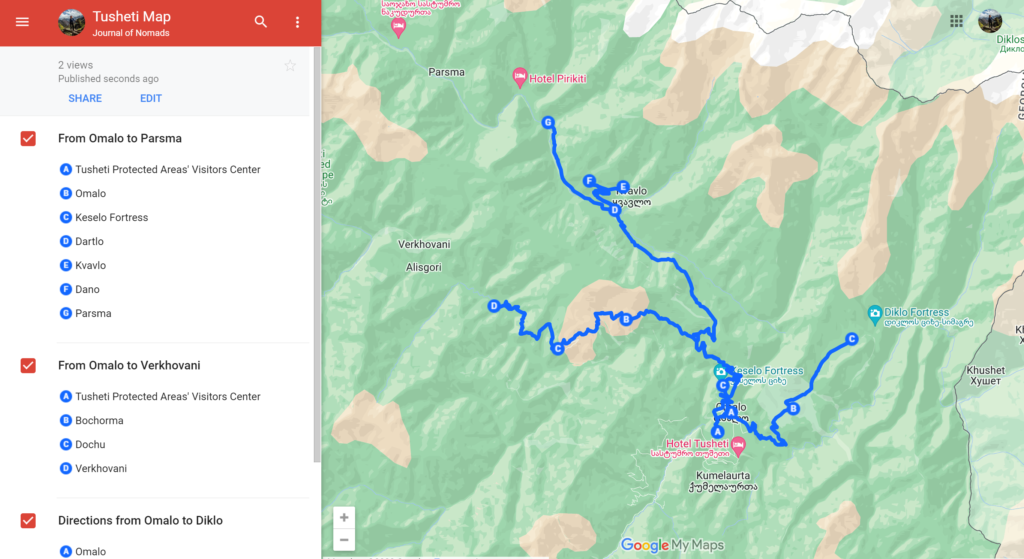
6.2 Trekking and hiking in Tusheti
Tusheti is a paradise for outdoor lovers and hikers. The Tusheti Protected Areas has 10 tourist trails, varying from easy one-day hikes to 6-day treks.
You can buy a hiking map of the area with all the trails at the Tusheti Protected Areas Visitor Center in Omalo.

The Tusheti-Khevsureti trail is one of the most popular multi-day treks. It connects Omalo to Shatili, the central village of Khevsureti. This challenging trek can be done in about 5 days. You can read the detailed description of the Omalo- Shatili trek here.
If you are not an experienced hiker, taking a local mountain guide is highly recommended, especially considering that phone signal coverage is relatively poor in this region.
If you prefer to do this hike in a group with a guide, you can join one of the following trekking tours. During these tours, you’ll hike from Omalo in Tusheti to Shatili and finish in Kazbegi.

6.3 horse riding and cycling in Tusheti
Tusheti Protected Areas Visitor Center in Omalo offers possibilities for cycling, horse riding, bird, and gazelle-watching tours.
You can also join a horse tour with Soso Shetidze, a Tush horseman who has 50 amazing Tush horses.
6.4 Join the shepherds for the animal migration to and from Tusheti
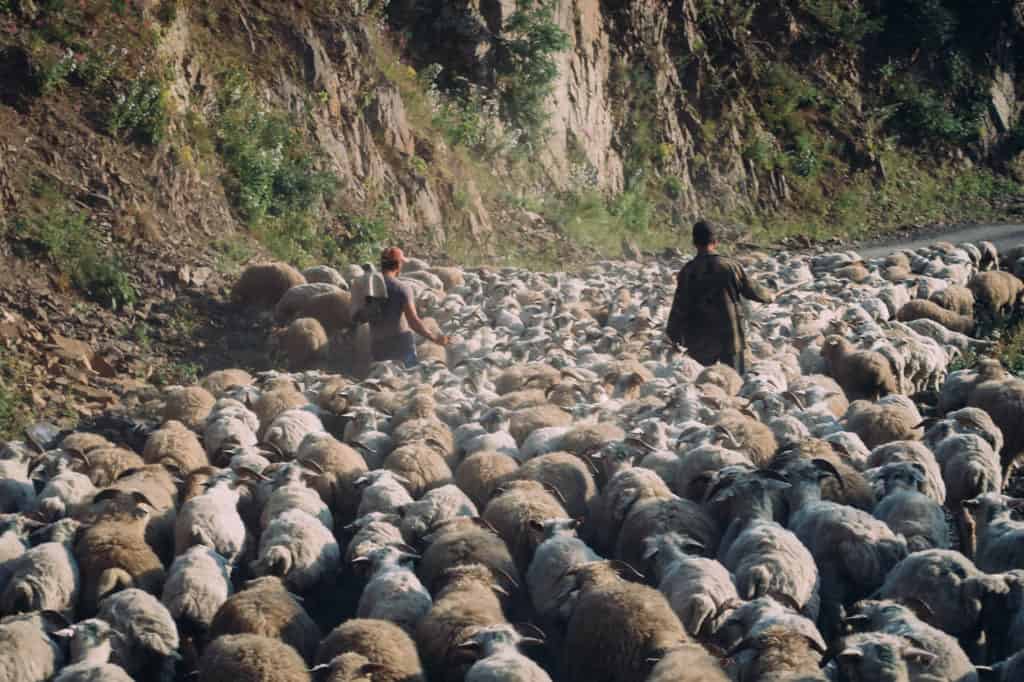
Once the snow starts to melt, the Tush shepherds start moving their sheep from the Kakheti valleys back to the Alpine mountains of Tusheti. There is an option to join them through this unique journey for a mind-blowing experience.
Such trips often start even before the road officially opens in spring/summer. You can also join them in the fall when the shepherds bring their sheep back from the mountains to the fertile fields of Kakheti.
More information here.
6.5 Attend a traditional festival in Tusheti
Tusheti is distinguished by its ancient traditions and the local festivals are one of them.
The greatest festival of Tusheti is Atnigenoba. It is a cycle of festivals that takes place in the different villages in Tusheti. It starts in the summer, on the 100th day after Easter, and lasts for 2 weeks until late July or early August.
The name might have derived from Greek “Anatos” (immortal) and «Geno» (community), or the Greek priest Athogen, who, together with his 10 disciples, was tortured for his devotion to Christianity in the 4th century.
He was known for his miracles and ability to cast out devils.
Atenigenoba is a festival for which people return to Tusheti. It is accompanied by a traditional feast, singing, and dances, and the sacred ritual of beer making, called “Aluda”.
Some of the festivals celebrated during Atnigenoba are Lasharoba, dedicated to Saint. George and celebrated on the 12th of July in the village of Shenako, and Tushetoba, also known as Shepherd’s day, is celebrated on the last Saturday of July or the first Saturday in August in Omalo.
You can find current updates about the festivals on the Facebook page of Tusheti National Park.
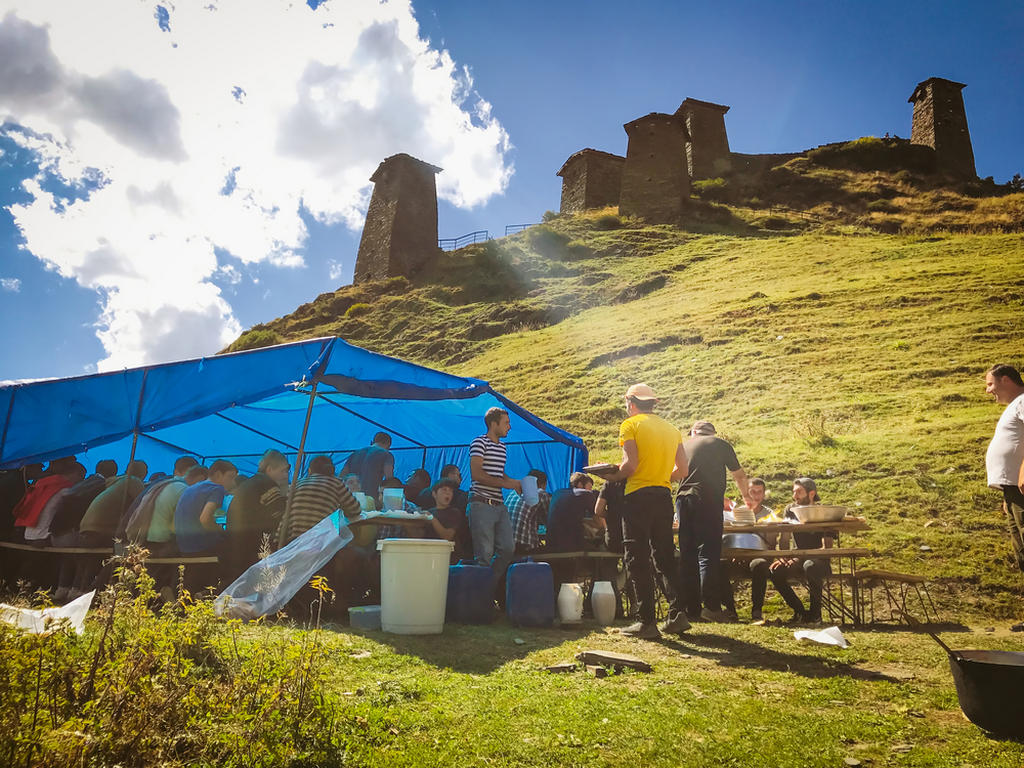
Aside from the traditional festivals, there are also more modern events taking place in Tusheti. There is for example an event called AqTushetii, a festival/residency program that fosters the arts, culture, history, and traditions of Tusheti while bringing together creatives from around the world to collaborate, create, and share knowledge.
7. Where to stay in Tusheti
7.1 guesthouses in Tusheti
The best place to stay in Tusheti is at a local guesthouse. A lot of local families turned their homes into guesthouse and they will welcome you with open arms. This gives you a chance to experience the Tush hospitality and culture.
Most guesthouses in Tusheti are located in Omalo. You’ll find some homestays in other villages but they can’t be booked online in advance. You just show up and ask if they have any availability.
My recommendations for guesthouses in Tusheti:
- In Omalo:

7.2 Camping in Tusheti
Wild camping in Tusheti is allowed so you can pitch your tent wherever you like. Just don’t leave any traces and take your garbage with you!
Just be aware that there are wild animals in the mountains (bears, wolves. lynx,…) and while chances are very low they’ll cross your path, take precautions. Don’t take your food with you in the tent, instead hang it on a tree at a distance.
If you decide to camp, you can still order dinner at most of the guesthouses and I highly recommend you to do so. This way you won’t leave Tusheti without having missed out on their delicious cuisine!

8. What and where to eat in Tusheti
When it comes to the culinary experience, Tusheti has quite a lot to offer.
There are only a few restaurants around, so the best option is to enjoy a nice homemade meal at your guesthouse.
When walking around the remote villages of Tusheti, you might come across locals or shepherds who’ll invite you for a bite and drink.
Here are some dishes of the Tush cuisine worth trying:
- Khavitsi: sometimes called Datkhuri, is a Georgian alpine fondue made of curd. This family dish is usually put in the center of the table and the whole family shares it with hot bread. It was a very popular dish as the people living in the mountains needed its energy for farm work and battles.

- Khinkali: a ritual food in the mountains. When the elders of the village would gather to make important decisions, they would prepare khinkali. Each of them would carry their own mix of herbs and cut their own meat with their own sword. Every person has their own manner of making khinkali, so it was easy for them to recognize their own piece.

- Kotori: Tushetian khachapuri made with very thin dough filled with cottage cheese and boiled butter. Kotori was prepared only for rituals and celebrations in the past.

- Guda cheese: Tushetian cheese matured in a leather bag (Guda means ‘leather bag’ in Georgian).
- Locally brewed beer: beer is a traditional local drink in Tusheti and the brewing of it is still a sacred ritual (as it also still is in other mountain regions like Khevsureti). There is even a special festival taking place in summer, where they perform the ritual of beer brewing.
9. Some more useful things to know before you visit Tusheti
9.1 Money in Tusheti
There aren’t any ATMs in Tusheti so bring enough local currency with you to pay for food, accommodation, and transport. You also can’t pay by credit card.
9.2 Internet in Tusheti
Until a few years ago there was no internet or mobile reception in Tusheti. Nowadays, about 80 families around Tusheti have wi-fi access, among which 48 local guesthouses. Omalo has the biggest coverage as it is the most populated village of Tusheti.
Don’t expect fast-speed internet tho and there are still many villages around Tusheti with no internet connection.
A lot of houses don’t have electricity or they use generators so be aware that you might not always have a warm shower or light at night.
9.3 What to do in case of emergency
If anything would happen during your visit to Tusheti, and you need medical assistance, you can call the number 122.
Keep in mind that you are at least 4 hours away from the nearest hospital. There’s a helicopter available for emergencies Make sure you have good travel insurance!

9.4 Shops and Gas stations in Tusheti
There are some small convenience shops in Tusheti but they are very pricey (expect to pay 3x more than you would in other places).
The prices are higher due to the remote location of Tusheti and the effort and expenses related to the transportation of goods.
I suggest buying food and snacks before your trip to Tusheti. Guesthouses also provide meals for an additional price but you’ll also pay more than in other, less-remote, places in Georgia.

I hope this guide provided you with all the info you need to prepare for your visit to Tusheti.
I wish you a wonderful time and know that you’re always welcome to ask questions, and share your experiences and travel updates in the comments below!
Related Posts

Kazbegi Travel Guide 2026: Best things to do, Hiking Trails & Essential Tips to visit Kazbegi, Georgia
Georgia Itinerary – 3 Great Travel Itineraries to see the best of Georgia (country)
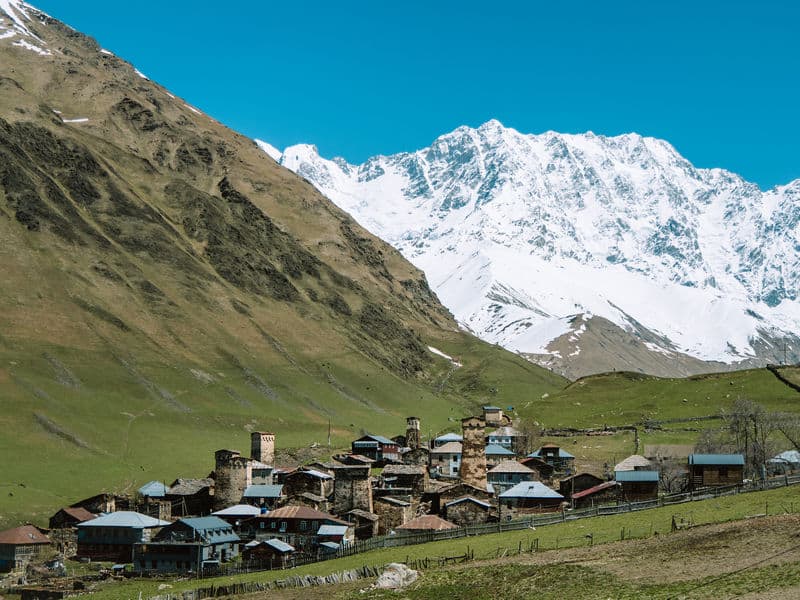
The Complete Svaneti Georgia Travel Guide – 21 Things to do in the Wild Heart of the Caucasus Mountains
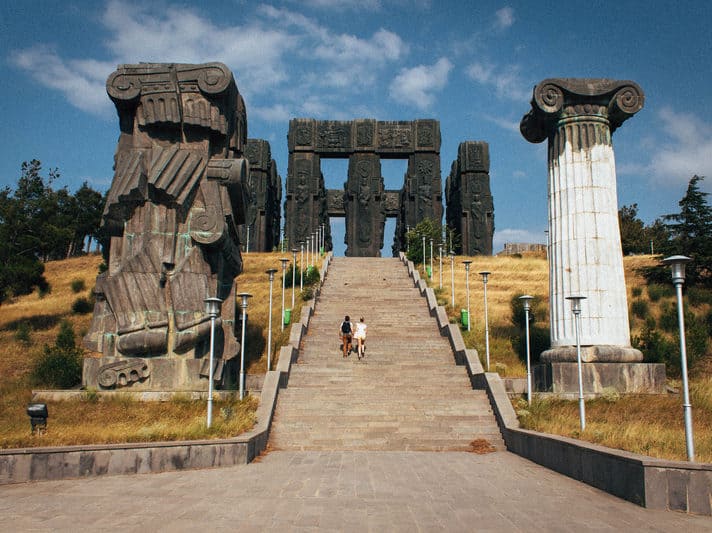
How to get to the Chronicles of Georgia in Tbilisi

15 Amazing and Unique Places to Visit in Georgia
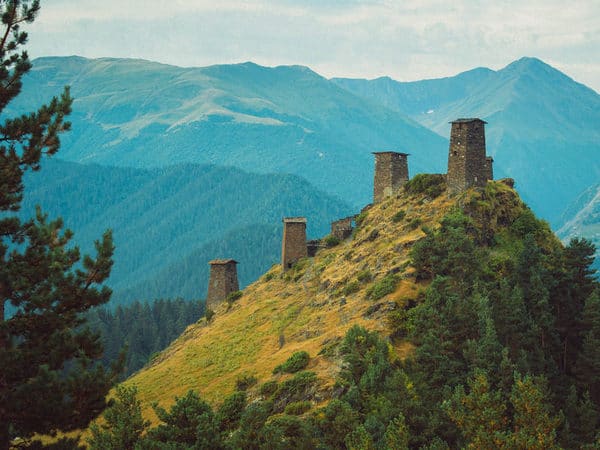
The Complete Georgia Travel Guide: 19 Useful Things you should know for backpacking in Georgia in 2026
More Georgia Travel resources
- Guide to Tbilisi, Georgia’s capital city
- Visit the 15 most beautiful and unique places in Georgia
- Plan your trip with these 3 awesome Georgia travel itineraries
- Discover the Chronicle of Georgia, Tbilisi’s hidden gem
- Guide to Batumi, Georgia’s most quirky beach city
- Hiking in Georgia: 7 beautiful off-the-beaten path hikes
- Visiting ghosts of the past in Chiatura, the cable car city of Georgia
- Visit Katskhi Pillar, the most incredible cliff church in the world
- Travel Guide to Vardzia, the ancient cave city of Georgia
- Visit Svaneti, the wild heart of Georgia
- Visit Tusheti, Georgia’s most remote region
- Visit these 10 beautiful historical places in Georgia
- Everything you need to know about skiing in Georgia
- 10 Georgian dishes you absolutely have to try
- Georgia, motherland of wine
- From Past to Present, a guide to Georgian Tea
Hi Cynthia – what’s the weather like in August? Is it very cold at night?
Hi Sezgi, it can be very hot during the day when the sun is out. Temperatures at night are comfortabel, I would bring a warm sweater but it won’t be freezing at night.
Hy Cynthia, thanks for this great blog with really valuable information. Unfortunately I have booked already my flight on the 10th of June otherwise I would have loved to join your tour.
Hopefully the wheather conditions would be a tour possible mid of June to this wonderful Tusheti National Park… Best, Kerstin
Hi Kerstin! Oh, that’s too bad, would have been lovely if you could join the tour.
It’s hard to tell at this moment in time if the weather conditions will be good and if Tusheti will already be accessible. Fingers crossed!
Wishing you a wonderful trip to Georgia!
Beautiful places to visit Cynthia.
God protect you in your travels.
Success!
Jorge Oliveira
Thank you Jorge!
Hey, thanks so much – great article! I’m coming to Georgia this week and am deciding between hiking in Svaneti or Tusheti – what would you recommend? How busy was Svaneti recently for you? Thank you!
Hi Chloe, I would recommend Tusheti, it’s my favourite region and less busy than Svaneti (which will be popular now). Have a great trip!
Practical article! Thanks A Lot!
Thanks Omid! Happy you liked it 🙂
Hey Cynthia! Is 3G working there? I am going there in a few days, alone, and wanted to relax and work in Omalo for 4 or 5 days. Also, I was planning on hiking to Diklo, as it is just 12km from Omalo. Are there guest houses there?
Hey Joan! I’m afraid that you won’t be able to access the internet in Omalo. At least, we couldn’t connect when we were there last year.
I heard that there’s one guesthouse in Diklo but I’m not 100% sure. Take enough food and water with you as there are no convenience shops up there!
Enjoy your time in Tustheti!
Prachtig! Mooi om deze regio te zien, ondanks dat we er zelf niet zijn geweest. Misschien nu nog wat te avontuurlijk voor onze kids ook (2 en 4), maar ooit gaan we terug… deze regio lijkt me fantastisch!
Dank je wel Yvonne! Deze regio is echt fantastisch!! Je kan er gemakkelijk enkele weken in doorbrengen 🙂 Zeker niet te missen bij jullie volgende bezoek aan Georgie 🙂 Wat was voor jou het hoogtepunt van je recente reis in Georgie?
Ja, gaan we zeker doen! Ik denk dat de omgeving van Kazbegi ons hoogtepunt was, paardrijden vanaf Juta en de Truso valley 🙂 Maar eigenlijk vonden we het hele land super.