Wondering what to see in Mangystau or how to plan your trip? This complete Mangystau travel guide covers the region’s top attractions, suggested itineraries, practical travel advice and insider tips to help you make the most of your adventure.
This guide is written by Janou from Echoes from Far Away, who explored the region firsthand, and all photos featured in this article were taken by her during the journey.
Imagine driving through a seemingly endless desert where the silence is broken only by the wind and the occasional herd of camels crossing the track. For miles, the landscape barely changes.
Then, without warning, the earth suddenly opens up into towering white cliffs, colorful canyons and surreal rock formations that look more like the surface of another planet than Kazakhstan.
Welcome to Mangystau, Kazakhstan’s most extraordinary region.
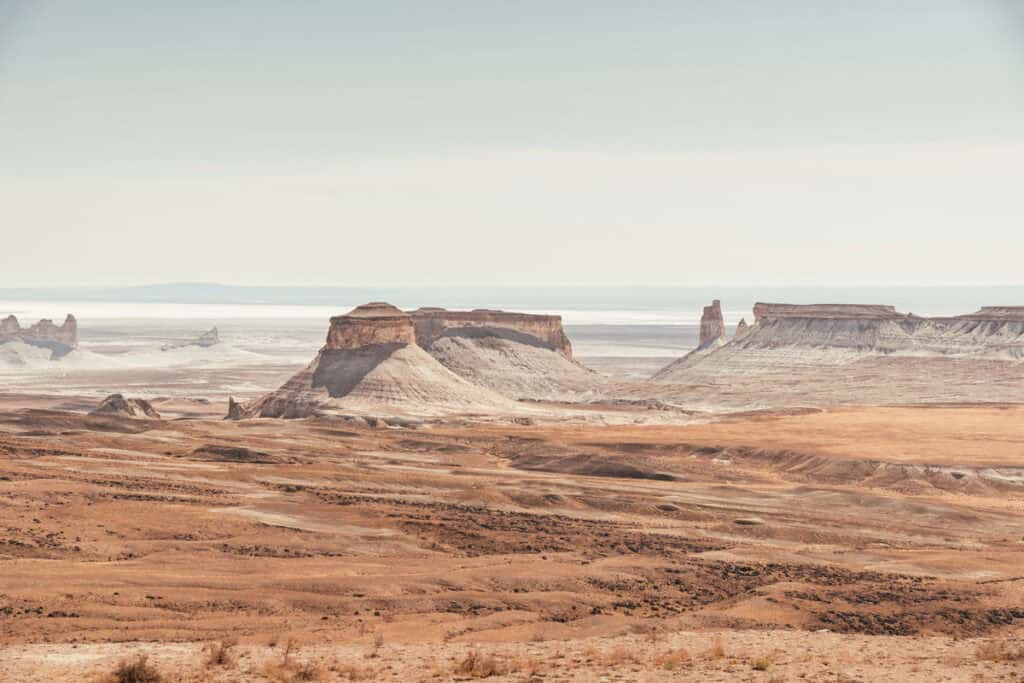
Located in the southwest of Kazakhstan, along the eastern shores of the Caspian Sea, Mangystau is unlike anywhere else in Central Asia.
Millions of years ago, this entire area lay beneath the ancient Tethys Ocean. Today, those former seabeds have transformed into dramatic chalk cliffs, colorful canyons, enormous salt flats, rocky plateaus, and bizarre geological formations.
The region’s landscapes are incredibly diverse. Within a single journey, you’ll travel across vast deserts, towering plateaus, deep depressions, rugged mountain ranges and endless open plains where you can drive for hours without seeing another soul.
But Mangystau isn’t just a paradise for nature lovers. It’s also home to the Aday tribe, one of Kazakhstan’s most well-known nomadic communities, and to dozens of sacred underground mosques, ancient necropolises and important Sufi pilgrimage sites that offer a fascinating glimpse into the region’s rich history and spiritual heritage.
The name Mangystau is often translated as “eternal mountains”, and after travelling through the region, it’s hard to imagine a more fitting name.
There are moments when the landscape feels almost timeless. Roads seem to disappear into the horizon, the silence is overwhelming, and the scenery barely changes for hours. Yet that’s precisely what makes Mangystau so unforgettable.
After kilometers of seemingly endless desert, the landscape suddenly transforms into a spectacular canyon, a towering limestone ridge or a viewpoint so surreal it hardly seems real.
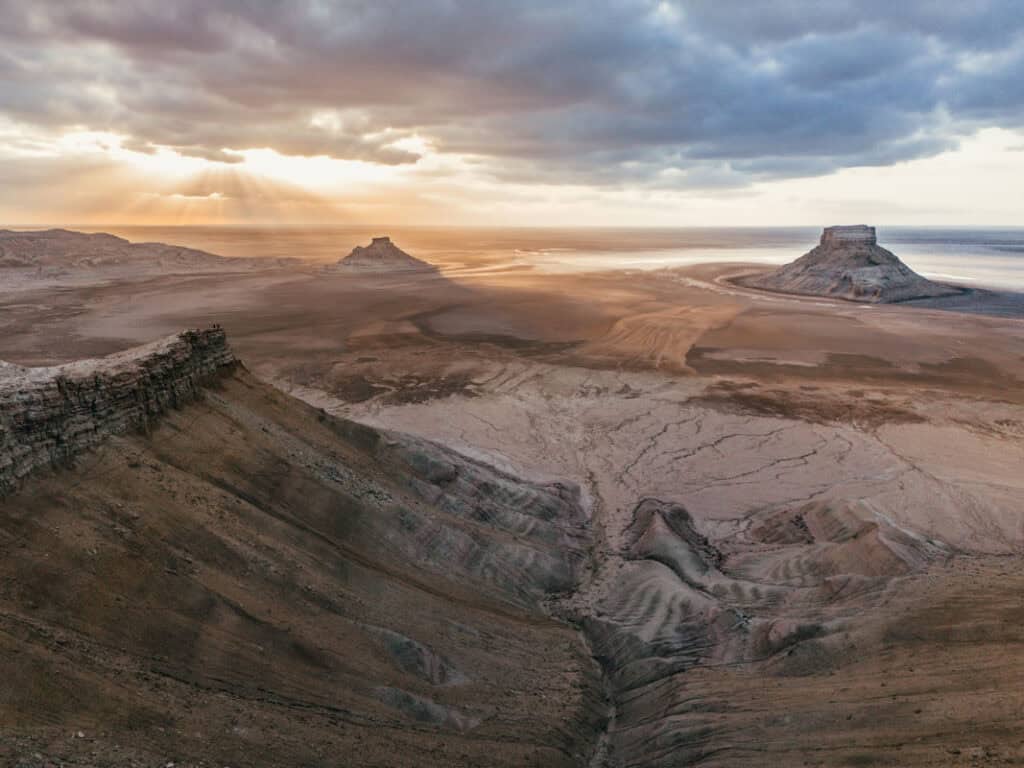
Despite its growing popularity among adventurous travelers and photographers, Mangystau remains one of Kazakhstan’s least-visited destinations. There are no crowds, few paved roads and very little infrastructure once you leave Aktau behind.
Exploring this region requires time, preparation and a sense of adventure, and that’s exactly what makes it so rewarding.
In this blog, Janou from Echoes from Far Away shares her firsthand experiences exploring Mangystau, along with her best travel tips and everything you need to know to plan your own adventure.
Tip: See my Kazakhstan Travel Page for a complete overview of all travel guides and blog posts about Kazakhstan!
Disclaimer: This posts might contain affiliate links, meaning that if you make a purchase through these links, I may earn an affiliate commission. Thank you for helping to support this website!
Planning a trip to Kazakhstan? Start here!
- ✈️ Find the best flight deals → Compare routes & prices easily (most international travelers fly into Almaty)
- 🏡 Find the best places to stay →Book a room in a hotel, guesthouse or homestay
- 🚗 Rent a car for full freedom (highly recommended) → Find the best deals with full coverage here
- 🚖 Airport & city transfers → Book in advance or use Yandex Go locally
- 🚆 Book train tickets → Find schedules and buy tickets
- 📶 Stay connected → get an eSIM (instant data on arrival throughout Central Asia – use code CYNTHIA and get a 15% discount )
- 🛡️ Travel with peace of mind → travel insurance for your Kazakhstan trip
- 🧭Explore with local guides → best tours & day trips
- 🗺️Need help with your itinerary → Itinerary Planning for Kazakhstan
Why visit Mangystau Kazakhstan?
If you’ve already visited Southeast Kazakhstan and Almaty, you might think you know what the country looks like. Snow-capped mountains, alpine lakes, and endless steppes certainly dominate much of Kazakhstan’s landscape. Mangystau, however, feels like an entirely different world.

Instead of forests and mountain peaks, you’ll find vast deserts, towering white cliffs, colorful layered canyons and enormous limestone formations sculpted by millions of years of wind and water. The region is home to sacred underground mosques, ancient necropolises, unique geological formations, and one of the largest plateaus in Central Asia.
One day you can hike among giant stone spheres in Torysh Valley, watch the sunrise over the famous Bozzhyra rock formations, climb through a centuries-old underground mosque and end the evening camping beneath one of the darkest night skies you’ve ever seen.
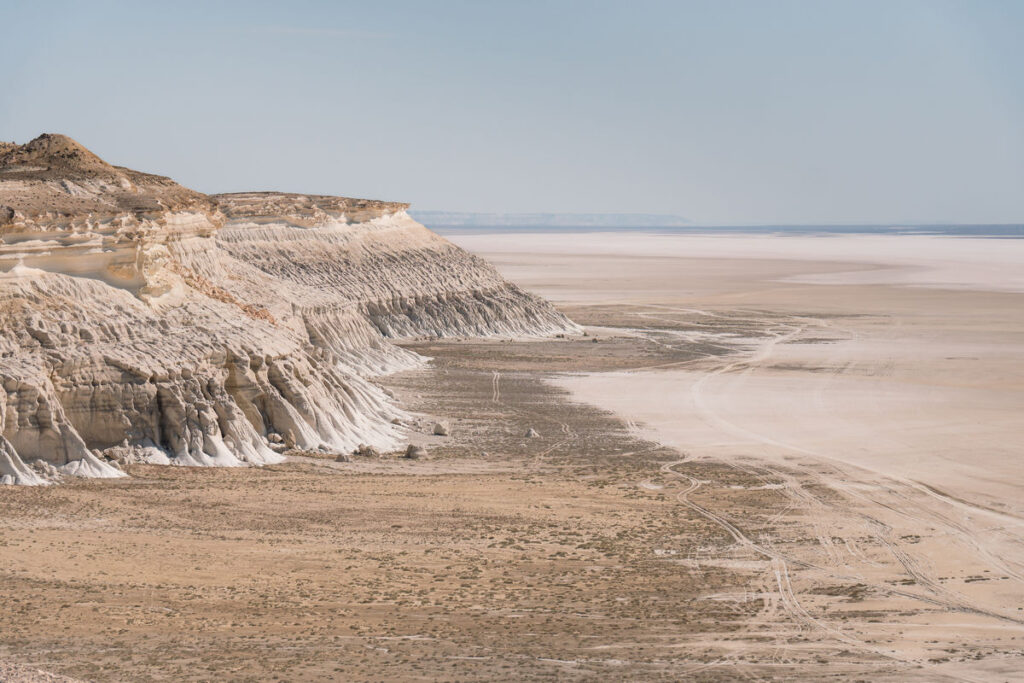
Mangystau isn’t a destination for travelers looking for luxury resorts or busy tourist attractions. It’s a place for those who enjoy road trips, wide-open landscapes and the feeling of discovering somewhere that still lies far beyond the usual tourist trail.
If you’re looking for one of the most unique adventures in Kazakhstan, Mangystau deserves a place at the very top of your bucket list.
When is the best Time to Visit Mangystau
The best time to visit Mangystau is during spring (April to early June) and autumn (September and October). During these months, daytime temperatures are pleasant, making it much more comfortable to spend long days exploring the desert landscapes, hiking to viewpoints, and camping under the stars.
Summer (June to August) can be extremely hot, with temperatures regularly exceeding 35°C, while winter can be surprisingly cold and windy, especially at night. Although both seasons have their own charm, they require a bit more preparation.
If you’re visiting Mangystau for the spectacular landscapes and photography, I’d recommend planning your trip in April, May, September (that’s when I went) or October.
The weather is generally more comfortable, and the softer light during sunrise and sunset makes the region’s white cliffs, colorful canyons, and rock formations even more spectacular.
Tip: No matter when you visit, pack warm layers. Even after hot days, temperatures in the desert can drop quickly once the sun sets, especially if you’re camping.

How to get to Mangystau
Almost every journey through Mangystau begins in Aktau, the region’s capital and largest city. Once a small mining town, Aktau has grown into one of Kazakhstan’s most important oil and gas hubs.
While the city itself isn’t the main reason travelers visit the region, it serves as the gateway to Mangystau’s extraordinary desert landscapes. Whether you’re joining a guided tour or planning your own self-drive adventure, Aktau is where your journey will begin.

There are three ways to reach Aktau:
Flying to Aktau
For most travelers, flying is by far the easiest and fastest way to reach Mangystau.
Aktau International Airport is well connected with both domestic and international destinations. If you’re already travelling through Kazakhstan, you can catch direct flights from Almaty, Astana, Shymkent and Atyrau.
There are also regular international connections from cities such as Istanbul, Baku and Tbilisi, making it easy to combine Mangystau with a trip through the Caucasus or the rest of Central Asia.
If you’re looking for affordable domestic flights, FlyArystan, Kazakhstan’s low-cost airline, usually offers the best prices. Other airlines, such as Air Astana and SCAT Airlines, also operate flights to Aktau.
Tip: flight schedules to Aktau can change depending on the season. If you’re travelling during spring or autumn, it’s worth booking your tickets a few months in advance, especially if you’re joining a fixed-date tour.
Travelling to Aktau by train
If you’re not in a hurry, travelling by train is a memorable experience in itself.
Kazakhstan has one of the world’s largest railway networks, and taking the train offers a unique opportunity to watch the country’s endless steppes slowly unfold outside your window. Aktau is connected by rail to several major cities, including Almaty, Astana, and Atyrau.
There are also international connections to Nukus in neighbouring Uzbekistan, making it possible to combine Mangystau with a visit to Karakalpakstan and the Aral Sea region.
Just be prepared for a long journey. Depending on where you depart, travelling to Aktau by train can take anywhere from one to three days. It’s certainly not the quickest option, but for travelers who enjoy slow travel, it’s an adventure in its own right.


Reaching Aktau by ferry
A lesser-known but adventurous option is to travel across the Caspian Sea by ferry.
Cargo ferries connect Baku in Azerbaijan with the port of Kuryk, about 70 kilometres south of Aktau. While this route is popular among overlanders travelling the Silk Road between Europe and Central Asia, it’s far less predictable than flying or taking the train.
Ferries don’t operate on fixed schedules and departures depend heavily on weather conditions and cargo demand. Delays of several hours- or even several days – are not uncommon. If you’re planning to cross the Caspian by ferry, make sure your itinerary is flexible.

How to travel around Mangystau: everything you need to know
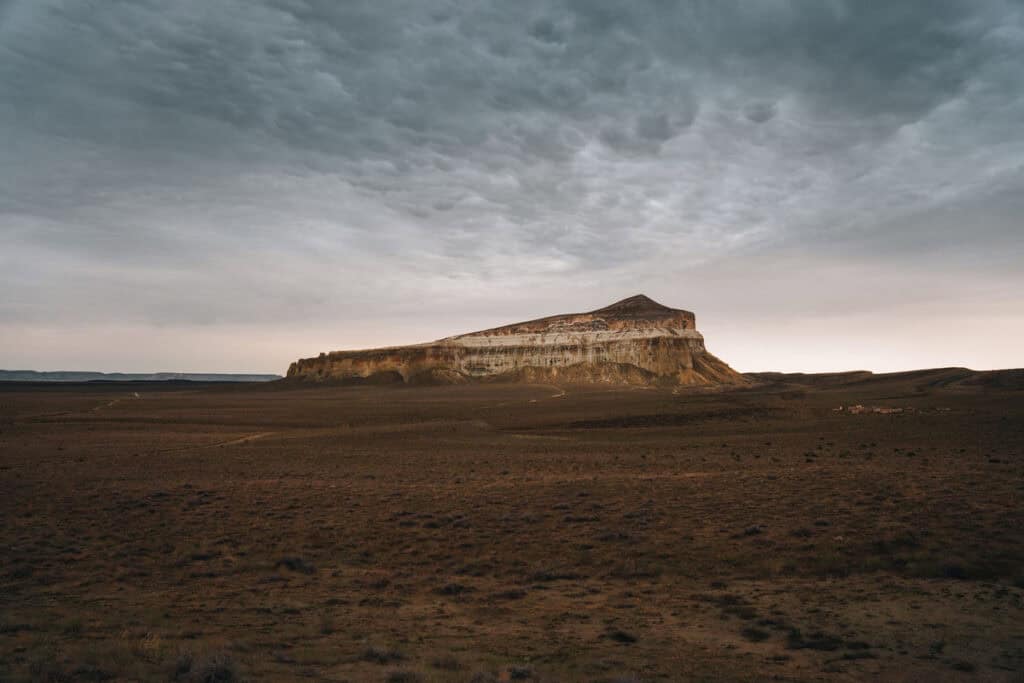
Travelling through Mangystau is unlike exploring almost any other part of Kazakhstan. Once you leave Aktau behind, you’re entering one of the country’s most remote regions, where vast deserts, endless plateaus and dramatic canyons replace towns, villages and busy roads.
Part of Mangystau’s magic lies in its remoteness. Roads seem to disappear into the horizon, mobile reception quickly fades, and it’s not unusual to drive for hours without seeing another vehicle. In fact, you’re often more likely to encounter a herd of camels than another traveller.
While this sense of isolation is exactly what makes Mangystau so special, it also means that travelling here requires a bit more planning than a typical road trip.
Distances are much bigger than they appear
One of the biggest mistakes first-time visitors make is underestimating the distances.
Mangystau covers more than 165,000 km², stretching from the shores of the Caspian Sea to the borders with Uzbekistan and Turkmenistan.
On a map, many of the region’s famous landmarks appear relatively close together, but don’t be fooled. The open landscapes make distances look deceptively short, while rough roads mean average driving speeds are often much lower than expected.
A viewpoint that seems only a few kilometres away may still require a long drive across rocky tracks or sandy desert roads.
When planning your itinerary, allow far more travel time than Google Maps suggests and avoid trying to visit too many places in a single day.
Road conditions in Mangystau
Outside Aktau, road conditions vary considerably.
Some attractions can be reached via paved roads, but many of Mangystau’s most spectacular landscapes, including Bozzhyra, Kyzylkup and Tuzbair (see below), require driving on rough dirt tracks. Depending on the season, these roads can be dusty, rocky, muddy or covered in deep sand.
After heavy rainfall, some tracks become temporarily impassable, while strong winds can quickly reshape sandy sections of the route.
Flat tyres, punctures and minor mechanical problems aren’t uncommon, particularly on longer expeditions into the Ustyurt Plateau.
Do you need a 4WD in Mangystau?
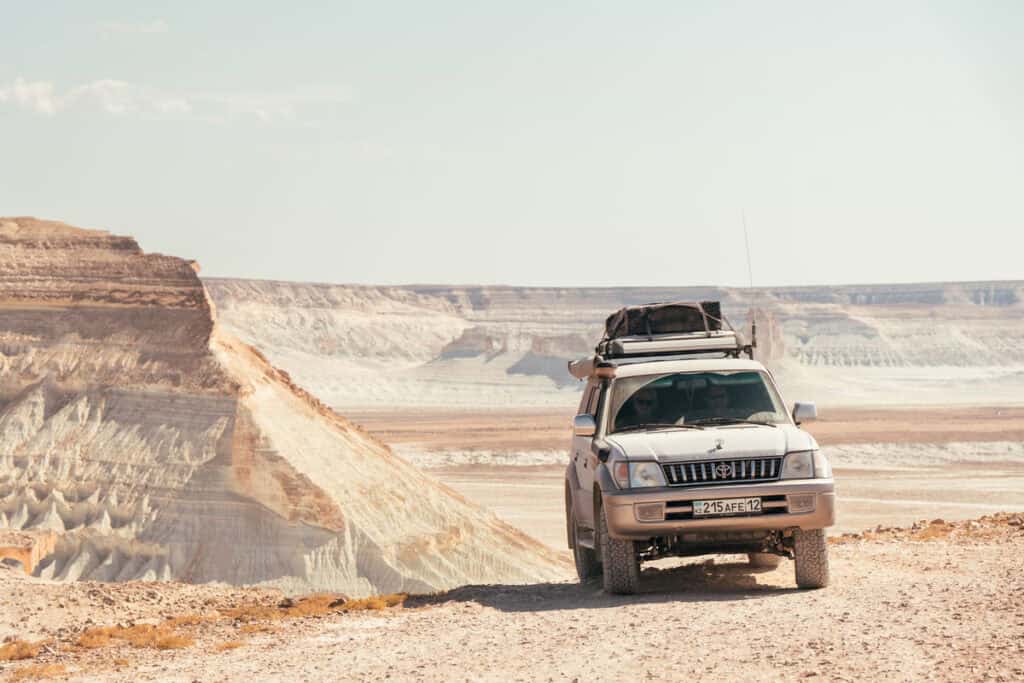
For most places, yes. Although a handful of attractions are accessible with a regular car, exploring Mangystau properly requires a reliable 4WD vehicle with good ground clearance.
Many of the region’s highlights lie far from paved roads, and reaching them often involves driving across uneven desert terrain, rocky tracks and loose sand.
If you’re planning to visit places such as Bozzhyra, Kyzylkup, Airakty, Tuzbair or Karynzharyk, a 4WD is strongly recommended.
Can you visit Mangystau by public transport?
Not really. Public transport in Mangystau is limited to buses and shared taxis connecting Aktau with a handful of towns, including Zhanaozen and Fort-Shevchenko. However, none of the region’s main natural attractions are accessible by public transport.
If you’re not renting a vehicle, your best option is to join a guided tour or arrange private transport from Aktau.
Should you self-drive or book a guided tour to Mangystau?
While it’s certainly possible to explore Mangystau independently, I only recommend doing so if you have previous experience driving in remote off-road environments.
Navigation can be challenging, as many tracks aren’t accurately marked on online maps and mobile reception is limited or completely absent in much of the region. If your vehicle breaks down, help may be hours away, and there are very few services once you leave the main roads.
For that reason, most travellers will have a much more enjoyable – and safer – experience by joining a guided 4WD tour. Local guides know the desert tracks, carry recovery equipment and spare fuel, and take care of all the logistics, from camping gear and meals to permits where required.
They also know the best viewpoints, sunrise and sunset spots, and often share fascinating stories about Mangystau’s history, geology and nomadic culture.
If you do decide to self-drive, make sure you are well prepared! Bring plenty of drinking water, extra fuel, offline navigation, a spare tyre, recovery equipment and enough food to be self-sufficient should conditions change unexpectedly.
Recommended Mangystau Tours
After comparing countless reviews and local tour operators, I decided to explore Mangystau with Redmaya Travel, a local tour company based in Aktau. It turned out to be an excellent decision.
From the moment I arrived until the end of the trip, everything was well organized. It allowed me to fully enjoy the journey without having to worry about navigation, road conditions or logistics.
If it’s your first time visiting Mangystau or if you simply want to experience the region without the stress of planning an off-road expedition, I can genuinely recommend joining one of their tours (see below).
Mangystau Tours:
- 3-day Mangystau Tour: Experience the breathtaking landscapes of Mangystau on this 3-day small-group adventure, exploring surreal canyons, towering limestone cliffs, ancient underground mosques, and camping beneath some of the clearest night skies in Kazakhstan.
- 5-day Mangystau Tour: Spend five unforgettable days exploring the extraordinary landscapes of Mangystau, where towering chalk cliffs, colorful canyons, ancient underground mosques, and vast desert scenery reveal the remnants of the ancient Tethys Ocean.
Where to stay in Mangystau
Accommodation in Mangystau is very different from what you’ll find in other parts of Kazakhstan. Once you leave Aktau behind, hotels become scarce and the vast majority of the region has little to no tourist infrastructure. Depending on your itinerary, you’ll likely combine hotels in Aktau with camping in the desert.
Where to stay in AKtau
Almost every trip to Mangystau starts and ends in Aktau, making it the ideal base before and after your desert adventure. The city offers a good selection of hotels, guesthouses, and apartments for every budget, as well as supermarkets, restaurants and ATMs where you can stock up on supplies before heading into the desert.
If you’re arriving late at night or leaving on an early flight, I recommend spending at least one night in Aktau.
Here are my recommendations:
- Kaspi Hostel: ideal for budget solo travelers
- Aston Hotel: ideal for mid-range solo travelers
- Ustyurt Boutique Hotel: ideal for mid-range budget travelers who want some comfort
- Holiday Inn – Aktau Seaside by IHG: very affordable for travelers who want to enjoy a luxury stay before or after the Mangystau adventure
Camping in Mangystau
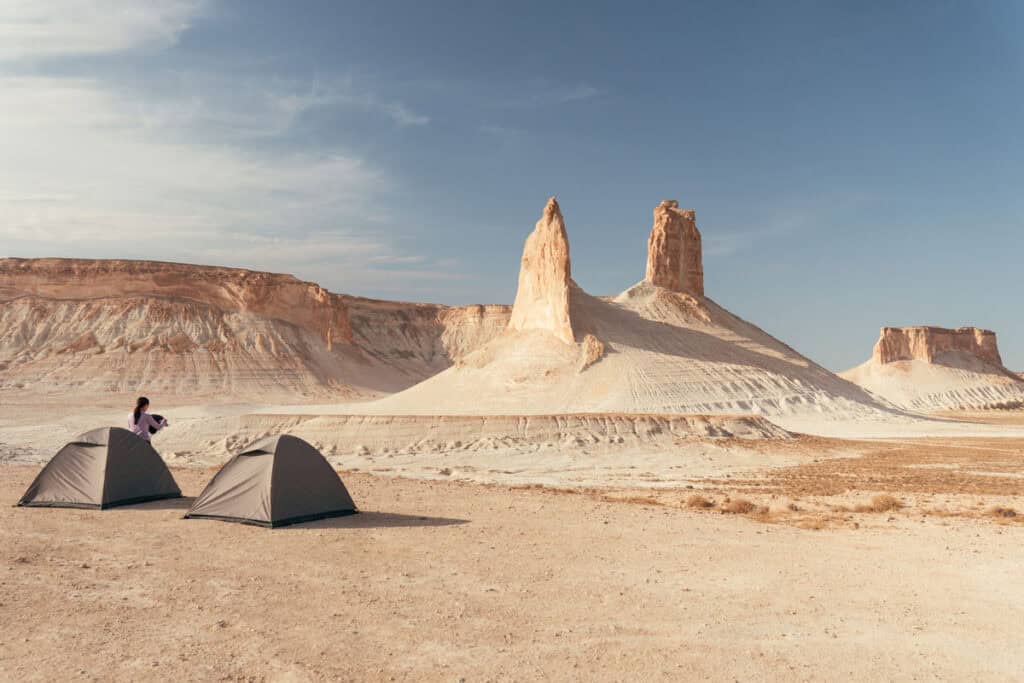
One of the highlights of visiting Mangystau is camping in the middle of its spectacular landscapes. Imagine watching the sunset over the white cliffs of Bozzhyra, cooking dinner under a sky filled with stars and waking up surrounded by complete silence. It’s an unforgettable experience and one of the best ways to appreciate the region’s remoteness.
If you’re joining a guided tour, camping equipment, meals and overnight logistics are usually included. If you’re travelling independently, you’ll need to bring your own camping gear and enough food and water to be completely self-sufficient.
There are no official campsites in most of Mangystau. Wild camping is generally permitted and is the most common way to spend the night while exploring the region. Always camp responsibly by taking all your rubbish with you and leaving the landscape exactly as you found it.
Guesthouses and Homestays in the Mangystau region
Although accommodation options outside Aktau are limited, you’ll occasionally find simple guesthouses or homestays in villages such as Shetpe, Fort-Shevchenko and Zhanaozen. These can be useful if you’re travelling independently and prefer not to camp every night.
Facilities are generally basic, but you’ll experience genuine Kazakh hospitality and have the opportunity to meet local families.
Best places to visit in Mangystau
Mangystau is huge. Covering more than 165,000 km², the region is home to countless geological wonders, sacred sites and landscapes that feel almost otherworldly. While it’s impossible to see everything in a single trip, most of Mangystau’s highlights can be grouped into three distinct regions, each offering a completely different experience.
From ancient underground mosques and Silk Road necropolises to colorful canyons, towering rock formations and the iconic landscapes of the Ustyurt Plateau, every part of Mangystau has its own character.
If you’re visiting Mangystau for the first time, I’d recommend spending at least 6 days exploring the region. This gives you enough time to experience the incredible diversity of landscapes without feeling rushed.
Mangystau at a glance: Suggested itinerary
Here’s an overview of how I explored Mangystau. You’ll find a detailed description of every destination further below.
Day 1: Tub-Karagan Peninsula
Day 2: Mangystau Mountains
Day 3: Ustyurt Plateau
Day 4: Ustyurt Plateau
Day 5 – 6: Ustyurt Plateau
Day 7: Ustyurt Plateau
Day 8: Return to Aktau
Cape Zhygylgan • Kenty-Baba Necropolis • Shakpak-Ata Mosque • Kapamsay Canyon
Torysh Valley • Kok-Kala Tract • Sherkala Mountain • Airakty (Valley of Castles)
Karynzharyk Depression
Kyzylkup (Tiramisu Canyon) • Mount Bokty
Bozzhyra National Park
Tuzbair Salt Marsh
Ybykty Gorge • Karagiye Depression
1. Tub-Karagan Peninsula: Glimpses of the Caspian Sea and a cultural deep dive
Mangystau’s oldest archaeological sites date back to at least 10,000-8,000 BC. Those numbers are hard to wrap your head around. Mangystau’s history was shaped by ancient settlers, nomadic cultures, Silk Road traders and maritime connections across the Caspian Sea. This rich heritage has left behind a remarkable collection of archaeological sites, sacred places and historic settlements.
Nowhere is this more evident than on the Tub-Karagan Peninsula, located on the eastern shore of the Caspian Sea in the northwestern part of the Mangystau Region. It’s the perfect introduction to Mangystau, combining spectacular coastal scenery with fascinating cultural and spiritual landmarks.
Highlights:
- Hanga-Baba Necropolis
- Shakpak-Ata Underground Mosque
- Kenty-Baba Necropolis
- Cape Zhygylgan
- Kapamsay Canyon
Hanga-Baba Necropolis
Hanga-Baba Necropolis might be the first, but certainly not the last necropolis you will come across on your Mangystau journey.
Hanga-Baba is a dusty long drive away north of Aktau. It once began as a Silk Road trading hub, suitable for habitation because of its many water sources. Nowadays, it’s a memorial complex for Hanga-Baba (the spelling of the name differs greatly from source to source).
Because of the many graves in this location, the memorial complex has become a necropolis. The plaques on top of the sarcophagi display a unique mix of Islamic and shamanic influences. As goes for all religious and spiritual sights in Mangystau, it’s recommended for female travellers to cover up bare arms, legs, and hair.
Shakpak-Ata Mosque
Further inland, you find the Shakpak-Ata Mosque, one of the most famous religious sites of Mangystau.
Shakpak-Ata is not an ordinary mosque; it was hewn out of a limestone cave. It’s often categorized as an underground mosque, but it’s only partly underground, as there are multiple floors carved out of the soft stone.
Pay close attention to all the inscriptions on the wall, from animals and plants to an old Sufi poem. Alongside the cliff there are many tombs hidden in niches… don’t fall into the open ceiling in between the floors of Shakpak-Ata on your way out!

Kenty-Baba Necropolis
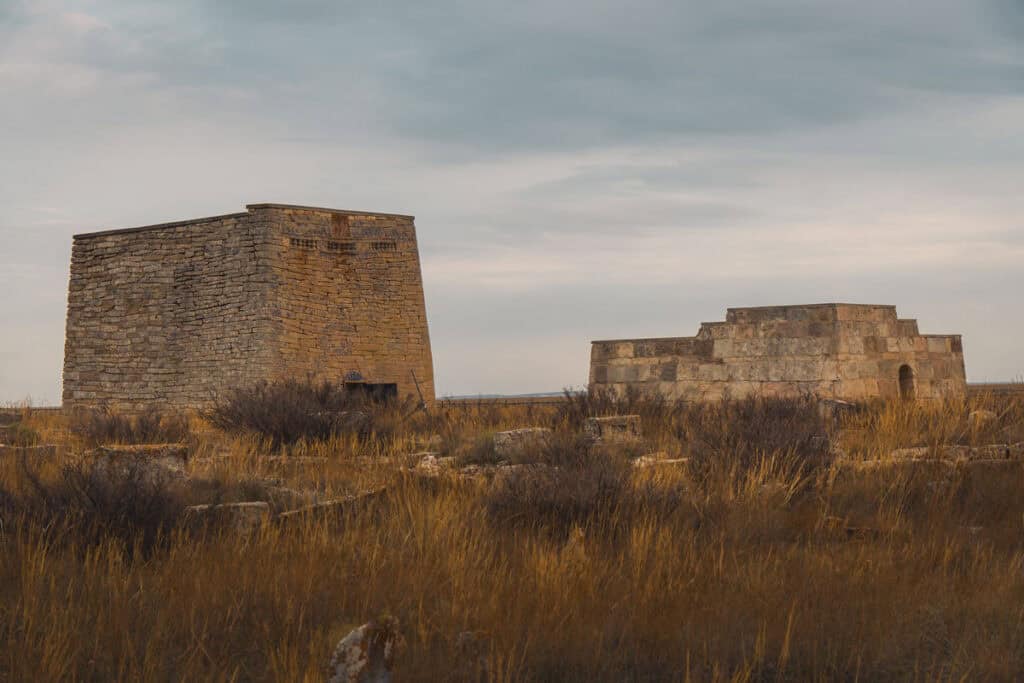
The Kenty-Baba Necropolis can be spotted from afar, as the three big buildings stick out on these empty plains. The three buildings are domed mausoleums.
If you’re visiting with a guide, they can give you access to one of the mausoleums and crawl through a narrow passageway in the wall to the top of the monument.
There are no safety fences involved (Mangystau style), and it’s not for the claustrophobic traveller, but definitely a unique insight into this sacred place.
Cape Zhygylgan
Moving on to glimpses of the Caspian: Cape Zhygylgan, also called Zhygylgan Hollow, is a crumbling cliff that stretches all the way to the Caspian shore.
Between the highest point of the cliff and the water, you can see kilometers of layers of sand, clay, and limestone, and it doesn’t need much imagination to envision that this was once the bottom of the ocean.
”Zhygylgan” means ”fallen”, as the area is named after a landslide. You’re standing upon ancient soil: if you look closely, you might spot dinosaur footprints. There are some footpaths and dirt tracks around that you can follow all the way to the shore.
Again, Mangystau’s deceivingly large distances come into play here: it’s a 2,5 km hike one way to the Caspian.
Kapamsay Canyon
The white chalk cliffs of the Kapamsay Canyon stand out in contrast to their surroundings.
In the canyon, one can find huge boulders, abandoned shelters, and eagles nesting in the cliffsides. There is some greenery as well: in Kampansay lies one of the few rare oases of Mangystau.
Chances are that you end up camping in the canyon on your tour around the Tub-Karagan Peninsula, as the ground is perfectly flat to set up camp.
2. Mangystau Mountains: Ancient wonders in the desert
The endless, flat steppes of Mangystau are interrupted by four mountain ranges in the middle of the region. The North Aktau Ridge, the Kaskyrzhol Ridge, and the West and East Karatau Ranges together form the Mangystau Mountains.
Although their highest point reaches only 532 metres, these mountains are home to some of the region’s most extraordinary geological formations.
From towering rock formations that resemble medieval castles to mysterious stone spheres and colourful Jurassic landscapes, this is one of the most photogenic parts of Mangystau.
Highlights:
- Sherkala Mountain
- Airakty (Valley of Castles)
- Torysh Valley
- Ybykty Gorge
- Kok-Kala Tract
Sherkala Mountain
The Sherkala Mountain is shaped like a yurt or a lion (depending on the point of view) and surrounded by many local legends.
It is said that walking around Sherkala’s base (a 1-hour walk) brings you good luck. It’s also possible to scramble to the top of Sherkala. There are plenty of caves to explore. Archaeological sites from the Silk Road era surround Sherkala Mountain.
Airakty (Valley of Castles)
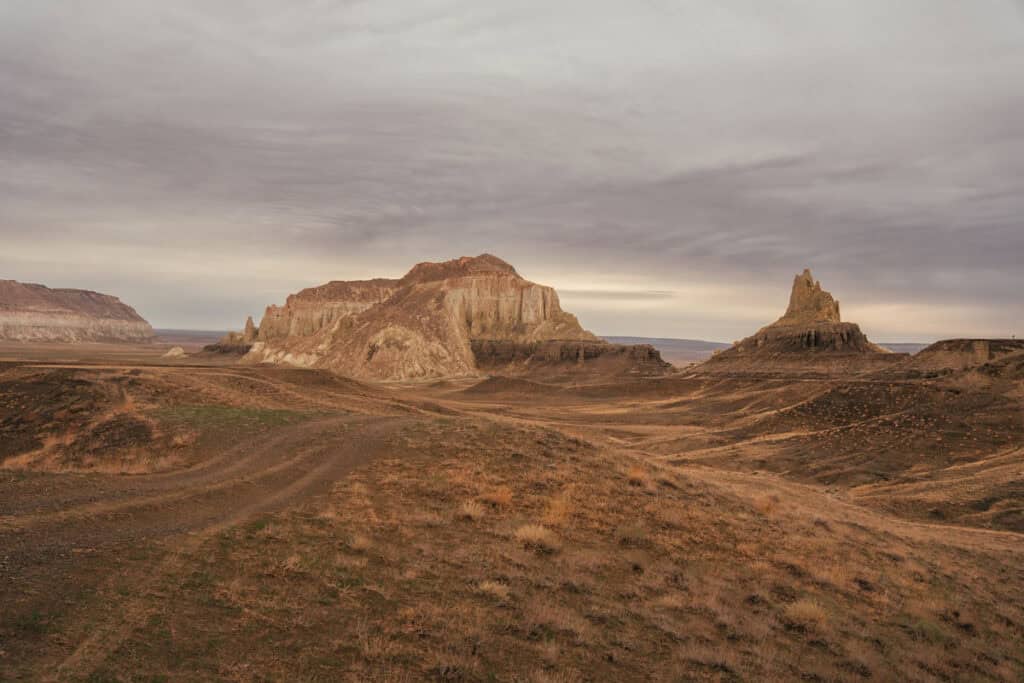
Airakty is nicknamed the Valley of Castles, after the pointy rock formations that look like castle towers.
These peaks were once islands in the Tethys Ocean. The desolate landscape will definitely feel like you’ve landed on another planet, aside from the herds of camels, reminding you that this is planet Earth after all.
There are plenty of hiking opportunities in the valley. Getting higher up will give you some incredible photogenic perspectives. You can climb up the taller rock formations but be careful as it is very steep.
Torysh Valley
From the Valley of Castles, we move on to the Valley of Balls – the people of Mangystau love a good nickname!
Torysh Valley is littered with giant, ancient spheres. Locals have come up with a plethora of wild theories about the origin of the spheres over the years (and you can’t blame them, some balls are so perfectly round they almost can’t be of natural origin): gods that turned invaders into stone, a playing field of the gods, or were they placed by aliens?
Scientists agree that the balls are traces from sedimentation on the ancient ocean floor. The elements have turned the clumps of sedimentation into round balls.
There aren’t many places in the world where you can see a similar phenomenon: round spheres like this can only be found in Kazakhstan, New Zealand, the US, and, not kidding, Mars.
Ybykty Gorge
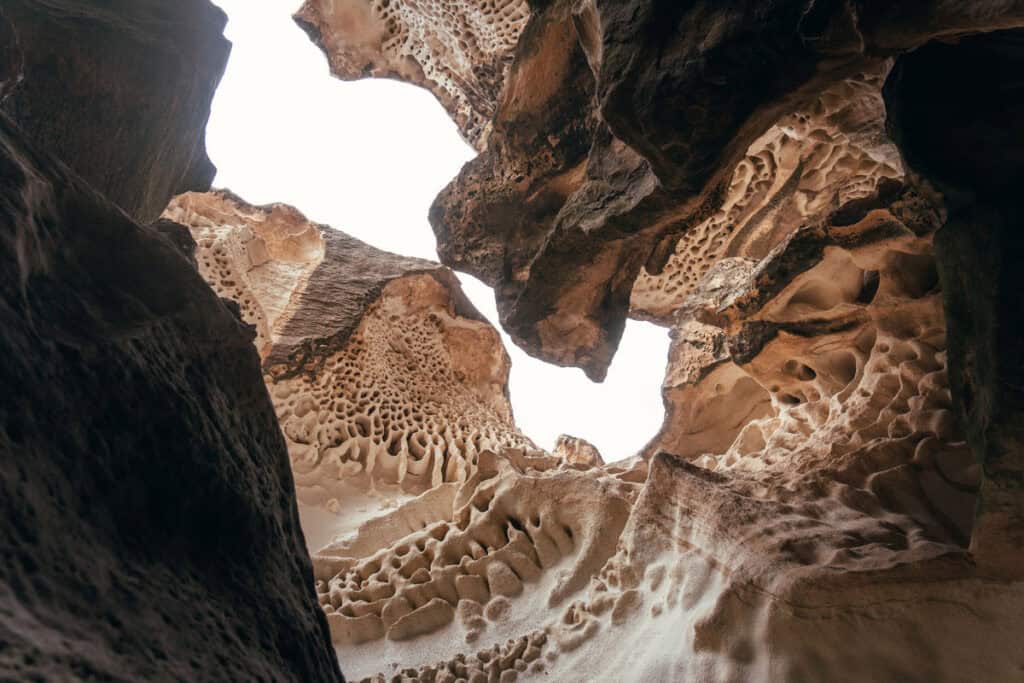
Ybykty Gorge looks completely unassuming when you drive past it. It looks like another ordinary flat plateau. You need to wander into the gorge to see its beauty.
Ybykty is very narrow, and its unique structures were formed by water and wind. Standing inside the gorge and pointing your camera straight up will give you some one-of-a-kind perspectives of the textured walls.
Ybykty is best explored around midday, when the sunlight reaches deep into the gorge.
Kok-Kala Tract
Whereas most of the Mangystau mountains boast every possible shade of brown and beige, Kok-Kala is a colorful exception.
Layers of limestone, clay, and sediments create striking tones of yellow, blue, and red, which shine even brighter in certain light or after rare rainfall. The gorge dates to the Jurassic period.
One can explore freely around the tract or follow the hiking trail depicted near the base of the site. Be careful, there are a lot of short and slippery climbs involved. Kok-Kala can be easily combined with a visit to Sherkala Mountain.

Ustyurt Plateau: Mangystau’s most spectacular landscapes
If there’s one place that defines Mangystau, it’s the Ustyurt Plateau.
Home to iconic landmarks such as Bozzhyra and Kyzylkup, this immense plateau is the crown jewel of the region and an absolute must on any Mangystau itinerary. Covering almost 200,000 km², the plateau stretches far beyond Kazakhstan into Uzbekistan and Turkmenistan, yet remains almost completely devoid of human settlements.
Here, you’re more likely to encounter gazelles, wild horses or camels than other travellers. The roads are rough, the distances enormous and the landscapes unlike anywhere else in Central Asia.
With the right preparation – or even better, a knowledgeable local guide – exploring the Ustyurt Plateau is one of the greatest adventures Kazakhstan has to offer.
Highlights
- Bozzhyra National Park
- Kyzylkup (Tiramisu Canyon)
- Karynzharyk Depression
- Tuzbair Salt Marsh
- Karagiye Depression
Bozzhira National Park
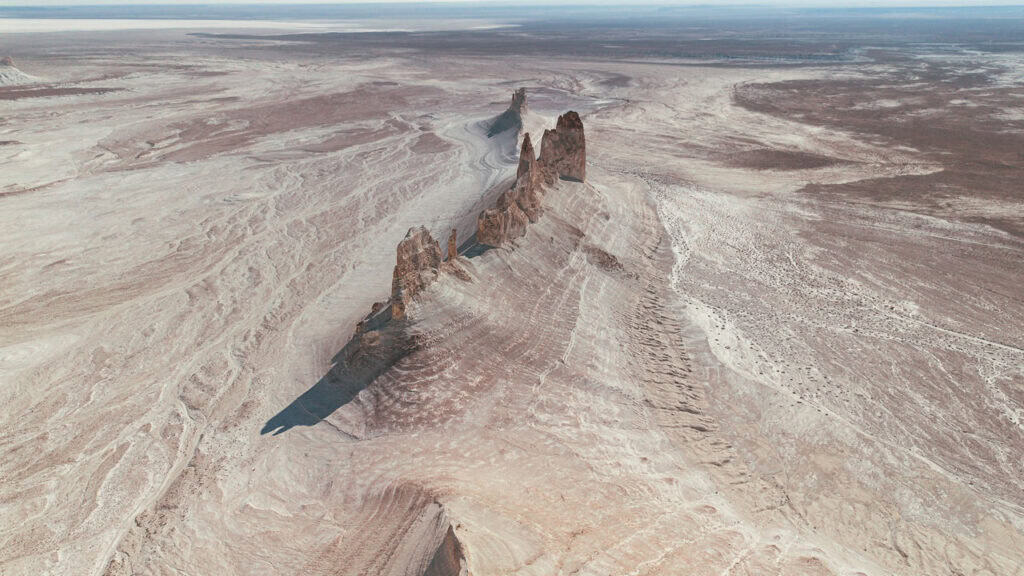
Bozzhira (also spelled Bozjyra/Bozzhyra/Boszhira/anything in between) is outright spectacular.
When you see a picture of Mangystau, chances are that the Bozzhira ”fangs” are in it. The national park really is the crown jewel of Ustyurt.
The area is large, but all famous viewpoints and formations are relatively close together. Such outlandish landscapes demand equally evocative names, leading to landmarks known as ”Mars Panorama” and ”Dragon’s Crest”.
Visiting Bozzhira National Park is an overnight type of activity. If you camp there for multiple nights, you get the chance to see different areas during sunrise and sunset, which I highly recommend. Also, keep your eyes peeled for ancient fossils in the ground.
Kyzylkup
Another crowd favorite, also known by the name ”Tiramisu Canyon”. It actually does resemble the Italian dessert in real life, including the thin layer of cocoa powder on top.
The Kyzylkup Canyon is big and can be explored freely. There are no trails, but you just need to look for an accessible ridge to climb to the top. The red-colored soil pops during the soft light of sunrise and sunset.
Mount Bokty is often depicted as a separate sightseeing spot, but it’s actually part of the Kyzylkup area!
Karynzharyk Depression
The Karynzharyk Depression is about as remote as you can get on your Ustyurt expedition. The depression lies below sea level and consists of a giant salt flat (over 85 km long!), filled with nothingness and some free-standing mountains.
The scenery is surreal and can be appreciated best from the edge of the cliffs on the southwest side of the ”Three Brothers” mountain formation.
Here, you will feel like you have found the edge of the map. For independent travellers it’s important to note you need a Ustyurt Nature Reserve Permit to visit Karynzharyk, since it’s located very close to the Turkmen border.
Tuzbair Salt Marsh
The Tuzbair Saltpan is surrounded by moonscape-like white rocks. The marsh itself consists of thick mud, and it’s surprisingly easy to get your car stuck in it.
Depending on the season and recent rainfall, the moist surface of the marsh turns into a giant mirror. The moonscape rocks are full of caves, which are interesting to explore both by day and night. In total darkness, this is an excellent stargazing spot.
Karagiye Depression
Maybe a bit niche, but if you’re a collector of the lowest places on earth, you can’t skip the Karagiye Depression.
It’s the lowest point in Central Asia at 132 meters below sea level. There are some viewpoints of the Karagiye Depression along the road between Aktau and Zhanaozen.
There are places that impress you because they’re beautiful, and there are places that stay with you because they make you feel something. Mangystau is definitely one of those places.
Driving for hours through seemingly endless desert before suddenly arriving at towering white cliffs, colorful canyons or ancient sacred sites never stopped feeling magical. The vastness of the landscapes, the silence and the complete absence of crowds create an experience that’s becoming increasingly rare in today’s world.
If you’re willing to venture off the beaten path, Mangystau will reward you with some of the most extraordinary landscapes you’ll ever see, and memories that will stay with you long after the desert dust has settled!
Planning a longer trip through Kazakhstan? Don’t miss my other Kazakhstan travel guides, including the best places to visit in Kazakhstan, my suggested Kazakhstan itineraries and practical travel tips to help you plan your adventure through Central Asia.
About the author:
My name is Janou and I am the traveller behind Echoes from Far Away! I’m an aspiring digital nomad, and until that dream becomes reality, I keep living my life in the Netherlands.
I travel at every chance I get. I’m drawn in by places that guidebooks have surprisingly little to say about, vast landscapes that make me feel small, and genuine connections with people I meet on the road. I enjoy the journey itself, especially if it requires effort.
After getting to know Central Asia through a Journal of Nomads group trip, the region has gained a special place in my heart, and I have been returning ever since!
YOu might also want to read:

Best Tips and complete Packing List for Traveling in Central Asia in 2026 – When to go and what to wear when visiting Central Asia

How to visit Turkistan Kazakhstan’s spiritual and historical center
The Complete Hiking Guide to Sayram Ugam National Park, one of the most beautiful Kazakhstan National Parks
19 Best Things to do in Almaty Kazakhstan – The Complete Guide to visit Almaty City

The Best Guide to Travel in Kazakhstan: 18 things you should know to visit Kazakhstan in 2026
How to visit the Kolsai Lakes and Lake Kaindy, The most beautiful lakes in Kazakhstan
Blown away by the beauty of Charyn Canyon – The Complete Travel Guide
How to get from Almaty to Bishkek by public transport in 2026: Best way to Cross the Kazakhstan – Kyrgyzstan border