
The Complete City Guide to Samarkand, Uzbekistan’s magnificent Silk Road City. In this guide, you’ll find everything you need to know about traveling to Samarkand Uzbekistan. I also added an itinerary to visit ancient Samarkand if you only have one day in this stunning ancient city.
Samarkand, Uzbekistan‘s second largest city, is one of those places that feels almost unreal when you first arrive. Giant turquoise domes rise above ancient madrasahs, locals drink tea beneath centuries-old mosaics, and every corner of the city breathes Silk Road history.
I’ve visited Samarkand several times over the past years while traveling across Uzbekistan, and every time it leaves me in awe. While many travelers come here just to see the Registan, there’s actually so much more to discover!
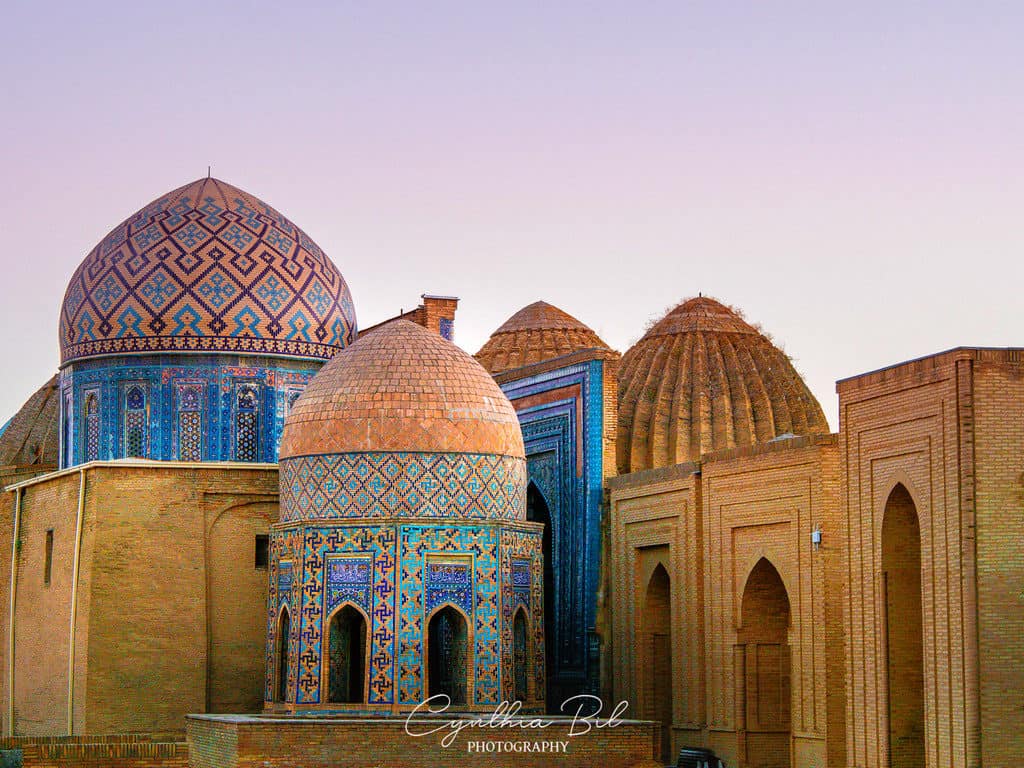
Samarkand is famous for being one of the most important Silk Road cities, as it has been at the crossroads of world cultures for more than two millennia.
It’s one of the oldest cities in the world. It was founded around the 7th century BC, making it even older than Rome! It is listed today as “Samarkand, Crossroads of Cultures” in the UNESCO World Heritage list.
In this Samarkand travel guide, I’ll share the best things to do in Samarkand, where to stay, how to get around, what not to miss, and my personal tips to help you experience one of the most beautiful cities in Central Asia.
Tip: See my Uzbekistan Travel Page for a complete overview of all my travel guides and blog posts about Uzbekistan!

Disclaimer: This posts might contain affiliate links, meaning that if you make a purchase through these links, I may earn an affiliate commission. Thank you for helping to support this website!

Plan your trip to Samarkand
Where to stay in Samarkand:
- Altair Boutique → beautiful mid-range hotel at walking distance from all the highlights of Samarkand
- Kosh Havuz Boutique Hotel → stunning boutique hotel in the old center of Samarkand
- Old Radio Hostel→ Ideal for solo travelers and backpackers
Top experiences in Samarkand:
- Samarkand Highlights City Tour → Explore Samarkand with a local guide and uncover the stories behind its mosques, minarets and hidden corners.
- Cooking Workshop in Samarkand → Learn how to cook traditional Uzbek plov and discover the rich flavors and hospitality in a village nearby Samarkand
- Day trip to Shakhrisabz → Travel through the mountains to Shakhrisabz, the birthplace of Amir Timur, and discover one of Uzbekistan’s most underrated Silk Road cities.
- Day trip to the Seven Lakes in Tajikistan→ Escape the Silk Road cities and explore the stunning Seven Lakes of Tajikistan
Uzbekistan Travel Tips
- 🧭Plan your trip → Uzbekistan Itineraries
- 🚆 Getting around → Travel Uzbekistan by train
- 🚖 Need transfer → Install Yandex.go or find transfers here
- 📱 Stay connected → Get an e-SIM
- 🛡️ Be prepared → Travel insurance for Uzbekistan
Is Samarkand worth visiting?
Absolutely: Samarkand is one of the most fascinating and iconic cities along the Silk Road and is definitely worth visiting during your travels in Uzbekistan.
One of the main reasons to visit Samarkand is to marvel at the stunning Islamic architecture of its mosques, mausoleums and madrasahs. For centuries, poets and historians described the city as “The Pearl of the Eastern Muslim World”, and once you stand in front of the majestic Registan or wander through the blue-tiled corridors of Shah-i-Zinda, it’s easy to understand why.
I’ve visited Samarkand many times over the years. The first time was in December 2017 during my overland journey across Central Asia. I returned again in August 2019, September 2022, and since 2023, I’ve been bringing travelers here during my 14-day Highlights of Uzbekistan Adventure Tour.
When I first arrived in Samarkand, I expected something similar to Bukhara, a scenic old town where you can endlessly wander through narrow alleyways and centuries-old neighborhoods.
That wasn’t really the case. The city’s main sights are spread out across different areas, and many historical monuments have been heavily restored, which sometimes reminded me a little of Khiva.
While the architecture is still incredibly beautiful and impressive, parts of the city can feel less authentic than you might expect from a place with such an ancient history.

Samarkand has also become extremely popular in recent years. It was already a touristic destination when I first visited in 2017, but tourism has exploded since then, especially after Uzbekistan introduced visa-free travel for many nationalities.
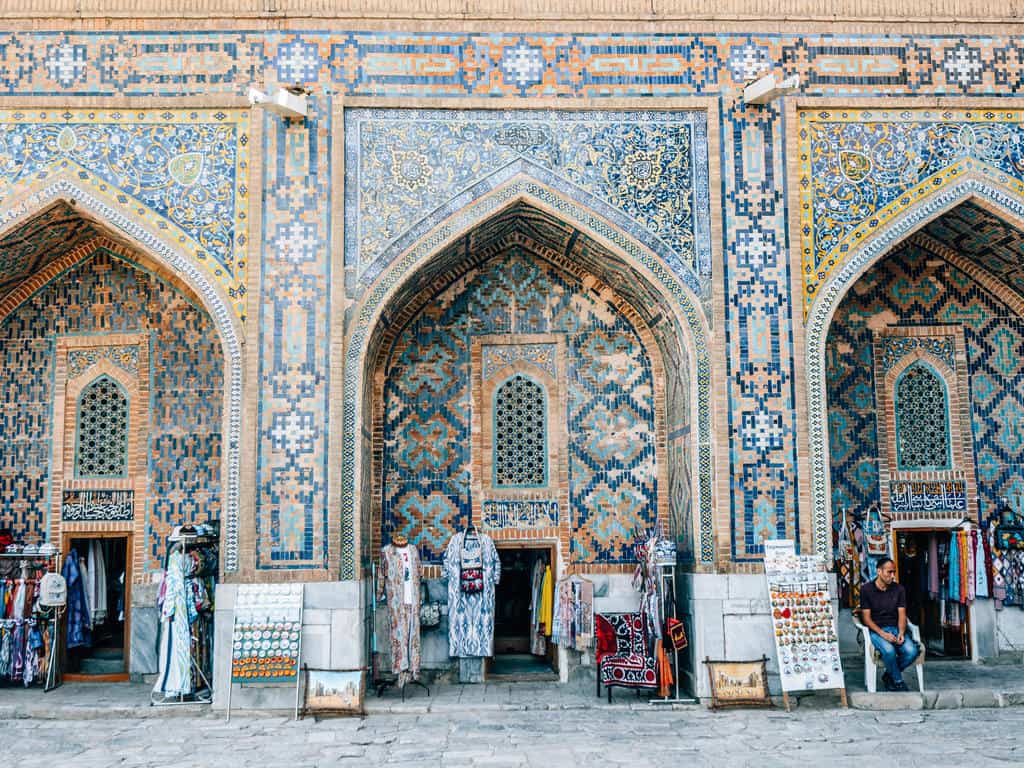
Today, Samarkand is one of the biggest travel hotspots in Central Asia. Around the main attractions, souvenir stalls now fill nearly every corner, and you’ll definitely be sharing the city with plenty of other travelers.
If you’re hoping to photograph the stunning Islamic architecture without crowds, I highly recommend visiting the main sights at sunrise or around sunset. Not only is the light much softer and more beautiful for photography, but the monuments are also much quieter at those times of the day.
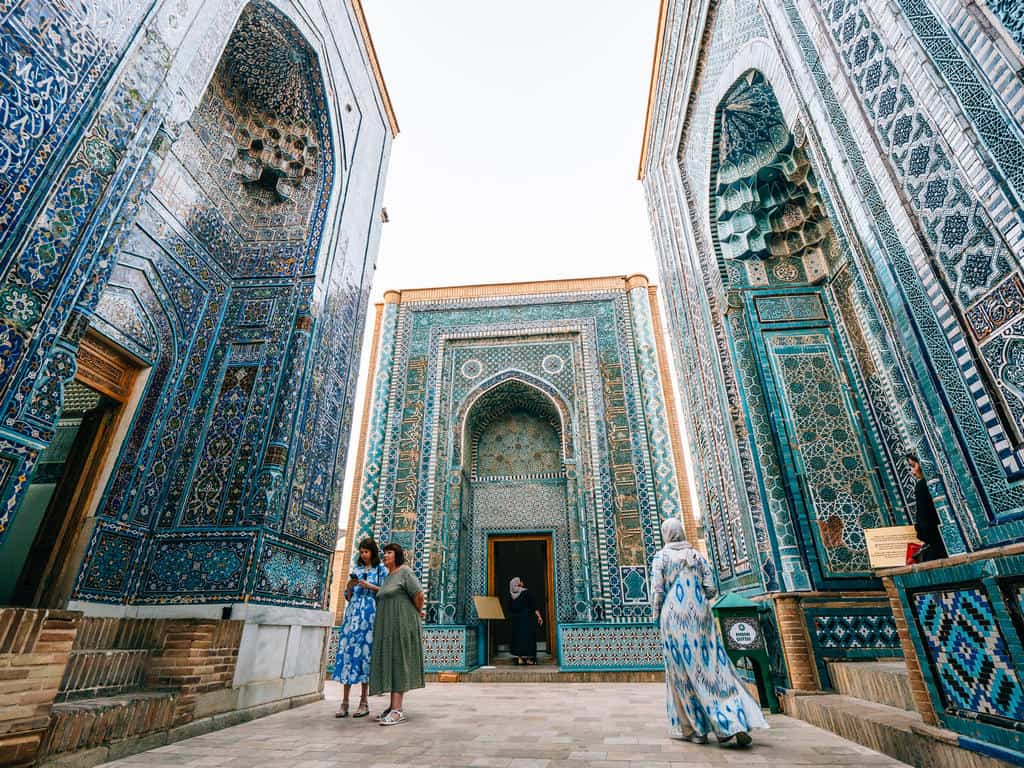
But don’t let the crowds put you off. Even with the increasing tourism and restoration work, Samarkand still feels magical. The scale of the architecture, the deep Silk Road history and the atmosphere of this legendary city make it one of the absolute highlights of traveling in Uzbekistan.
Samarkand Travel Tips
Here are some useful travel tips when visiting Samarkand:
- The train station is located at a 10-minute drive from the ancient Samarkand city center (Registan). You can get there by taxi for 20.000 UZS, or by taking bus #3 and #75. There’s also a tram that goes from the train station to the end station near the Siyob Bazaar.
- I recommend installing the Yandex Taxi app on your phone. This app allows you to order a taxi to easily get around and shows you the rate in advance. They’ll also save you the hustle of bargaining for a good price.
- There are nowadays plenty of ATM’s in Samarkand and you can also pay by credit card or cash in Euro or US Dollars at hotels, restaurants and shops.
- Uzbekistan is a conservative country so dress appropriately (so no short dresses, tops showing cleavage, and short shorts), even if it’s soaring hot. You should also cover your shoulders and knees when visiting mosques and mausoleums.
- A last thing I would recommend is to install the app of maps.me on your phone and download the map of Uzbekistan. Out of experience, I can tell that Google Maps hasn’t been working very well in Uzbekistan and Central Asia.

EXPERIENCE UZBEKISTAN BEYOND THE SILK ROAD
Go on an active 14-day adventure combining legendary Silk Road cities with remote mountain trails, desert camps and meaningful local experiences.
Is Samarkand safe for tourists?
When I traveled for the first time to Uzbekistan and Samarkand in 2017, I was a bit worried about my safety.
I was traveling alone as a woman, I didn’t know many people who had been there before and the country was a bit of a mystery to me.
But I can guarantee you, Uzbekistan is a country where you don’t have to worry about your safety and Samarkand is a very safe city, even if you’re traveling as a woman by yourself.
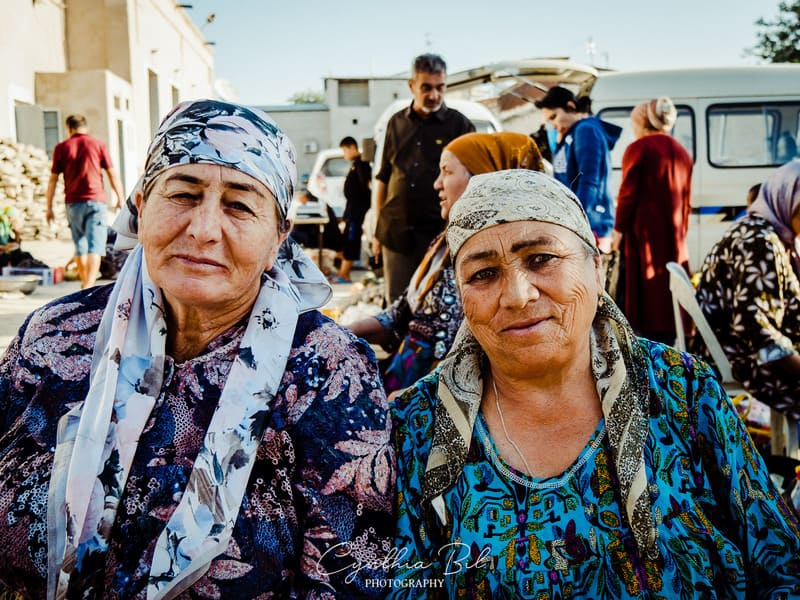
The Uzbeks are very friendly and have no bad intentions whatsoever. On the contrary, young people might approach you and respectfully ask if they can practice their English with you. You’ll quickly notice how kind and soft-hearted the Uzbeks are!
I walked around Samarkand with my camera exposed and I even went out alone in the evening when it was already dark and nobody ever bothered me.
There might be cases of petty crime such as pickpockets, especially in crowded places and in bazaars, but this barely happens in Uzbekistan. Just always keep your valuables in a safe place, no matter where you are in the world.
It’s always a good idea to have good travel insurance that covers both medical health and theft.
Need Travel Insurance for Central Asia? I use and highly recommend HeyMondo Travel Insurance. As a reader of Journal of Nomads, you get a 5% discount off your insurance plan!

Unfortunately, as with almost every tourist destination in the world, the only thing you’ll need to watch out for are the taxi drivers and salesmen. They love overcharging ignorant tourists by doubling (or even tripling) the standard rate and prices.
Know that the standard rate for getting around Samarkand by taxi is 8000 UZS. To get from the station to the city center is usually maximum 20000 UZS. Never get into a taxi before agreeing on the price.
If you’re at a bazaar or in a shop, bargain down the price at least 2/3 of what is asked.

Uzbekistan also introduced the ‘tourist police’. You’ll find their boots in every tourist city. So in case you’d ever feel unsafe – which I highly doubt – just go to one of those tourist police stands and they will help you.


When is the best time to visit Samarkand
Samarkand can be visited year-round, but in my opinion, the best time to visit is during spring (April and May) or early autumn (September and October), when the temperatures are pleasant and ideal for exploring the city’s historical sights. On the downside, this is also the busiest time of the year, so expect larger crowds around the main attractions.
Summers (June till August) are usually very hot in Uzbekistan. I’m talking about temperatures between 35°C and 40 °C, sometimes even hotter!). If you’re not good with the heat, it might be too hot to do some sightseeing during those months.
Winters (December till February) are also lovely though. I went to Samarkand for the first time in December. It wasn’t too cold and if you’re lucky, you might get to see the stunning architecture coated in snow.
Winters are also the least touristic months so you won’t have to share the places with big crowds.

How many days do you need in Samarkand
Although Samarkand is the second-largest city in Uzbekistan, you don’t need a huge amount of time to explore its main highlights.
1 day in Samarkand
If you only have one day, you’ll still be able to visit the city’s most famous landmarks, including the Registan, Shah-i-Zinda and Gur-e-Amir Mausoleum. It will be a fairly busy sightseeing day, but enough to get a first impression of this legendary Silk Road city.
2 days in Samarkand
I personally think two days is the ideal amount of time to spend in Samarkand. This gives you enough time to explore the main attractions at a more relaxed pace, wander through local neighborhoods and bazaars, enjoy the atmosphere in the evenings and revisit some places during sunrise or sunset when the monuments are at their most beautiful.
The main attractions are spread out across the city, but if you follow the order in which I listed them below, you can easily explore most places on foot while getting a good feel for the city itself.
3 days in Samarkand
With three days in Samarkand, you can slow down your pace even more and add one of the fantastic day trips nearby. Popular options include visiting Shakhrisabz, the birthplace of Amir Timur, or crossing into Tajikistan to discover the stunning Seven Lakes in the Fann Mountains.
I’d also highly recommend exploring Samarkand with a local guide, especially if you’re interested in the city’s fascinating Silk Road history and Timurid heritage. A half-day or full-day guided tour is usually enough to cover the main highlights and gives much more context to the impressive monuments you’ll visit. Afterwards, you can always revisit your favorite places at your own pace.
Plan your perfect Central Asia journey
Dreaming of exploring Uzbekistan and Central Asia, but not sure where to start? Whether you’re looking for a custom itinerary tailored to your travel style or a fully organized guided tour, I’m here to help you create a journey that goes beyond the typical route.
With years of on-the-ground experience in the region, I’ll help you travel deeper, smoother, and with confidence.
👉 Get in touch for a custom itinerary
👉 Explore my small group tours in Central Asia
Top places to see and things to do in Samarkand City
Tip: Install the app maps.me, download the map of Uzbekistan and bookmark these places in the app. Google Maps isn’t always accurate in Central Asia but Maps.me does the job and works offline as well!
Samarkand City Map
1. Walk along the University Boulevard
Most hotels and hostels are located near University Boulevard Street. If yours happens to be there as well, a nice way to start your day is to follow this street towards Gur-e-Amir, the first mausoleum on this itinerary.
The 128-meter-long boulevard is lined with oak and plane trees, making it a nice green area in the midst of the city.
The University Boulevard is Samarkand’s educational and scientific center as several universities, schools and institutes are located near it. You’ll often see students walking or sitting there with their books in the shade of the trees.

At the end of University Boulevard Street, you’ll see the statue of Amir Timur, one of Uzbekistan’s greatest rulers (I’ll tell you more about him later on).
This statue of Timur sitting on his throne is right at the intersection between the old Uzbek town and the Russian-designed new town in Samarkand.
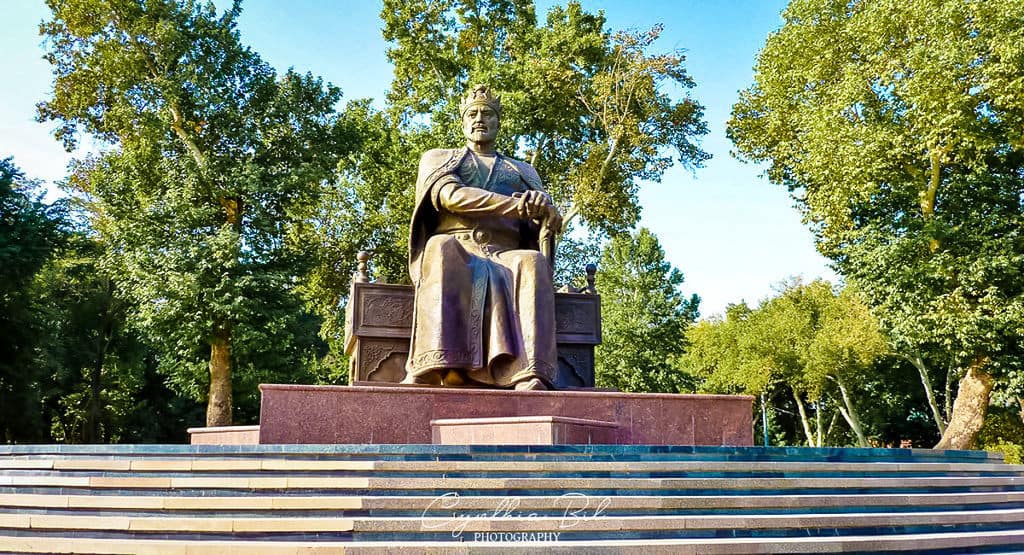
Once you’ve reached this statue, go to the right, and your next stop will be the Gur-e-Amir mausoleum, the place where Amir Timur was buried.
2. Visit Gur-e-Amir Mausoleum or the Mausoleum of Amir Timur
Gur-e-Amir, meaning “Tomb of the King” in Persian, is a beautiful architectural complex with a ribbed turquoise dome.
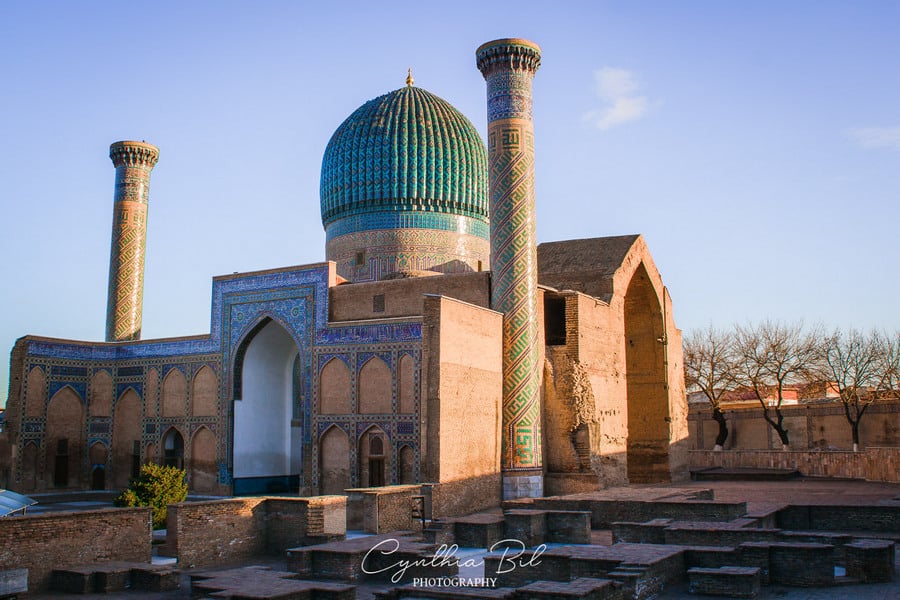
The exterior decoration of the mausoleum consists of blue, turquoise and white tiles organized into geometrical and epigraphic ornaments against a background of terracotta bricks.

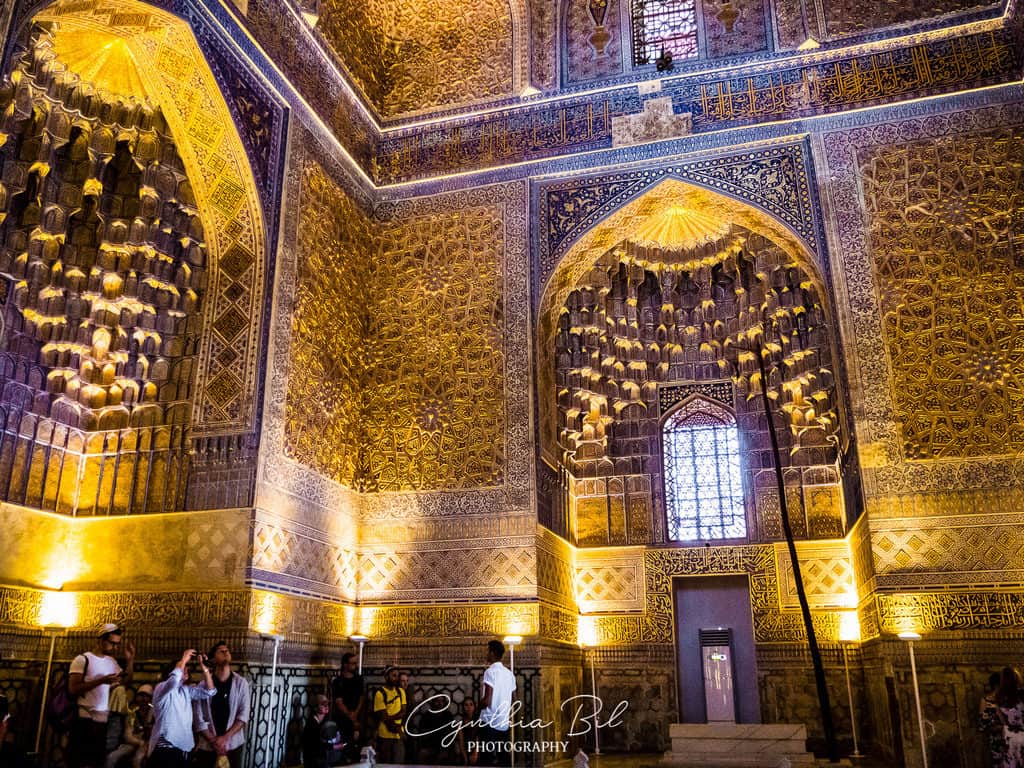
The interior of the mausoleum is even more spectacular! Geometric panels shine with radiating stars, beside niches hung with stalactites molded from papier-mache painted blue and gold.
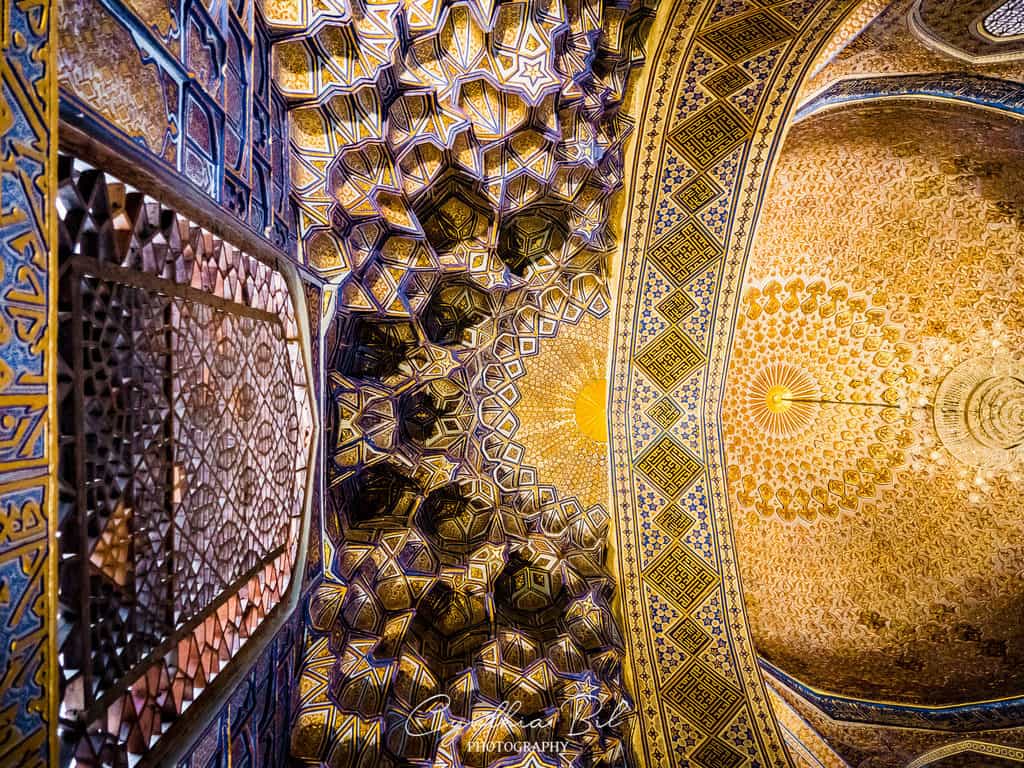
The inner dome drips an intricate gilded coating around high lattice windows.
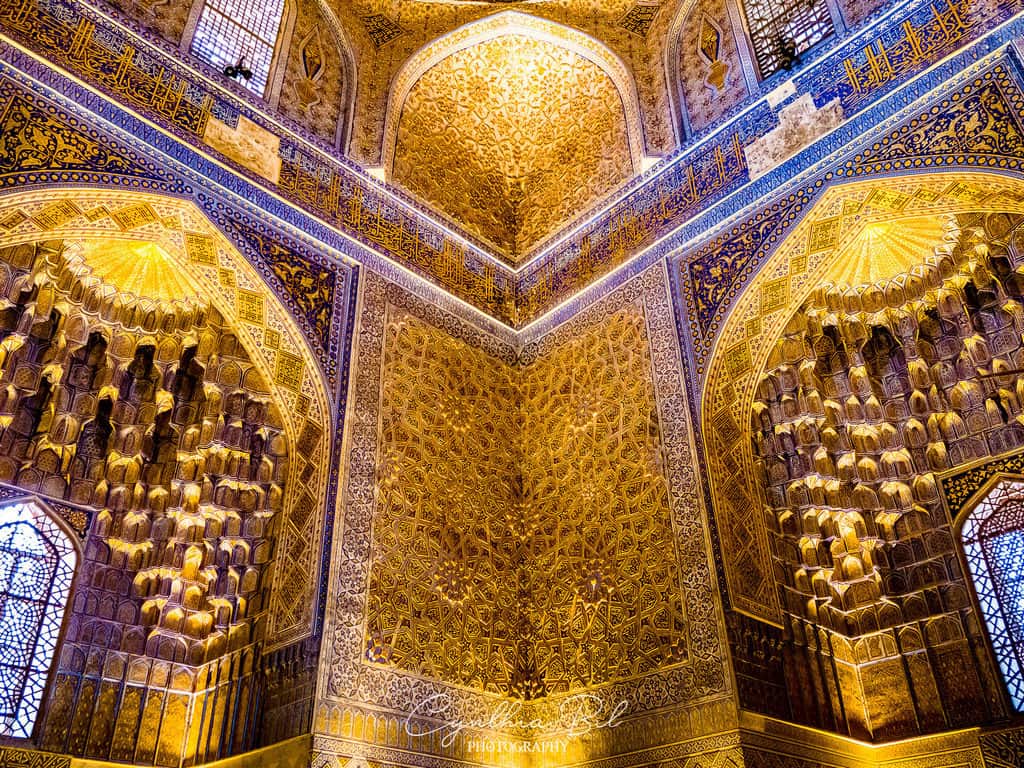
In the middle of the room, you’ll see ornately carved headstones, indicating the location of actual tombs in a crypt directly underneath the main chamber. These tombs are the final resting places of Amir Timur, his sons, and grandsons.

Now, who’s this Timur guy?
Amir Timur, also known as Tamerlane, was born in Shahrisabz, a city located 80km from Samarkand.
He was a complex and multifaceted man that definitely left his mark as one of Uzbekistan’s and Central Asia’s most important rulers and historical figures.
He founded the Timurid Empire with Samarkand as its center and expanded his empire from the Volga River and the Caucasian ridges in the west to India in the Southwest.
Timur wasn’t only a great conqueror but also a great builder. He’s the man behind the greatest constructions in Samarkand, including the Bibi Khanym Mosque, Shah-i-Zinda, the Ulugh Beg madrasah at Registan, the Ulug Beg Observatory and the Gur-e-Amir mausoleum.
He also built the Mausoleum of Khoja Ahmed Yasawi in Turkestan, Kazakhstan.
Tips for visiting Gur-e-Amir:
- Visit Gur-e-Amir as soon as it opens to avoid the crowds. The interior room of the mausoleum might be large but it quickly gets noisy and crowded inside when tour groups and their chatty guides visit this place.
- Gur-e-Amir is also a great photography location during sunrise and at night when lights illuminate this stunning complex.

Entrance fee Gur-e-Amir:
The entrance fee to visit the interior of Gur-e-Amir is 50.000 UZS (around € 4 or $4.50).
Opening hours Gur-e-Amir:
The Gur-e-Amir mausoleum is open daily from April to October from 8.00 am until 7.00 pm and from November to March from 9.00 am until 5.00 pm
3. Explore The Registan
The Registan is about 10 minutes walking from Gur-e-Amir. This central square THE most iconic sight of Samarkand and Uzbekistan.

All the main roads of Samarkand lead to Registan as it was the heart of the Timurid dynasty. It was used as a public square for royal proclamations, celebrations, and public executions.
The square was also a place where you could buy goods from farmers and artisans from all around the world. Registan means “sandy place” or “desert” in Persian as it used to be covered by sand.

Three stunning madrassahs frame the square. Madrassah is the Arabic word for an Islamic school, college or university.
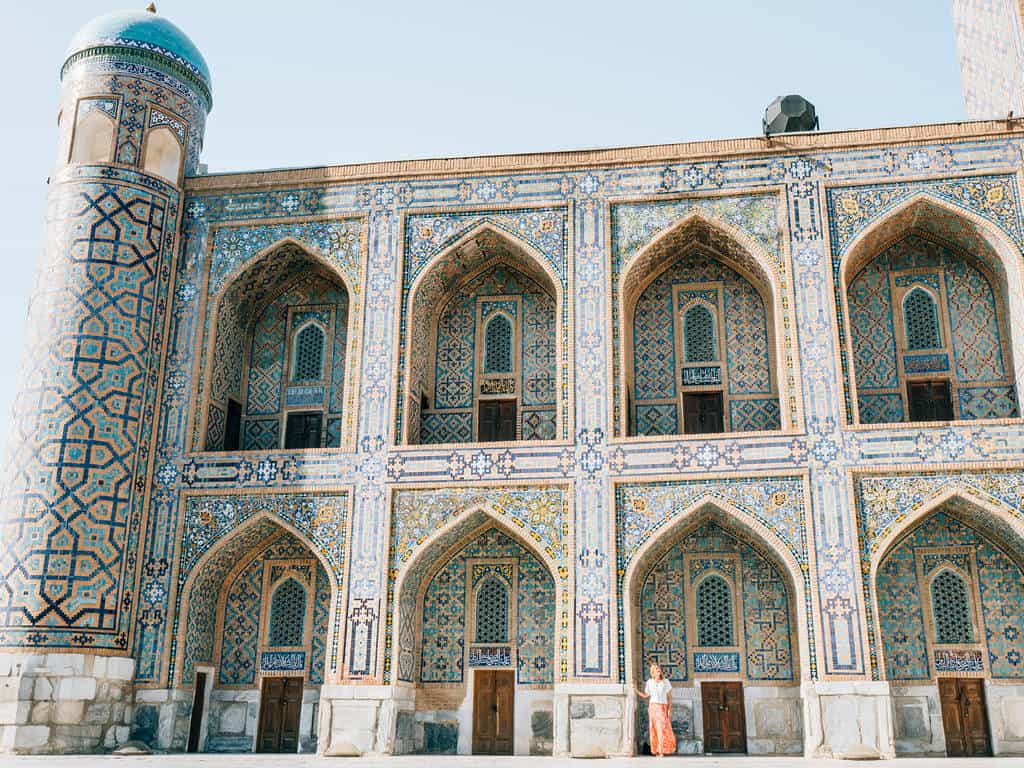
The Tilya-Kori Madrassah is the middle one. This madrasah has a 2-storied main façade, a courtyard surrounded by dormitory rooms and a mosque in the western section of the courtyard.
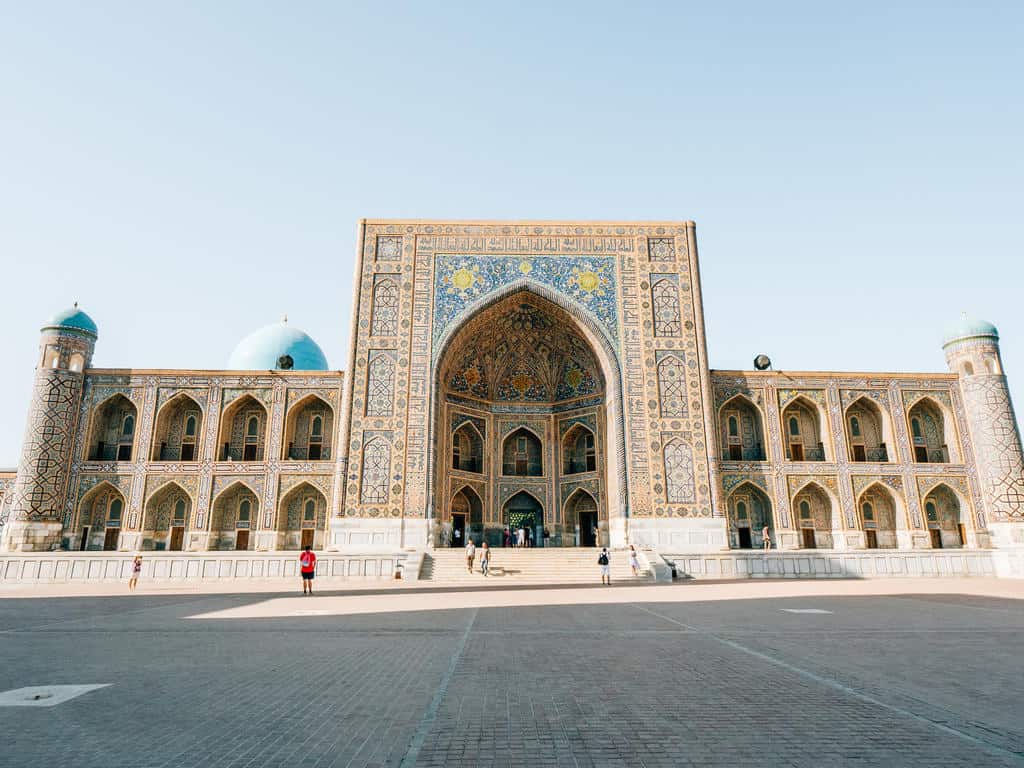
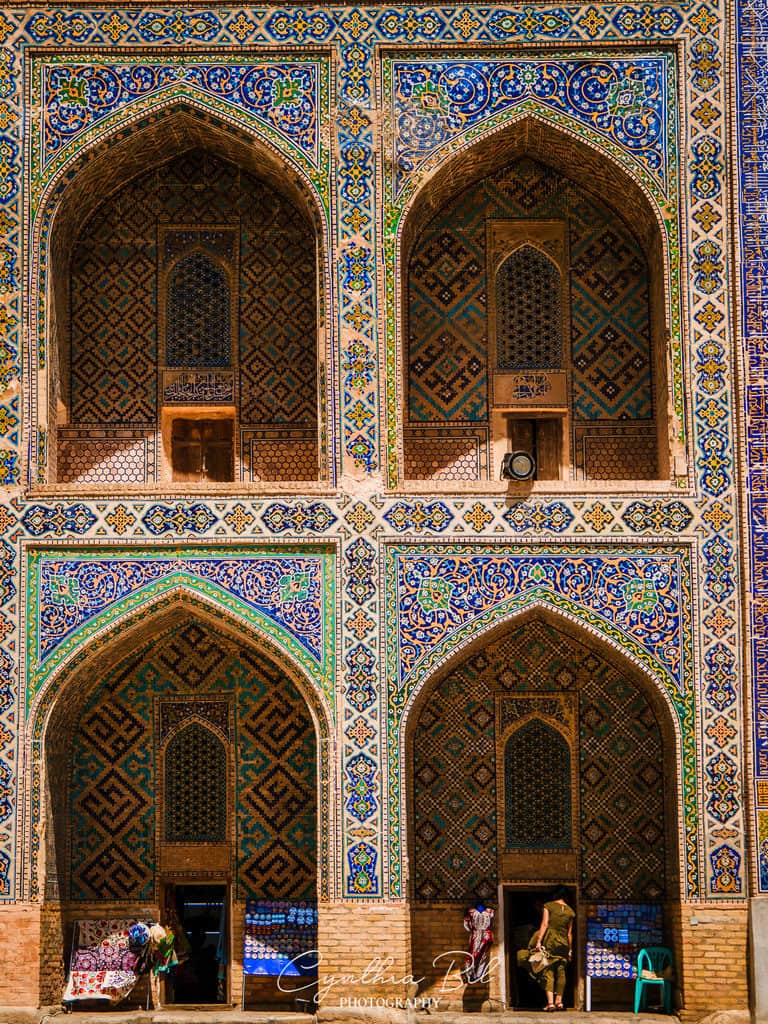
The madrasah was used as a residence for the students but the dormitory rooms are now transformed into little souvenir shops.
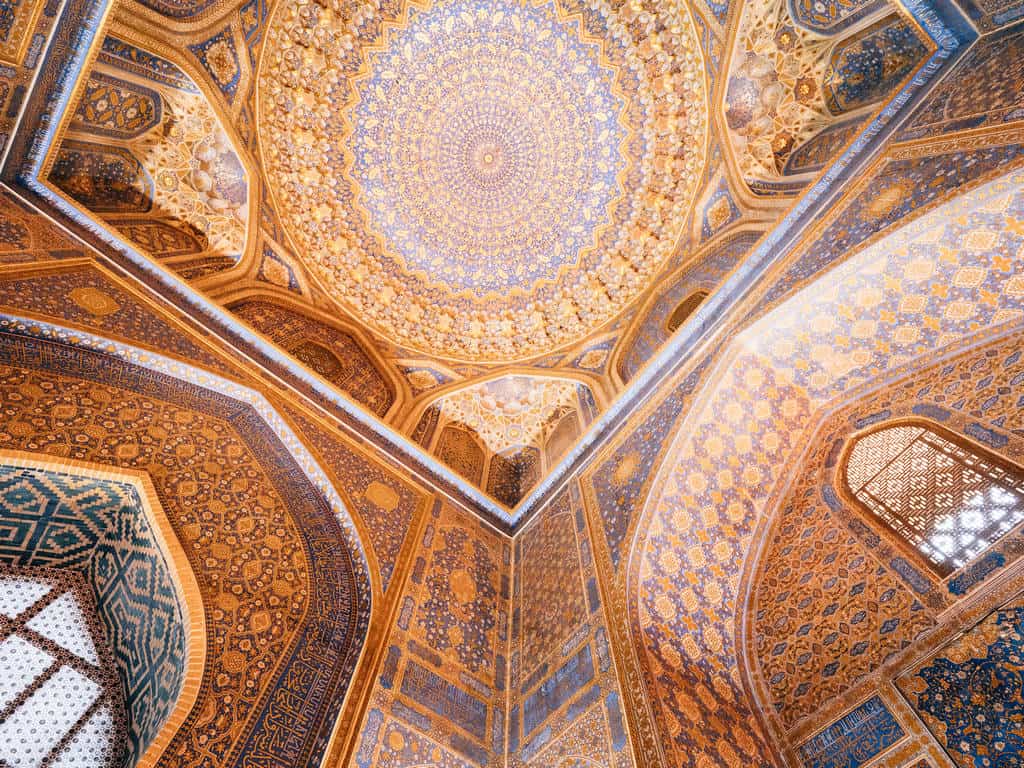
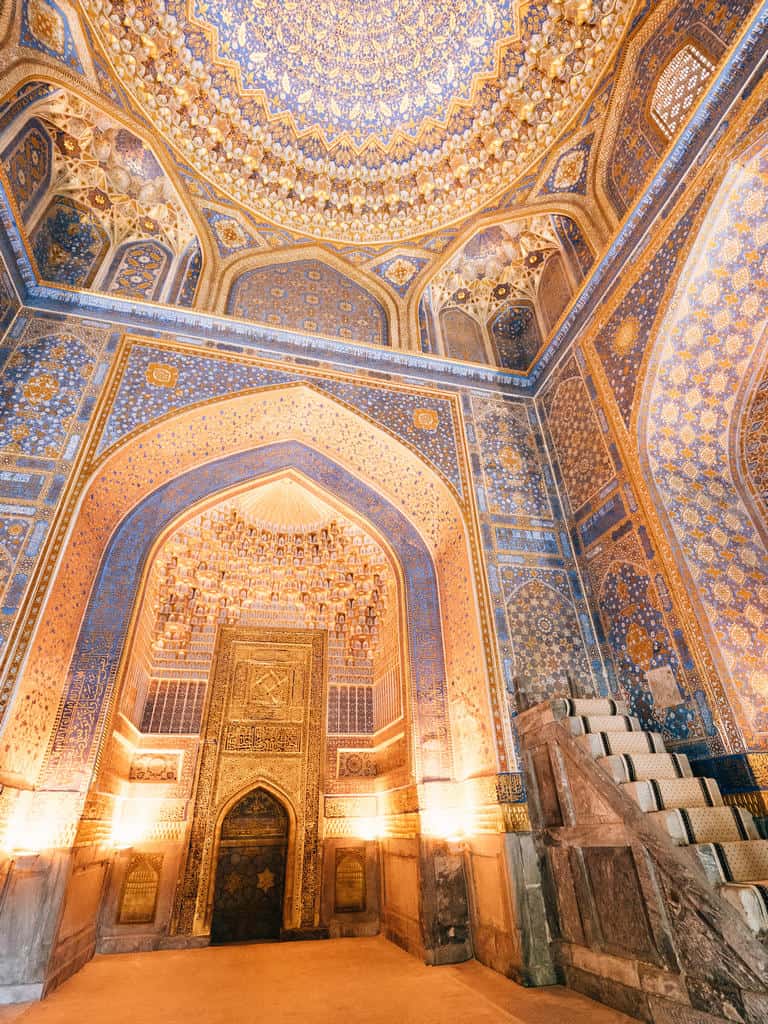
The interior walls of the mosque are abundantly gilded and that’s exactly what Tilya Kori means in the Persian language – “gilded”.
Facing the Tilya-Kori Madrasah, you’ll see the Ulugh Beg Madrasah on the left. It’s the oldest madrasah in Samarkand.

It was built by Ulugh Beg and the man himself gave lectures there. The Ulugh Beg Madrasah was one of the best universities of the Muslim Orient.
The Sher-Dor Madrasah is the third madrasah on the square. Sher means tiger and the name of the madrasah comes from the images on the portal: two big tigers carrying a sun on their backs.

These images are very interesting as it’s prohibited in the Islam religion to paint images of living beings on religious buildings.
Tips for visiting the Registan:
- The best time to visit Registan is early in the morning before the crowds arrive (most people usually arrive there between 10 and 11 am) and the souvenir shops open.
- You don’t need more than 2 hours to visit the whole Registan complex.
- Registan is a beautiful location for sunrise photography. It’s also the best time to visit Registan as there won’t be many tourists going there so early in the day.
- While it’s not advertised, it’s possible to climb the Sher-Dor Madrasah’s 40-meter-tall minaret. Head over to the madrasah, ask for the guard and tell him you like to climb this 400-year-old minaret. I paid him 80.000 UZS and the guard lead me halfway up the staircases. It’s a steep and narrow climb so I don’t recommend it you’re claustrophobic, have a fear of heights and/or are not in good shape. There’s a small platform at the end of the staircase on which you can stand to pop your head through the top part of the minaret. The view over Registan and Samarkand city is fantastic!
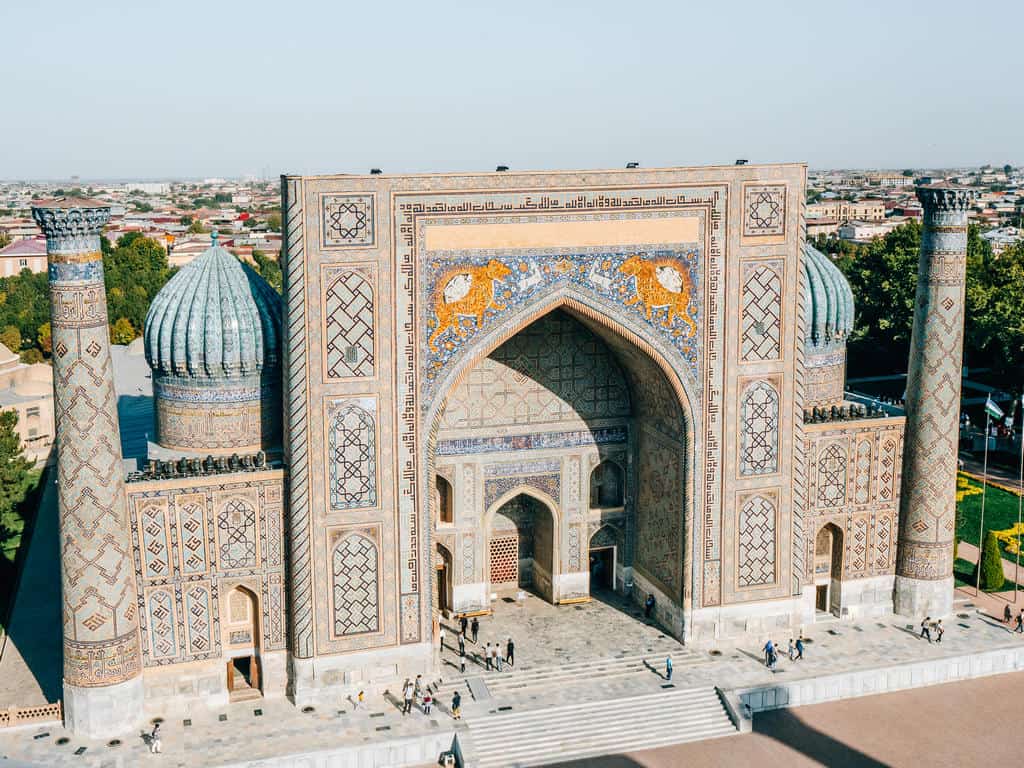

- If you’re at the Registan at 7 pm during high season, you can watch a traditional dance and music performance inside the Sher-Dor Madrasah, the building framing Registan on the right. You can buy tickets at the for 60.000 UZS at the ticket office in Registan (same place as where you buy entrance tickets for Registan).
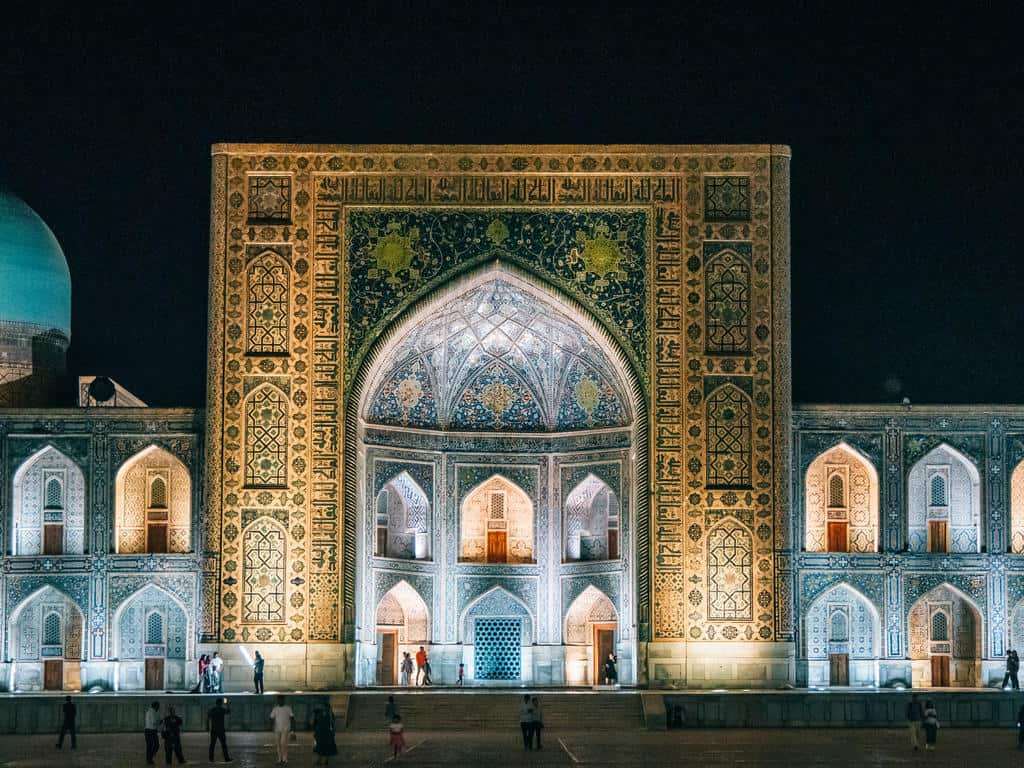
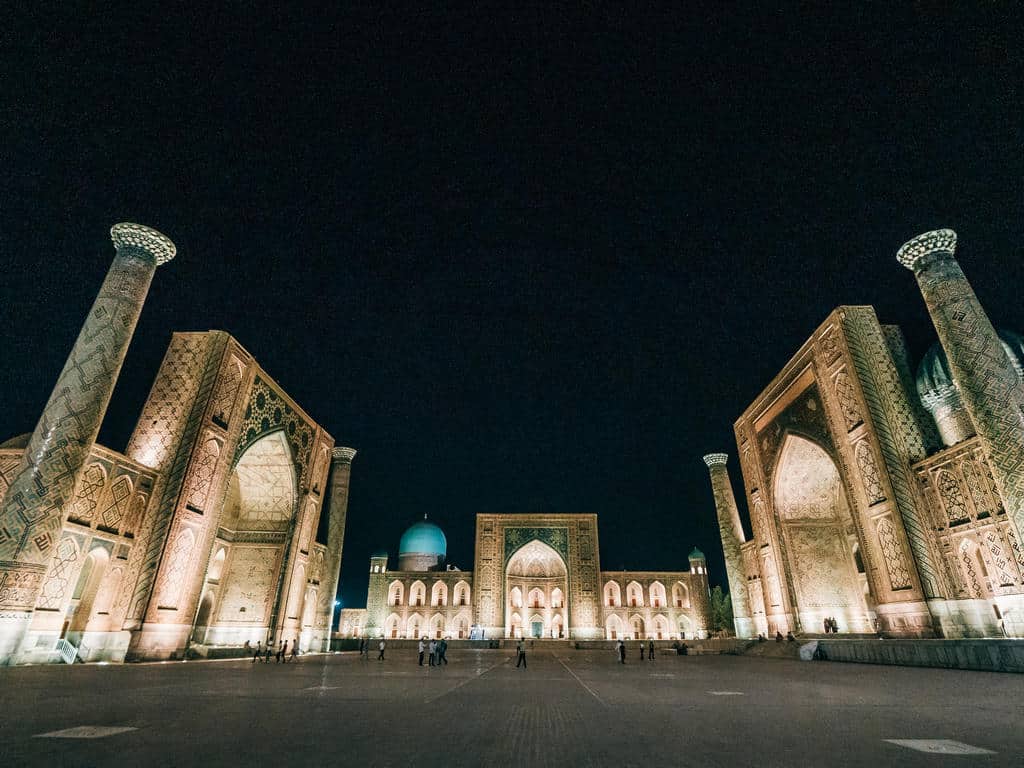
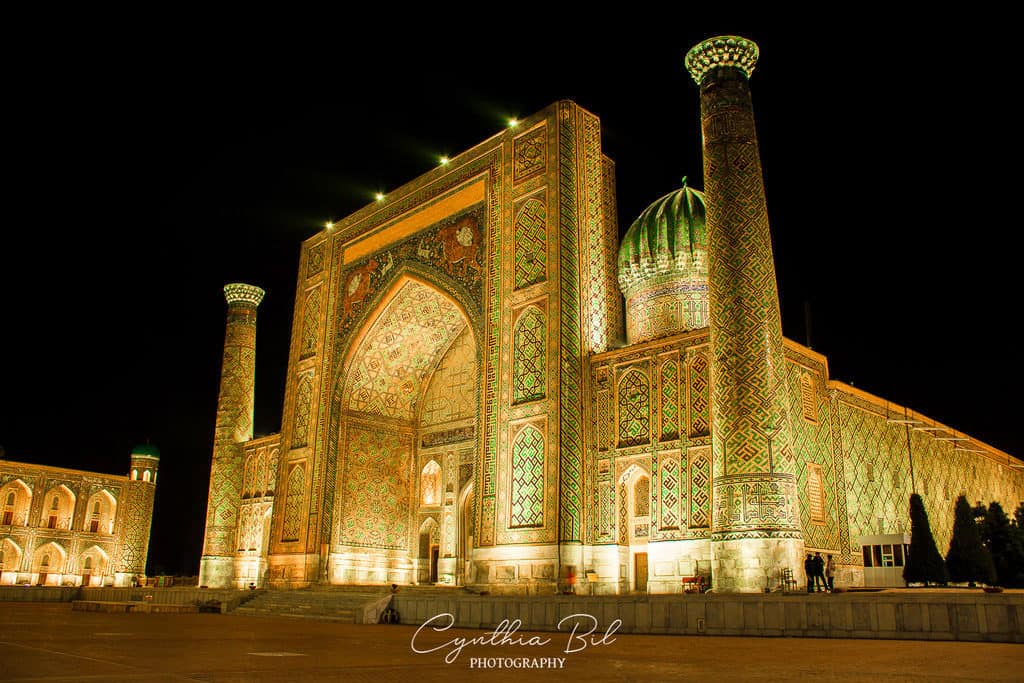
- I also recommend visiting Registan at night. The lights come on after sunset and illuminate all three of the stunning buildings. There’s also daily at 9 pm a light show during high season (late spring to early autumn).
Entrance fee for the Registan:
The entrance fee to visit the whole Registan complex is 50.000 UZS. Note: this is a one-entry ticket. Once you leave the complex, you have to pay again to re-enter.
Opening hours of the Registan:
The Registan is open daily from April to October from 8.00 am until 7.00 pm and from November to March from 9.00 am until 5.00 pm.
If you enter the Registan 15 minutes before closing time, they will allow you to stay for at least one hour longer. If you’re into photography, this is the moment to take beautiful captures of the lights illuminating the madrasahs.

Once you feel fulfilled by all the beauty of Registan, head right to Islom Karimov Street for the next point of interest.
You’ll see that this street is more like a fancy boulevard, framed by trees and souvenir shops.
Look out for an ice cream shop halfway through the boulevard. I have no details about its name but they have some super yummy ice cream there!!
If you’re already feeling hungry on your way to Bibi Khanym Mosque, stop at the Bibikhanum Teahouse (see where to eat in Samarkand) for a nice lunch in their garden.
4. Visit the historic Bibi Khanym Mosque
The Bibi Khanym Mosque is one of the most important monuments of Samarkand. It was named after the wife of Timur the Great.
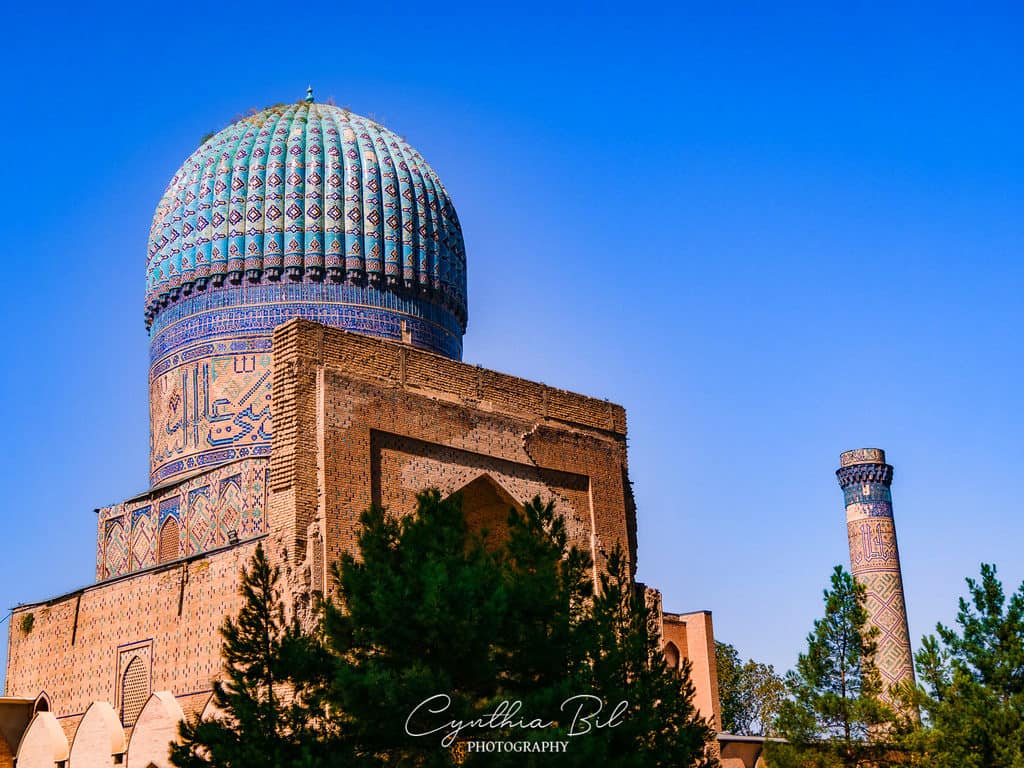
It was built by Amir Timur himself and he wanted to make it into the most magnificent mosque of the Islamic world.
However, Timur got a bit too ambitious. He wanted to go too big too fast. He pushed the building techniques of that time to their limit and encountered so many structural problems that the mosque wasn’t built to last.
Despite the renovation and reconstruction, the mosque slowly started to deteriorate until an earthquake in 1897 left the building in ruins.
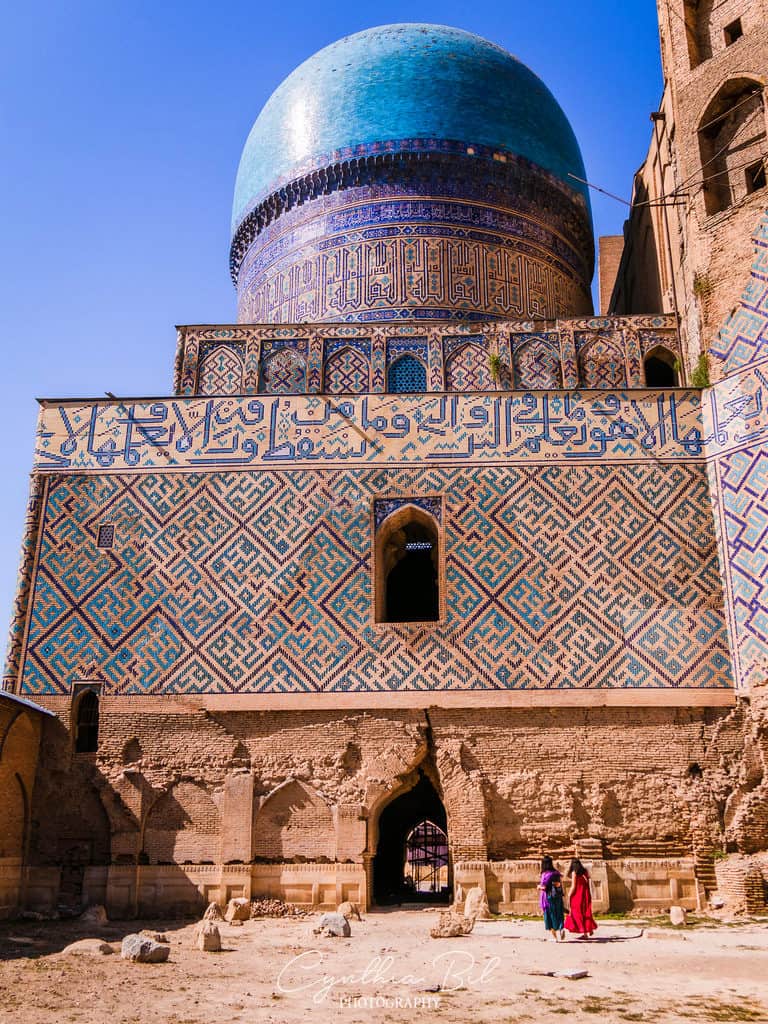
The mosque is now slowly getting restored (with proper building techniques…).
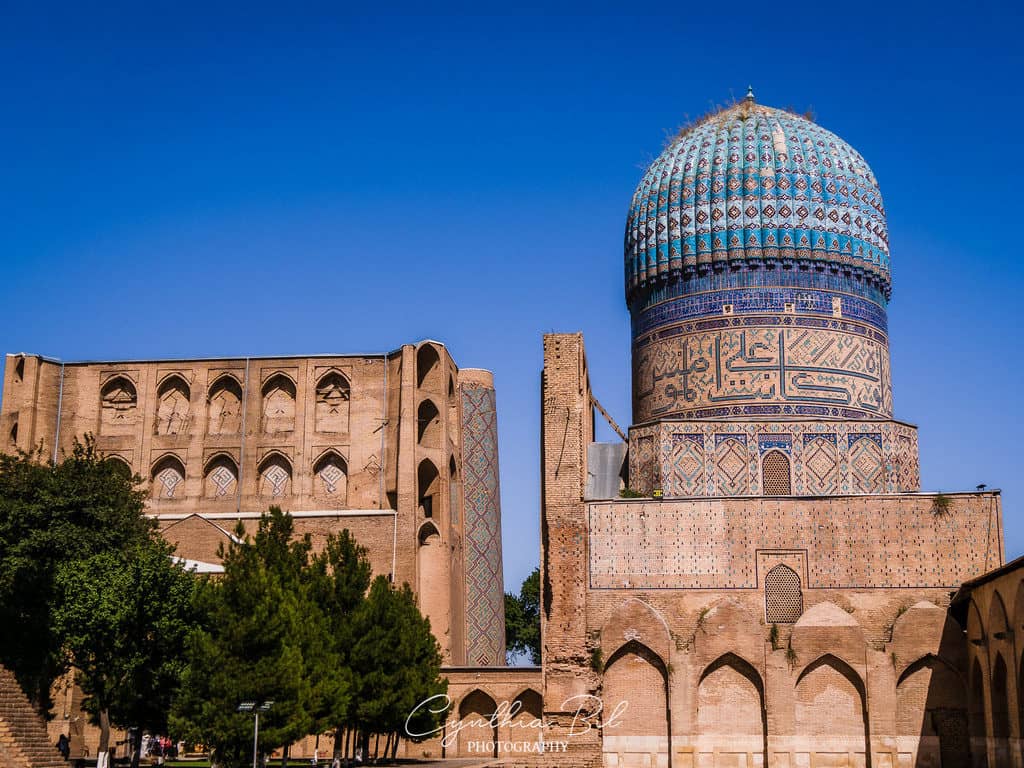
Some areas of the courtyard are off-limits due to the reconstruction but despite the current restoration work, the Bibi Khanym mosque is a striking building and will impress you.
The mosque is generally not very crowded so it offers many photography opportunities and it’s nice to spend some time relaxing in the garden of the courtyard.
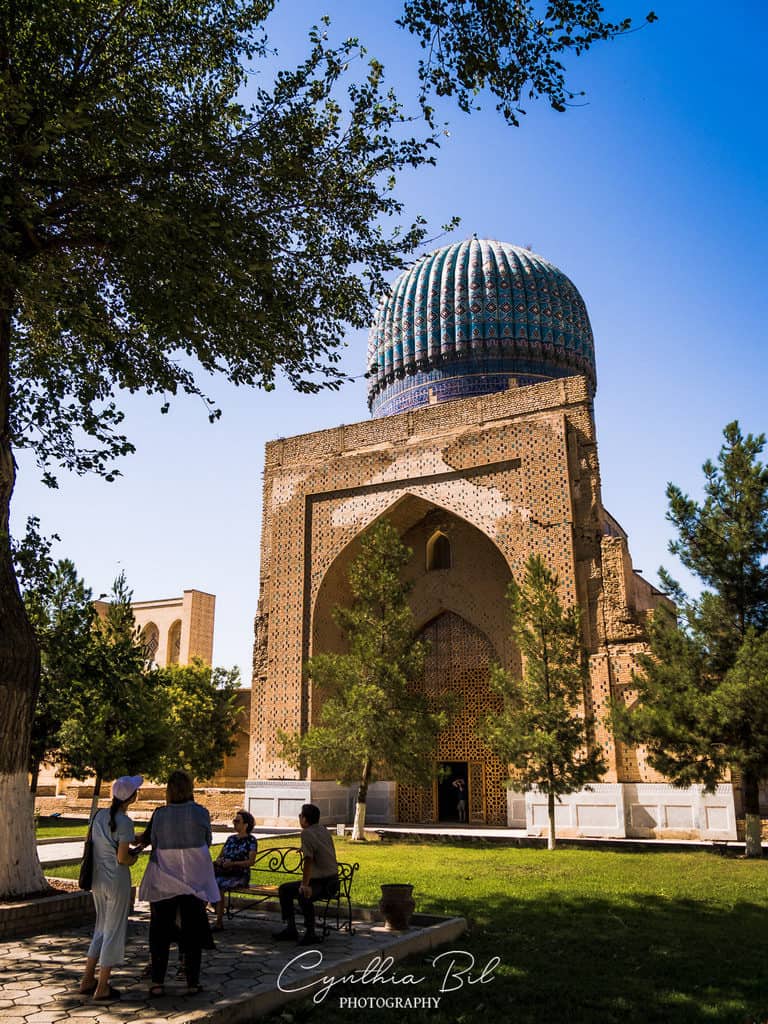
Directly opposite the mosque, you can visit the mausoleum of Bibi Khanym.
Entrance fee Bibi Khanym Mosque:
30.000 UZS
Opening hours Bibi Khanym Mosque:
Open daily from April to October from 8.00 am until 7.00 pm and from November to March from 9.00 am until 5.00 pm.
5. Experience local life at Siyob Bazaar
Siyob Bazaar, also called Siab bazaar, is the largest bazaar in Samarkand. It’s right next to Bibi Khanym Mosque.

It’s a typical Central Asian market where both locals and foreigners can shop for food, spices, nuts, candy, fruits, and vegetables. Vendors will call out to you, offering to taste their goods.

There are also some stalls selling Uzbek souvenirs.

After having visited many bazaars throughout Central Asia, the Siyob Bazaar feels a bit touristy but it’s still a nice market to visit. Just get your bargaining skills up as it’s likely to get ripped off here as a foreigner.

Entrance fee Siyob Bazaar:
Visiting Siyob Bazaar is free.
Opening hours Siyob Bazaar:
The Siyob bazaar is open daily from 5.00 am until 7.00 pm and closed on Mondays.
After visiting the Siyob Bazaar, keep walking north towards the end of the boulevard until you reach the crossroads. Cross the bridge and go to the right until you reach the Shah-i-Zinda Complex.
6. Have a photoshoot at Shah-i-Zinda Complex
Shah-i-Zinda is my favorites (photography) location in Samarkand.
I mean, there are many dazzling minarets, colorful buildings and shiny turquoise domes to be found in the city and across the country but this complex just has that little something extra.

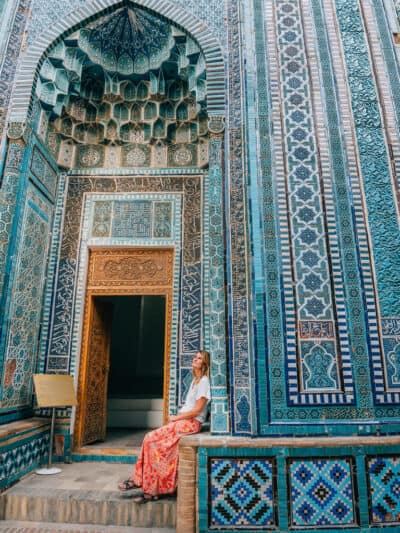
It’s not just only eye candy if you love colorful mosaics but there’s something magical and mysterious about this blue-tiled maze.

Shah-i-Zinda is a necropolis that consists of rows of blue tombs and various mausoleums grouped along a narrow avenue.
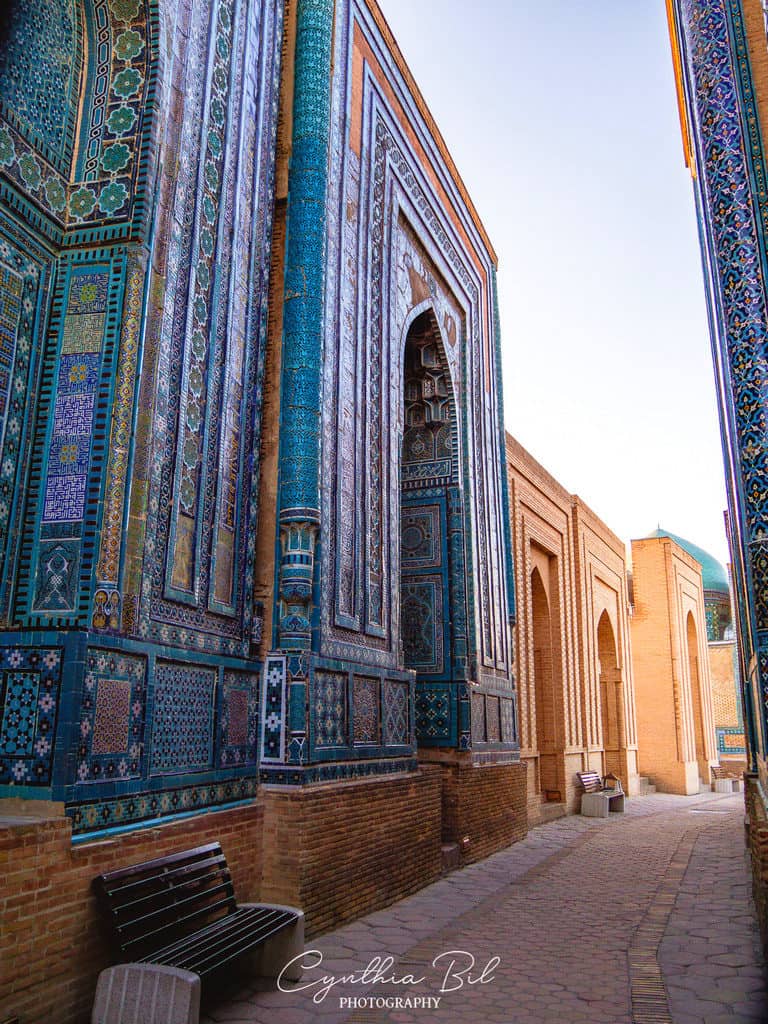
It’s the burial place of many royals and nobles, including a number of Timur’s relatives.
The legend goes that the Prophet Muhammad’s cousin, Kusam ibn Abbas, was buried here.
He preached Islam in this region and Shah-i-Zinda, which means “the Living King” in Persian, is now an important and sacred pilgrimage center.
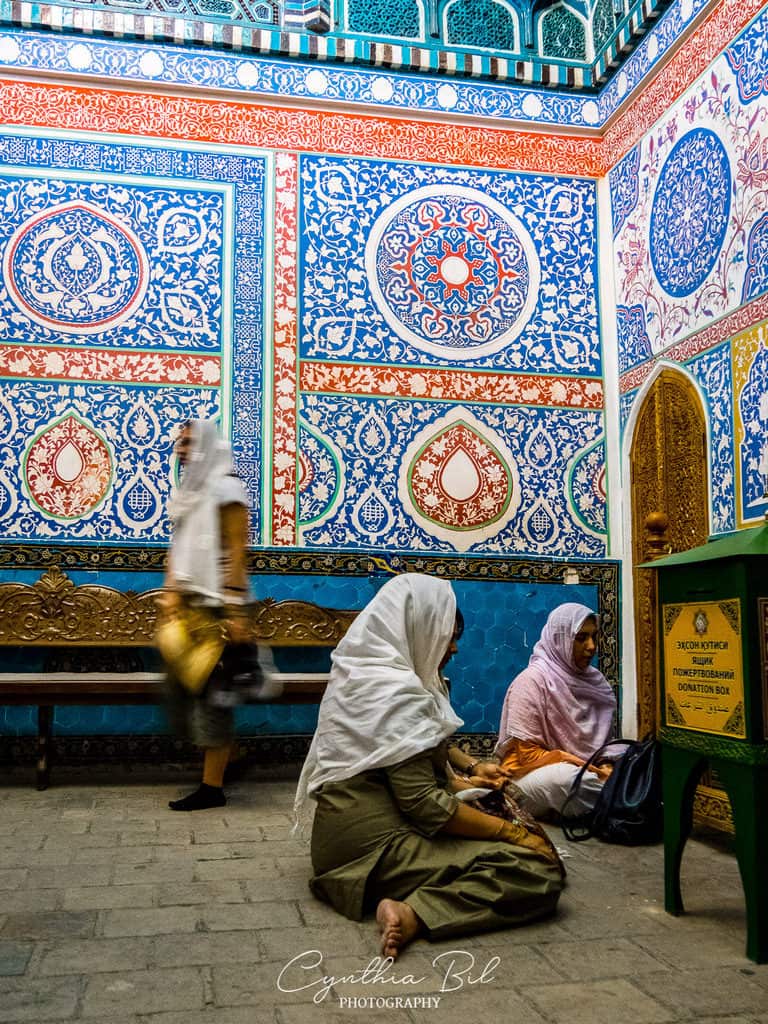
Be aware that Shah-i-Zinda is a sacred place where many pilgrims come to pray and pay their respects. Be respectful during your visit and don’t go all Instagram-crazy by twirling around in dresses. Make sure to dress modestly as well.

You’re also not allowed to take photos next to the tombstones and/or sit on them, you can’t put money on the graves and you’re not allowed to sacrifice animals on the tombs (in case you were planning to bring a sheep or a goat on your trip …)
Tips for visiting Shah-i-Zinda:
- During the day the complex receives many visitors – tourists and pilgrims – but if you go late and wait until sunset, you won’t only find the place nearly empty (great for photography), you’ll also get to see how the golden light gently caresses these beautiful mausoleums and tombs.

- If you’re a bit earlier and you’re waiting for the sunset, walk to the end of the pathway between the mausoleums. The complex opens up into Samarkand’s main cemetery, which is also worth a visit.
- Shah-i-Zinda opens very early in the morning, which is also a good moment to photograph the complex without loads of people getting in the way
Entrance fee Shah-i-Zinda:
50.000 UZS
Opening hours Shah-i-Zinda:
Open daily from 7.00 am until 7.00 pm
Once you paid the entrance fee to Shah-i-Zinda, you can walk in and out of the complex throughout the day.
My suggestion is to visit this necropolis, then walk towards the back of the complex and into Samarkand’s main cemetery. From there you continue walking to the Hazrat -Khizr Mosque (see below) and later return to Shah-i-Zinda for sunset.
7. Walk to Hazrat-Khizr Mosque
The Hazrat-Khizr Mosque isn’t the most attractive mosque of Samarkand and is usually not mentioned on many lists of things to do in Samarkand but it’s in my opinion still worth a visit.
This mosque was built in the 7th century, making it one of the oldest mosques in the world and the very first that has been built in Samarkand and Uzbekistan.

Hazrat Khizr was an important prophet in Islam. There is a belief that he lived in the time after Abraham and that he was granted immortal life, although Islamic theologians reject these beliefs.
You’ll see that the Hazrat Khizr mosque has been heavily restored. It’s not as spectacular as the other mosques and mausoleums in Samarkand but the woodwork is beautiful.
If you don’t feel like paying the entrance fee to visit this mosque, which is mostly a museum now, at least walk on the hill on which it is located to enjoy the stunning panoramic view over Samarkand. You’ll see a lot of glittering domes and shiny minarets popping out in the sunlight!
Entrance fee Hazrat Khizr:
50.000 UZS
Opening hours Hazrat Khizr:
Open daily from 8.00 am until 6.00 pm
8. Take a short bus ride to the Ulugh Beg Observatory
Before or after visiting Shah-i-Zinda and/or Hazrat Khizr, you can take city bus #45, #99 or #17 to the Ulugh Beg Observatory. The bus stop is across the street from the Hazrat Khiz mosque (it’s indicated on maps.me as “to Ulug Bek”). The bus ticket costs 3000 UZS.
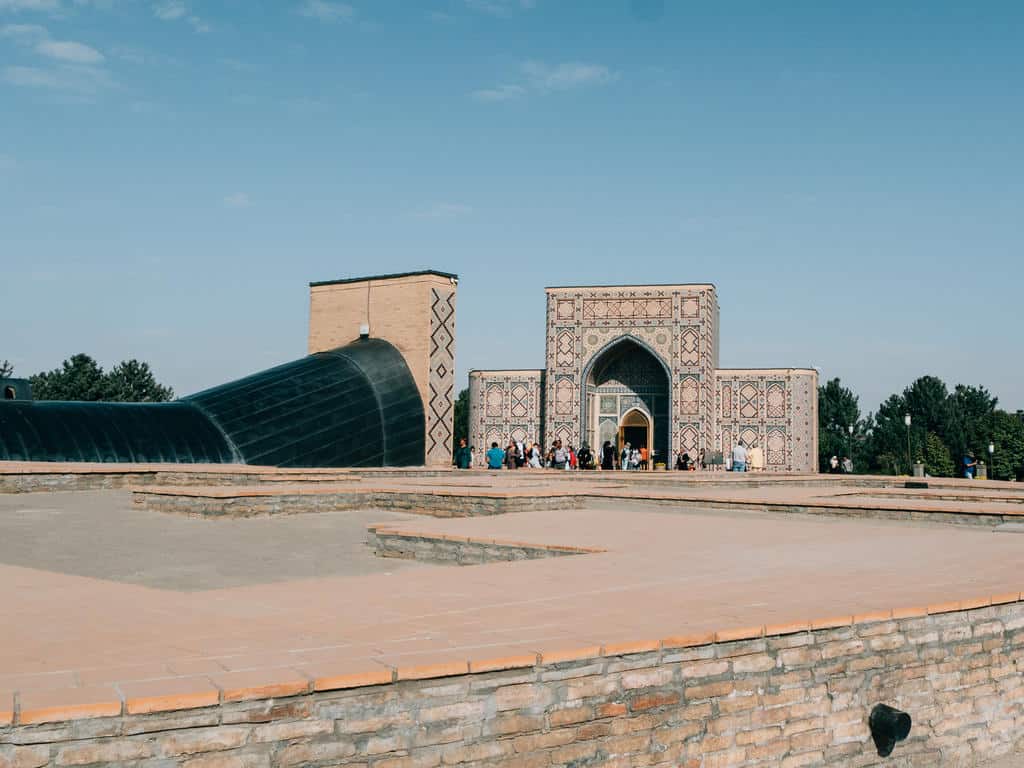
The Ulugh Beg Observatory was built in the 1420’s by the Timurid ruler Ulugh Beg, the grandson of Amir Timur. It was one of the greatest observatories ever built and nurtured some of the best astronomers of the time.
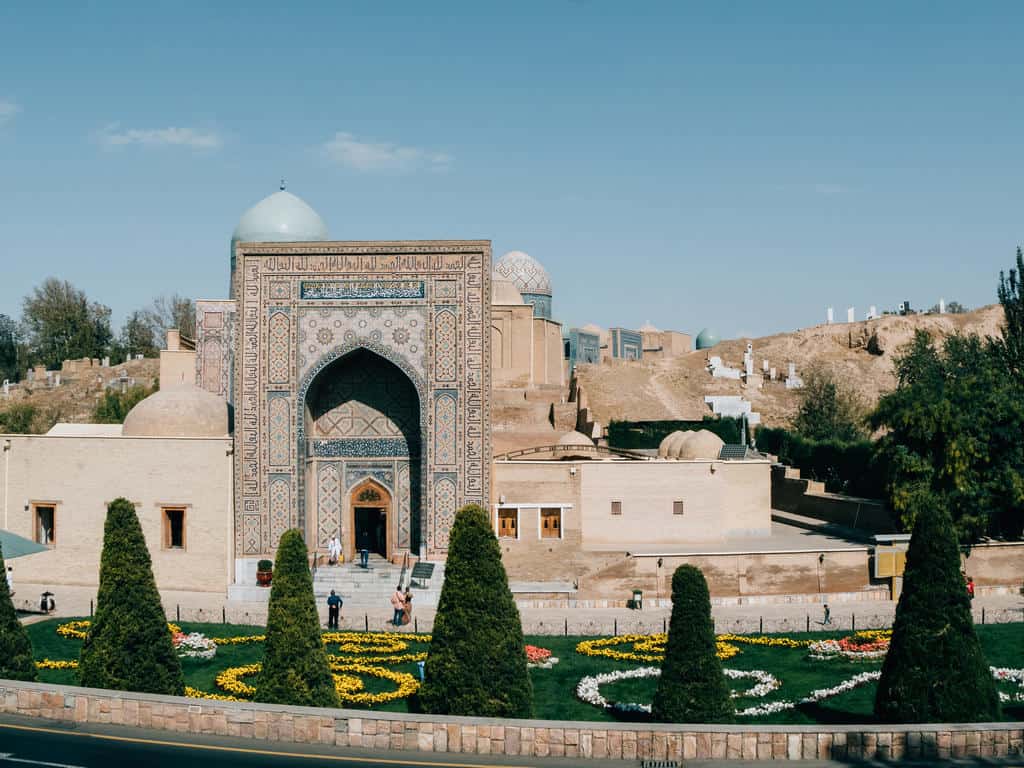
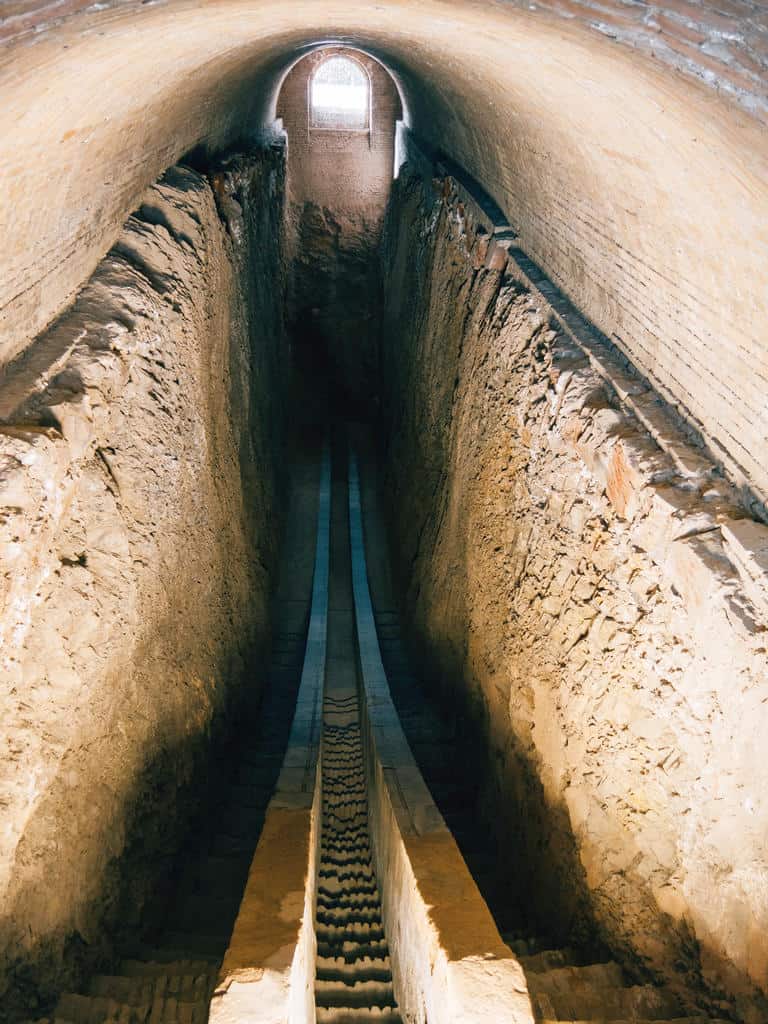
The observatory consisted of a three-story cylindrical building constructed around three enormous astronomical instruments. The main instrument was a monumental 40-meters tall meridian arc, used to measure the angle of elevation of bright celestial objects.
One of Ulugh Beg’s greatest achievements was a thorough star catalogue containing over 1,000 stars and their exact locations in the sky. This catalogue was created 200 years before telescopes came into existence!
But Ulugh Beg was better at being a scientist and astronomer than a ruler. In 1449, only two years into his reign, and after losing several battles, Beg got assassinated by his own son and the observatory destroyed. The Russian archaeologist Vassily Vyatkin discovered its remains in 1908.
The Ulugh Beg Observatory is a nowadays a museum where you can see a model of the ancient observatory and the remains of meridian arc.
Entrance fee Ulugh Beg Observatory
The Ulugh Beg Observatory entrance fee is 50.000 UZS per person.
Opening hours Ulugh Beg Observatory
The Ulugh Beg Observatory is daily open from 9.00 am to 7.00 pm.
9. Go on a day trip to Shahrisabz
If you have some extra time to spend in Samarkand, I’d recommend going on a day trip to Shahrisabz, a city located 88 km south of Samarkand. I’m calling it a day trip but the trip takes a total of 4 to 5 hours.
It takes about 1,5 hours to drive to Shahrisabz and the city is that small, that you can visit all its highlights in 2 hours.
You can plan this trip in the morning and enjoy the rest of the late afternoon and evening back in Samarkand.
Shahrisabz, also written Shakhrisabz and formerly known as Kesh, is one of the most ancient cities along the Silk Road. It was the birthplace of Amir Temur (yes, this guy again).
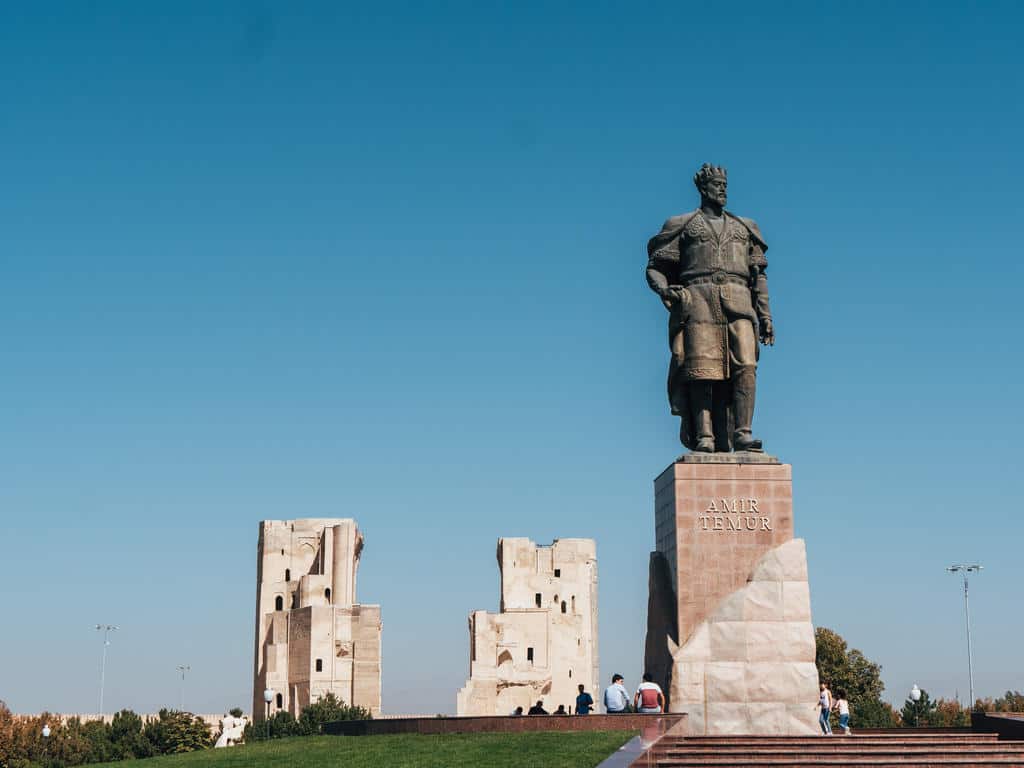
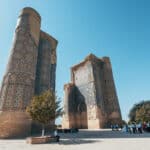
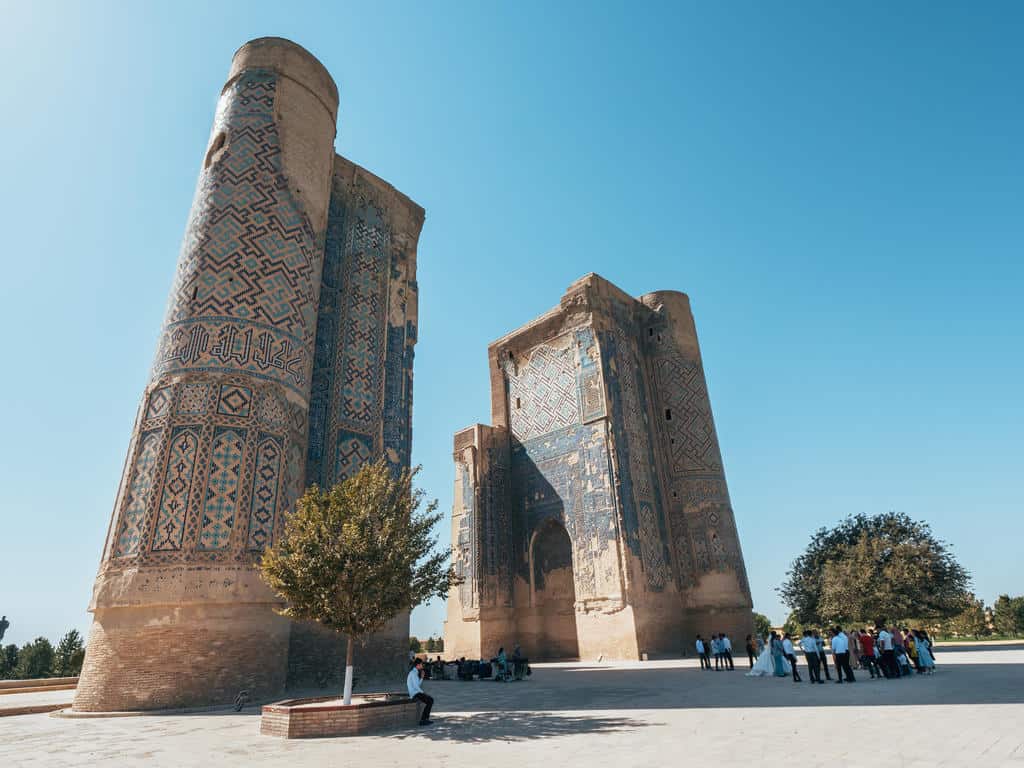
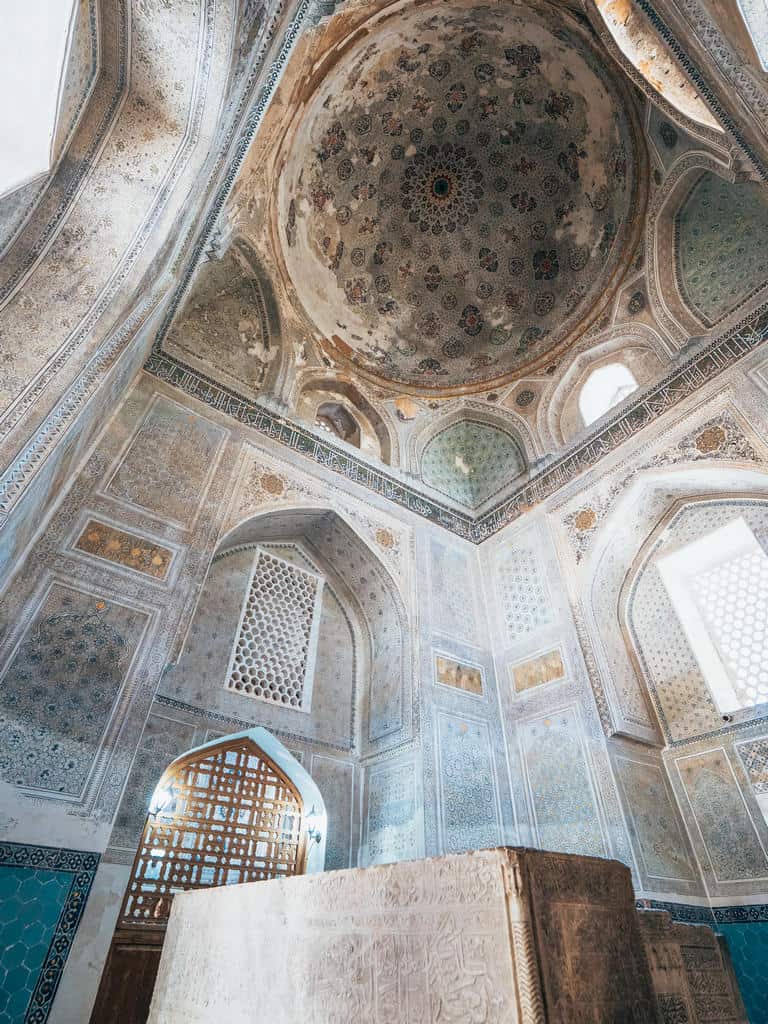
Shahrisabz has some impressive monuments that are on the UNESCO World Heritage List. The most famous place in Shahrisabz are the gate arches of the Ak-Saray Palace, the only remains of the palace that was built for Amir Timur.

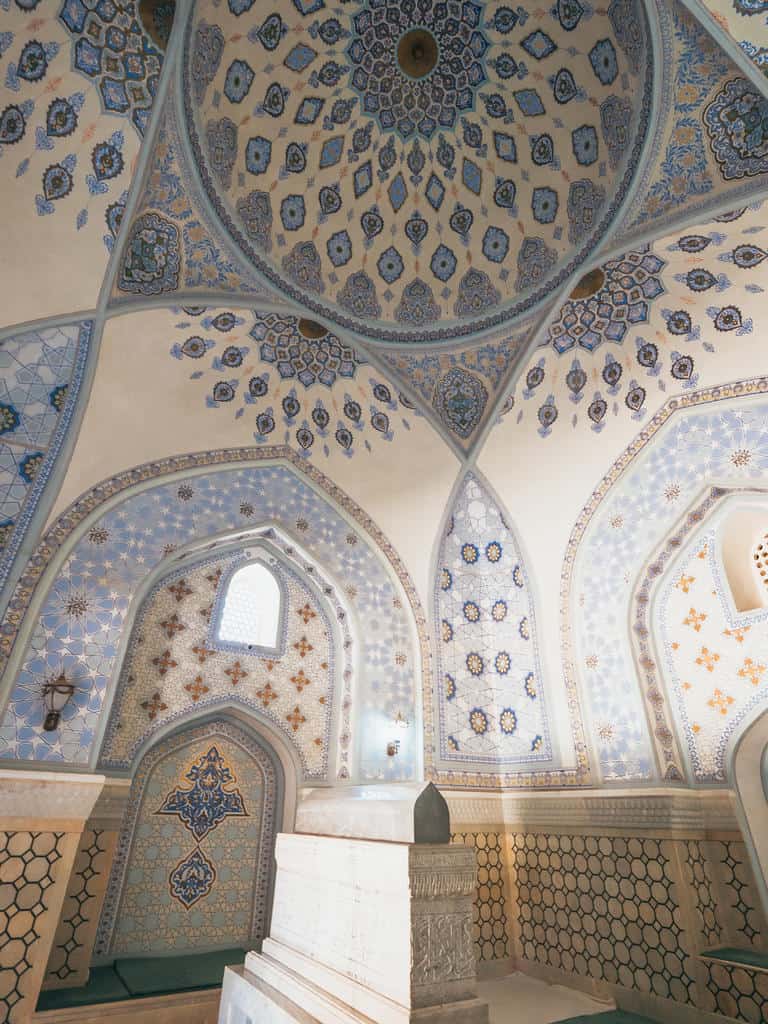
Other places of interest in Shahrisabz are the Dorut Tilovat Complex with the Kok Gumbaz mosque and the Dorus Siyadat Complex which contains the tomb of Timur’s eldest son.

How to get from Samarkand to Shahrisabz
The easiest and most interesting way to get to Shahrisabz would be by booking a guided day tour to Shahrisabz and visit this historical site with a guide.
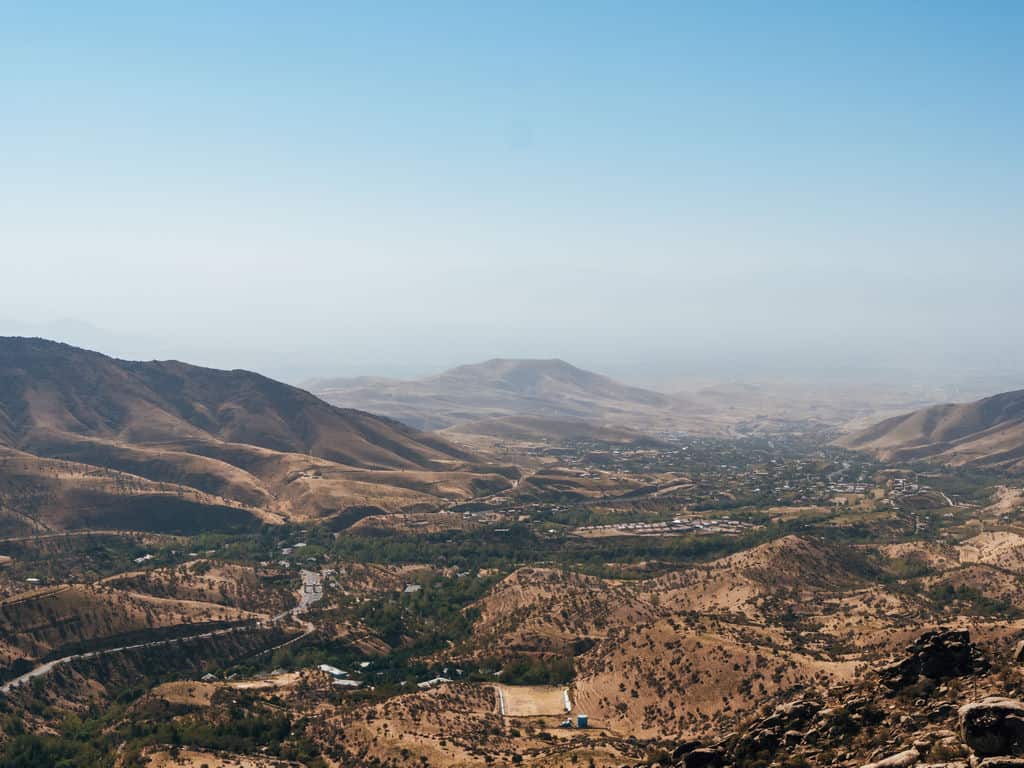
You get picked up in Samarkand, have a photo stop at the beautiful Tahtakaracha Pass on your way to the site, and have a guided tour around the main sights of Shahrisabz.
Another way to get there is to hire a driver for the day who’ll drive you there, wait for a few hours and take you back to Samarkand. This 2-way trip costs about $50 USD and you can book a driver at the tourist office of Samarkand.
If you want to keep the costs low (and you have a full day to spare), you can also get there by shared taxi.
You can find a shared taxi from Samarkand to Shahrisabz at Suzangaran, which is about 100m south of the Registan mashrutka stop. You shouldn’t pay more than 10.000 UZS for a seat in the shared taxi.
It might happen that the taxi only goes to Kitab, a town located at 10 km from Shahrisabz. From there you can take a mashrutka (minibus) or another shared taxi to Shahrisabz, which shouldn’t be more than 4000 UZS.
To get back from Shahrisabz to Samarkand, you can look for a taxi in the surrounding area but be aware that the taxi drivers might ask for a lot more money.
You could also take a mashrutka (minibus) from Shahrisabz to Kitab, visit the bazaar there and go to the taxi stand near the junction at the bazaar. Ask the locals for directions if needed.
Shahrisabz entrance fees
The entrance to the city of Shahrisabz is 30.000 UZS per person and this ticket allows you to visit the Ak-Saray Palace. If you want to enter the Dorut Tilovat Complex or the Dorus Siyadat Complex, you have to pay each time a separate fee of 30.000 UZS.
Samarkand City Tours and Experiences
I recommend taking a guided city tour in Samarkand. There’s just so much history in this ancient Silk Road City that you won’t learn if you visit the city by yourself.
One of the best ways to experience Samarkand is through its food. Join a traditional plov cooking class and learn how Uzbekistan’s most famous national dish is prepared using local spices, rice, vegetables and slow-cooked meat.
It’s a fun and authentic cultural experience that gives you a glimpse into Uzbek hospitality and daily life, and, of course, you’ll get to enjoy a delicious homemade meal afterwards.
Where to stay in Samarkand
Here are my recommendations for Samarkand:
- Altair Boutique → beautiful mid-range hotel at walking distance from all the highlights of Samarkand
- Kosh Havuz Boutique Hotel → stunning boutique hotel in traditional style located in the old center of Samarkand
- Old Radio Hostel → ideal for solo travelers and backpackers
Where to eat in Samarkand
1. Bibikhanum Teahouse
Bibikanum Teahouse is a lovely restaurant with an outside seating space. They serve tasty Uzbek dishes and also have vegetarian options.
During my last visit to Samarkand, I enjoyed a nice lunch there. It’s a great place to relax and eat while sightseeing in Samarkand as it’s located on Islom Karimov street, between Registan and the Bibi Khanym mosque.
2. Labi G’Or
Restaurant Labi G’or might not have 5-stars on Trip Advisor but I’ve always enjoyed the food there. The restaurant is conveniently located across from Registan and offers traditional Uzbek food. They also have beer and wine when you ask for it (it’s not mentioned on the menu).
3. Old City Restaurant
Old City Restaurant is a cozy restaurant that offers Uzbek, European and vegetarian cuisine. It’s also a vegan-friendly place, which is quite hard to find in Uzbekistan.
Old City Restaurant offers delicious meals for reasonable prices in a warm and welcoming atmosphere. It’s said to be one of the best restaurants in Samarkand (and therefore a bit more pricey).
4. Cafe Magistr
Cafe Magistr is located between Gul-e-Amir and Registan Square. I went there a couple of times during my first visit to Samarkand.
They offer both Uzbek dishes as western food (I needed a break from all the plov and shashlik), the prices are very reasonable (especially when you’re on a budget) and they also serve good coffee and beer.
5. Platan
Platan is mentioned as the best restaurant in Samarkand. They serve both Uzbek and Western dishes. I’ve recently had a meal there and I have to say, it was good! Platan is a bit more pricey than other restaurants (you pay for quality) and about 30 minutes walking from the Registan.

My Samarkand photography gear
Below is an overview of the gear I used to capture the beauty of Samarkand. You can also see my article on photography essentials and cameras for travel photographers for more information.
Curious what I use to capture places like this? Here’s my go-to gear:
- Camera: Panasonic LUMIX DC-90
- Main lens: Panasonic Lumix G Vario 14-140mm f/3.5-5.6
- Wide-angle lens: Leica DG Vario-ELMARIT 8-18mm f/2.8-4.0
- Prime lens: Leica DG Summilux 15mm f/1.7
- Tripod: Manfrotto Compact Action Tripod (Hybrid Head)

How to get to Samarkand in Uzbekistan
Samarkand is located in north-eastern Uzbekistan, close to the border with Tajikistan. It is easy to travel from other cities in Uzbekistan to Samarkand by bus and by train.
I highly recommend traveling in Uzbekistan by train as it’s the most convenient way to get around the country. In my Uzbekistan Railways Guide, I explain in detail how it works to travel by train in Uzbekistan.
1. How to get from Tashkent to Samarkand
The easiest and fastest way to travel from Tashkent to Samarkand is by train.
There are 2 types of trains – the Afrosiyob and the Sharq – that run from Tashkent to Samarkand.
The Afrosiyob is the high-speed train and takes you from Uzbekistan’s capital to Samarkand in a bit more than 2 hours. It runs daily in the morning and in the evening.
The Sharq goes slower, the journey from Tashkent to Samarkand takes a bit more than 3 hours but is significantly cheaper than the Afrosiyob. It runs daily in the morning.
You can check the train schedules and book your train tickets on the official Uzbek Railways website. Read my Uzbekistan Railways Guide with all the information on how to take trains in Uzbekistan and how to order tickets online.
You can get to this train station by taking the metro to Tashkent Station or by taxi. Don’t forget to bring your passport!

2. How to get from Bukhara to Samarkand
The easiest and fastest way to travel from Bukhara to Samarkand is by train.
There are 2 types of trains – the Afrosiyob and the Sharq – that run from Bukhara to Samarkand.
The Afrosiyob is the high-speed train and takes you from Bukhara to Samarkand in a bit less than 1.5 hours. It runs daily in the morning and in the evening.
The Sharq goes slower, the journey from Bukhara to Samarkand takes a bit more than 2 hours but is significantly cheaper than the Afrosiyob. It runs daily around noon.
You can check the train schedules and book your train tickets on the official Uzbek Railways website. Read my Uzbekistan Railways Guide with all the information on how to take trains in Uzbekistan and how to order tickets online.
Another way is to go buy your ticket directly at the ticket office right next to the train station in Bukhara.
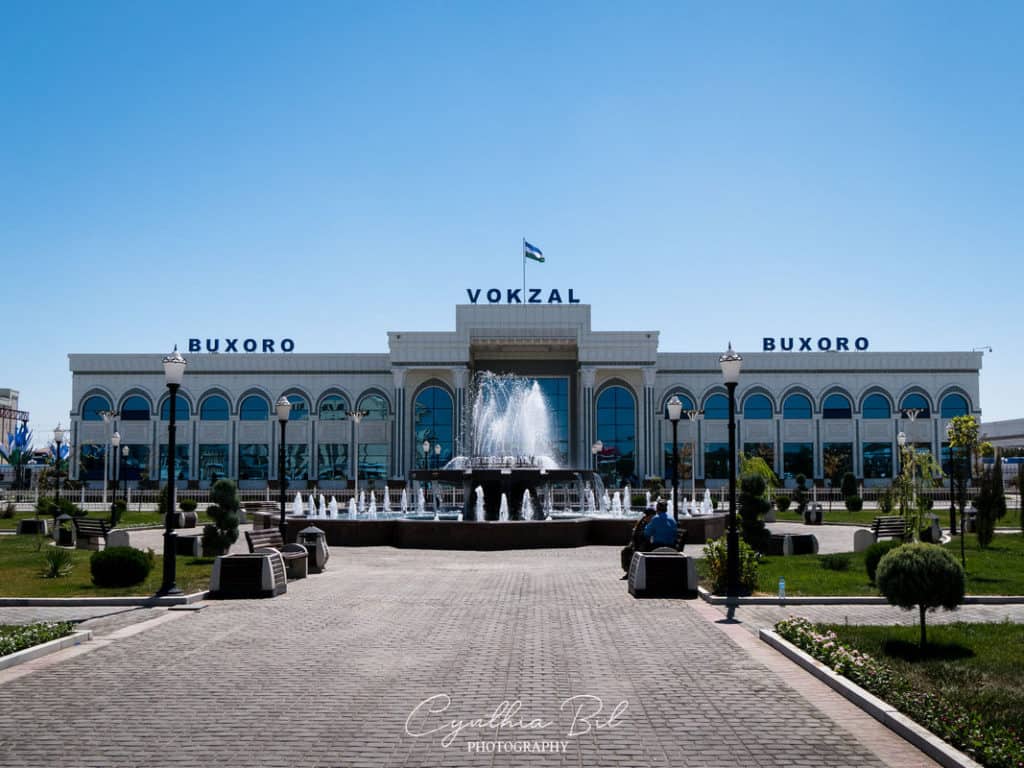
As this train station is a 20-minute drive from the old city of Bukhara, I’d recommend you buy your train ticket upon your arrival. This will save you from making the journey to the train station twice. A taxi from the old city to the train station costs 20.000 UZS.
3. How to get from Tajikistan to Samarkand
In case you’re traveling in the Fann Mountains of Tajikistan and you want to hop into Uzbekistan to visit Samarkand, it is possible now!
The Penjakent-Samarkand border has opened again so you can easily cross this land border between Tajikistan and Uzbekistan. Just check in advance if you need to apply for an Uzbek visa.
You can take a taxi from Penjakent city center to the border for around 3 US$. It’s a 30-minute drive.
Once you’ve crossed the border, you can take a taxi there to the city center of Samarkand. This takes another 30-minute drive and costs around 40.000 UZS.
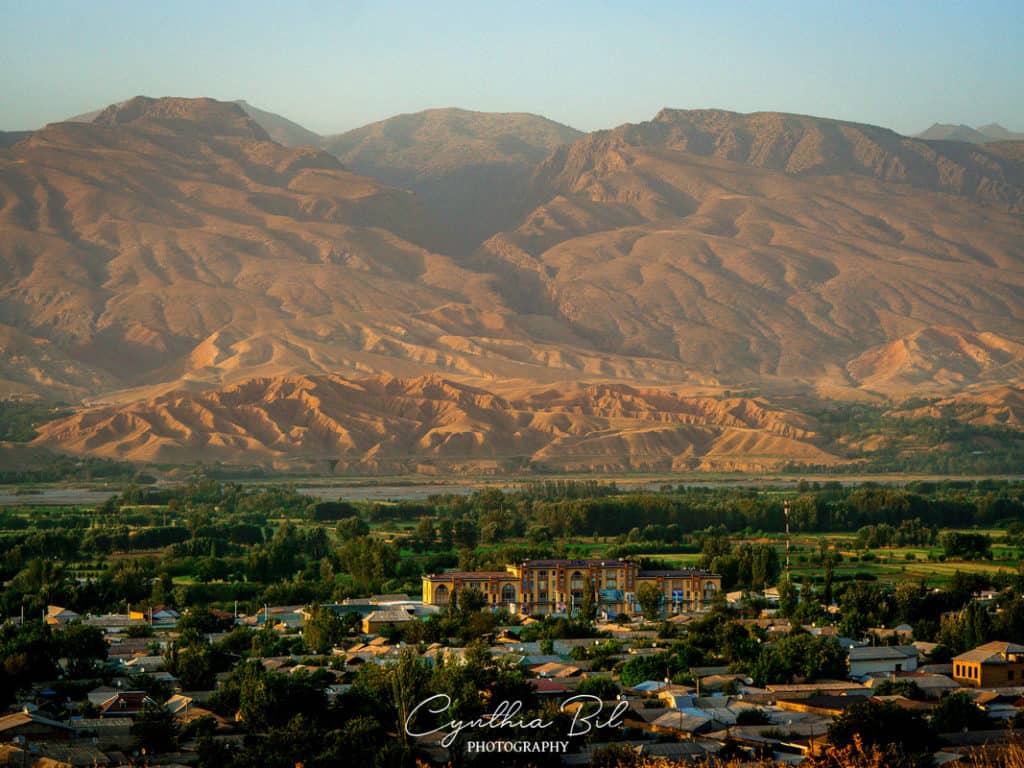
Samarkand is one of those places that stays with you long after you leave. Whether you come for the Silk Road history, the incredible architecture or simply the atmosphere of ancient Central Asia, this city has a way of making you slow down and look around in wonder.
If you want to experience Uzbekistan beyond the classic highlights, check out my Uzbekistan travel guides, itinerary planning services and small-group adventure tours across the country.
In case you want to add something to this list or if you have any questions, feel free to leave a comment below or send me an email!
Related Posts
| 👉Tashkent City Guide | 👉Samarkand City Guide |
| 👉Bukhara City Guide | 👉Khiva City Guide |
| 👉Shahrisabz City Guide | 👉 Karakalpakstan Guide |
| 👉Fergana Valley Guide |
What to wear in Uzbekistan – The Essential Uzbekistan packing list
The best way to get from Tashkent to Osh and from Osh to Tashkent, crossing the Dostyk border (Kyrgyzstan – Uzbekistan)
Uzbekistan Travel Itinerary (2026): 1, 2, 3 & 4 Week Travel Routes + Tips
Uzbekistan Money Guide (2026) – How much does it cost to live and travel in Uzbekistan?
What are the Best Places to visit in Uzbekistan in 2026?
Everything you need to know about horse riding in Uzbekistan+ 3 best horse trekking destinations in Uzbekistan
* Disclaimer: This publication is made possible by the support of the American People through the United States Agency for International Development (USAID) Competitiveness, Trade, and Jobs Activity in Central Asia. The contents of this publication are the sole responsibility of Cynthia of Journal of Nomads and do not necessarily reflect the views of USAID or the United States Government.
what a great guide! thank u! I’m planning to do a day trip and just wondering if u know where to store luggage in the area?
Hi Nanee, your best option would be to ask your ho(s)tel/guesthouse if you can leave your luggage there for the day.
Really helpful guide, thanks. Looking forward to my first trip to Samarkand, but a bit worried about stomach problems. Have you suffered from stomach problems in Samarkand, is it generally a problem and is it necessary to be particularly cautious about what to eat?
Hi Daniel, I didn’t struggle with stomach problems in Uzbekistan but my guts might have been used to it due to the large amount of time I spent in Central Asia. It’s really hard to say whether or not you’ll have issues, it’s kind of like playing the lottery… I definitely wouldn’t drink tap water and be cautious with raw vegetables. Hope this helps.
Thank you Cynthia, happy to report that I had no problems during my visit. I might have been a bit more cautious with food hygiene than usually. What a wonderful city Samarkand is!
Happy to hear Daniel!
Hello Cynthia, thanks and thanks again for this useful and complete guide!
I will travel to Uzbekistan next August (I know, it will be hot…)
Do you happen to know if there is an official site to purchase entrance tickets to the main attractions? I didn’t find it.
Regards
Hi Adelaide, you can’t purchase tickets online, you’ll have to buy them at the entrance of the sites itself.
Very comprehensive guide. Thanks you very very much.
My pleasure!
Thank you for the detailed article and fantastic photography! We just had to scramble our trip to Egypt and decided to go to Uzbekistan instead, so this was a great intro. Will update afterwards if we discover any great cafes or restaurants.
Hi Mike, great to hear and yes, all updates are welcome! Have a great trip to Uzbekistan and Samarkand!
Great information and helped us plan our trip. Tip: visited BIBIKHANUM TEAHOUSE, unfortunately very disappointed. Charged 66,000 som for two local beers. Found the same beers at other great places, never more than 20,000 som per beer. Food was also more expensive and service not as friendly as other places nearby.
Thanks again for your very useful overview.
Thank you for the update Jenn. Which restaurant(s) would you recommend?
This is super helpful, I am already excited. I hope it won’t be too hot by the end of May. Will be going with my wife and the little ones. I hope to take some nice shots with my NIKON. THANKS for all the tips. Was wondering if we should hire a car with a driver for 50$ or YandexGo would be enough.
Hi Eslam, thank you and already wishing you a wonderful trip!
Can I ask for what reason you want to hire a car with driver? To get around the city (if so, that’s not needed as everything is within walking distance and you can easily use YandexGo) or to go on a day trip to f.eg. Shahrisabz?
Best wishes,
Cynthia
Just to go around, thanks a lot for your tip. I will just use the app then 😀
Thank you so much for this article !
I am planning a short Uzbekistan trip next week and this guide is a real gem !!
So detailed and with so many tips, love it, specially the restaurant tips with vegetarian options that I knew would be a struggle to find 🙂
Hi Mariana,
I’m really happy to hear that my guide helped you! Have a great trip to Uzbekistan and Samarkand!
Dear Cynthia, this is a great guide for who wants to visit Uzbekistan.I will go there on April 2023 and it helped me very much. Thank you for your efforts..
Thank you so much Bekir! Wishing you a fantastic trip (and maybe we cross paths as I’ll be in Uzbekistan this April too :))
cynthia,
you mention free visas on arrival. on the train pae it says you need an evisa
Hi Joe, Uzbekistan offers free visas on arrival for passport holders of the following countries. If your country is not on the list, you have to apply for an e-visa.
Thanks Cynthia. So far this has been really helpful! Traveling from Bukhara to Samarkand today:)
Have a great time Liozos!
What a great article, thank you for making our job easier.
thanks alot
My pleasure! Enjoy your trip to Samarkand!
Superb guide based on first-hand experience. This will be invaluable to us as we discover the treasures of Samarkand and Bukhara. Thank you so much.
Thank you Gerry! Enjoy your time in Uzbekistan!
I think it is a good article that helps new tourists to get to know about Samarkand, and is beneficial in terms of giving tips, advice and instructions how to tour the city. Thanks to the author.
Thank you Salohiddin! I’m very happy you like this article!