
What are the best places to visit in Uzbekistan? Are you looking for the most beautiful things to do in Uzbekistan? In this comprehensive guide, we’ll look at both brilliant Uzbekistan tourist places and off-the-beaten-path destinations in Uzbekistan, my top tips for each spot and how to get there from Tashkent.
Uzbekistan holds itself with so much grace, especially in its people, architecture and landscapes. The magical allure of this Central Asian destination is that you can marry up a historical lesson with an outdoor adventure.
Uzbekistan is teeming with ancient sites that you can easily link up from city to city. I can’t not mention the country’s spectacular mountain ranges either. Uzbekistan’s nature is tranquil, and its terrain provides endless hiking and horse riding opportunities.
It’s fair to say I know Central Asia pretty well. It was my home for one year, and I have returned every summer since 2018, flitting between Uzbekistan, Kyrgyzstan, Kazakhstan, and Tajikistan. I thought it would be helpful to pass on what I’ve learned and take you through how to stride across a peak at sunrise or find glittering minarets at sunset.

There’s a lot to whittle down when you discover a new country and it’s sometimes hard to determine what you want from a trip.
In this guide, we’ll look at Uzbekistan’s most beautiful places, what makes them great spots for visiting and travel resources.
Tip: See my Uzbekistan Travel Page for a complete overview of all my travel guides and blog posts about Uzbekistan!
EXPERIENCE UZBEKISTAN BEYOND THE SILK ROAD
Go on an active 14-day adventure combining legendary Silk Road cities with remote mountain trails, desert camps and meaningful local experiences.
Disclaimer: This posts might contain affiliate links, meaning that if you make a purchase through these links, I may earn an affiliate commission. Thank you for helping to support this website!

Plan your trip to Uzbekistan
- 18 important things to prepare your trip to Uzbekistan
- 26 beautiful places to visit in Uzbekistan
- Uzbekistan Itineraries: 1 to 4 weeks in Uzbekistan
- How to travel around Uzbekistan by train
- What to pack for Uzbekistan
- Uzbekistan Safety Guide
- Uzbekistan Money Guide
- Tours & Experiences: Guided City Tours in Uzbekistan, Adventure Tours in Uzbekistan
What are the best places to visit in Uzbekistan?
Below is an overview of the 26 most beautiful places to visit in Uzbekistan. You’ll find both Uzbekistan tourist places as off-the-beaten-path destinations in the country.
Need Travel Insurance for Central Asia? I use and highly recommend HeyMondo Travel Insurance. As a reader of Journal of Nomads, you get a 5% discount off your insurance plan!

Map Visit Uzbekistan’s Best places
1. Shah-i-Zinda, Samarkand

Kicking things off with my favorite place in all of Uzbekistan: the Shah-i-Zinda Complex!
Shah-i-Zinda is a necropolis of many royals and nobles, including a number of Amir Timur’s relatives. The site is a dazzling avenue of blue tombs and various mausoleums in the ancient city of Samarkand.
The legend goes that the Prophet Muhammad’s cousin, Kusam ibn Abbas, was buried here. Shah-i-Zinda means ‘the Living King’ in Persian.
Kusam ibn Abbas preached Islam in this region, leading to the complex becoming so sacred to Muslims and is the focus of many global pilgrimages.
Each building is intricately decorated with teal and turquoise shapes. As a photographer, this place is like catnip for my eyes. It’s SO stunning and peaceful.


TIPS FOR VISITING SHAH-I-ZINDA:
- Visit during sunrise or sunset! If you’re a fan of minimal people traffic then you’ll love wandering around the complex when it’s calm. My advice is to head over for sunset. Not only will you find the place nearly empty, but it’s a light trap for photography when the evening rays strike the tombs.
- If you do head down for sunset and find you’re early, continue walking down the alleyway between the mausoleums. You’ll find yourself in Samarkand’s main cemetery!
- I’d recommend arriving a few hours before sunset, visiting the necropolis and continuing down to the main cemetery. Then head down the avenue to Hazrat -Khizr Mosque and return to Shah-i-Zinda for sunset.
- Taking photos next to the tombstones, or sitting on them, is a huge no no. Don’t place any money on the graves either. One final thing, whatever you do, don’t bring a goat to sacrifice on the tombs. That’s not allowed either…
- Shah-i-Zinda is a holy place. Many Muslims travel thousands of miles to come specifically here. Be respectful during your visit, and don’t go all Instagram-crazy by twirling around in dresses.
- Shah-i-Zinda has such an interesting history that I would recommend visiting the necropolis at least once with a guide. There aren’t any English-speaking guides at the complex itself so you’ll have to take a guided city tour in Samarkand – which I really recommend!
You can find guided city tours in Samarkand at the Samarkand Tourist Office or you can book a tour online. Here’s one that I would recommend:
ENTRANCE FEE FOR SHAH-I-ZINDA:
50,000 UZS. After you’ve paid the entrance fee, you can walk freely inside and out of the complex during the day.
OPENING HOURS FOR SHAH-I-ZINDA:
Open daily from 07:00 until 19:00.
HOW TO GET TO SHAH-I-ZINDA FROM TASHKENT:
The easiest and fastest way to reach Samarkand from Tashkent is hopping on a train. The Afrosiyob is a high-speed service that takes around two hours, running daily in the morning and in the evening.
There’s also the Sharq service which is so much cheaper and takes just a little over three hours. This one runs daily in the morning.
Read my Uzbekistan Railways Guide if you’re looking for all the details on how to get about by trains, and then book using the official Uzbek Railways website. Most importantly… don’t forget your passport!
Once you reach Samarkand station, it’s a 1hr 15min walk, or you can hop in a taxi which takes around 15mins and should cost about 25,000 UZS.
Install the Yandex Taxi app on your phone for a stress-free cab fix. The app is simple to use and saves you from hustling for a reasonable price because it shows you the rate before booking.
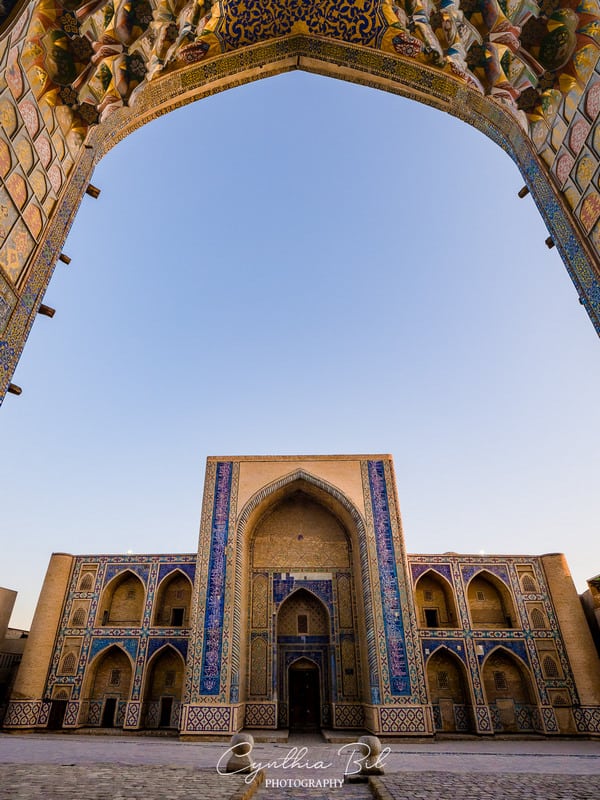
2. Ulugbek Madrasa, Bukhara
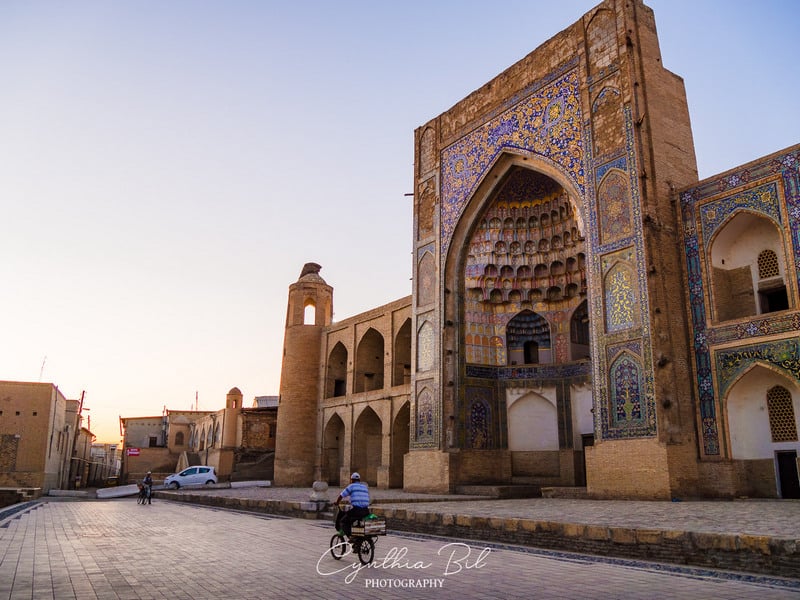
Founded in 1417, it’s said that the Ulug Bek Madrasa is the oldest surviving madrasa in Central Asia! I really love the story behind how it was built.
The fella ruling the area at the time was called Mirzo Ulug Bek. He was an enlightened and intellectual man, using his skills to nourish cities with educational facilities.
Ulugh Beg became worried about the lack of developments in science research in Uzbekistan. So he turned his focus to Bukhara, which was incredibly strict and conservative at the time. And so, the madrasa was constructed, formed under Ulugh Beg’s dream that the city would flourish into a center of science and education and grow from its rigid conservative ways.
Ordered by Ulugh Beg, a carved inscription at the entrance door reads: ‘The pursuit of knowledge is the responsibility of every Muslim man and woman.’ So cool, right? The center could receive up to 80 students who studied subjects including astronomy, mathematics, and Arabic.
It’s a pretty small madrasa compared to others you’ll find in Uzbekistan, but its historical importance speaks for itself.
TIPS FOR VISITING ULUGBEK MADRASA:
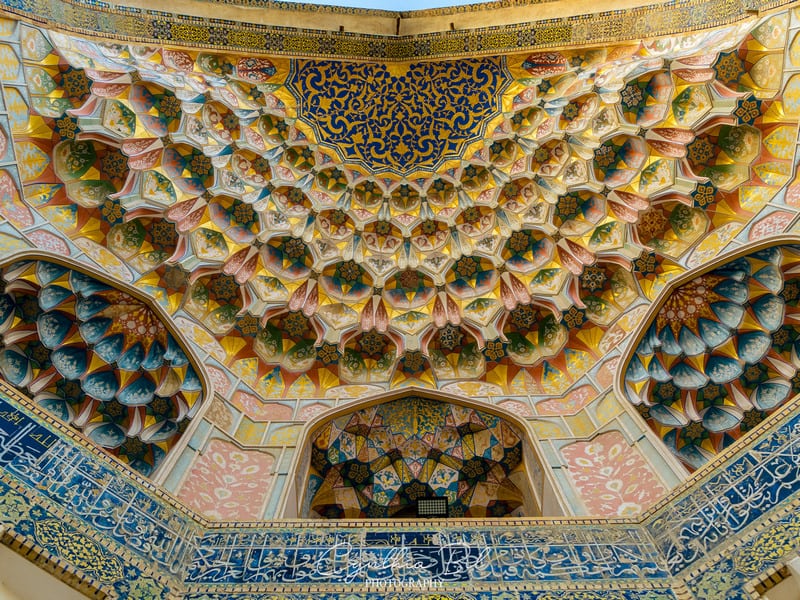
- The madrasa is free to enter so definitely check it out. It perhaps won’t have the dazzling architectural aesthetics you may have seen elsewhere, but that doesn’t make it any less unique!
- Don’t mix this up with the Ulugbek Madrasa in Samarkand! Especially if you’re asking for directions or sticking it into a map.
HOW TO GET TO ULUGBEK MADRASA FROM TASHKENT:
BY TRAIN
It’s super simple to get to Bukhara from the capital. Two trains, a high-speed and a standard, connect the two cities.
You’ll find the schedule and times on the official Uzbekistan Railway website. Check out my Uzbekistan Railways Guide to learn how to book the train tickets and select your seats.
From the train station in Kagan, (the new part of Bukhara where you’ll get off), you can catch a 20-minute taxi to the Ulugbek Madrasa for about 20,000 som. Taxi drivers waiting at the station are cheeky and some like to overcharge tourists but you shouldn’t pay more than this.
Top tip: install the Yandex Taxi or Yoko Taxi app to order a taxi online and receive the rate upfront easily.
BUS
You could get a bus from Tashkent to Bukhara, but it’s more than a 12-hour journey, and the price difference isn’t much of what a train is. You can buy tickets from the bus station near the Olmazor metro station. Bus prices tend to change regularly but generally cost around 66,000 som.
3. Small Chimgan Peak, Chimgan National Park

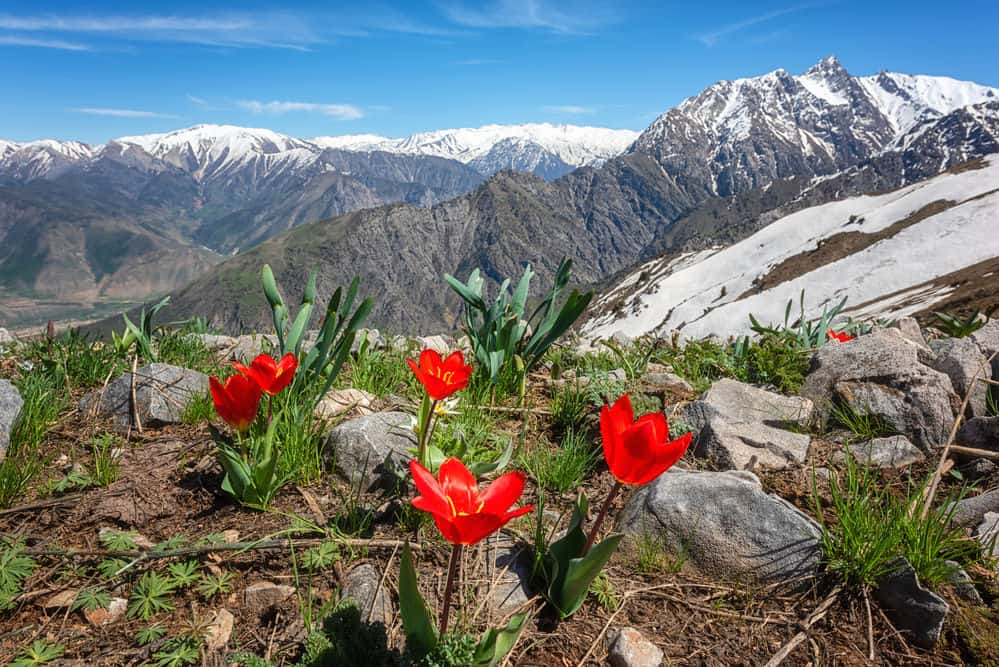
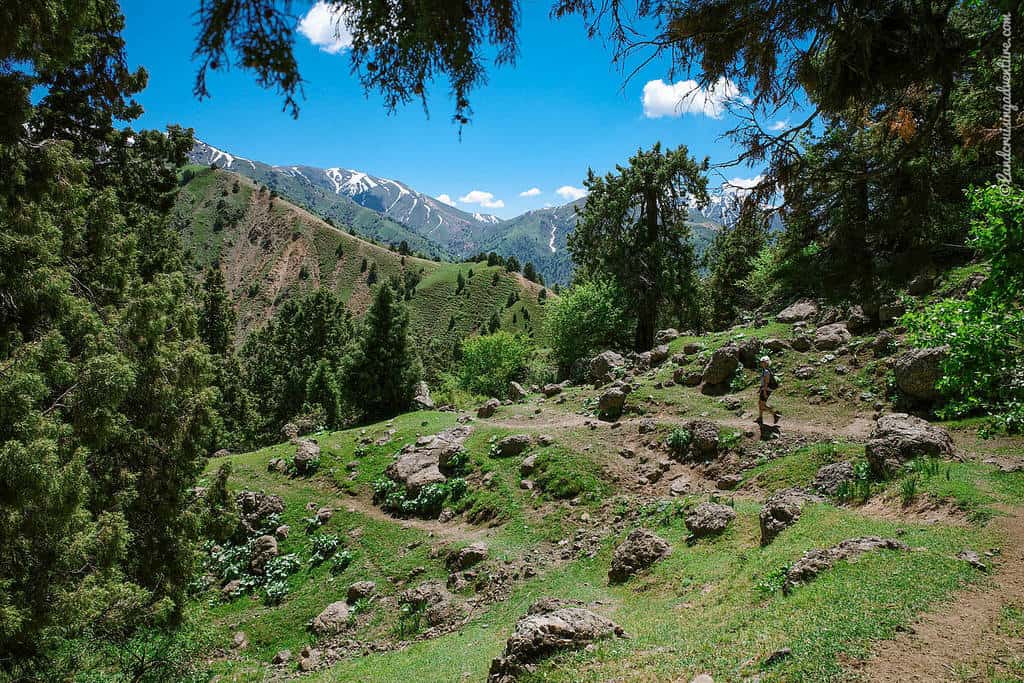
Uzbekistan has some seriously spectacular mountains, and you should definitely carve out some time for hiking during your trip.
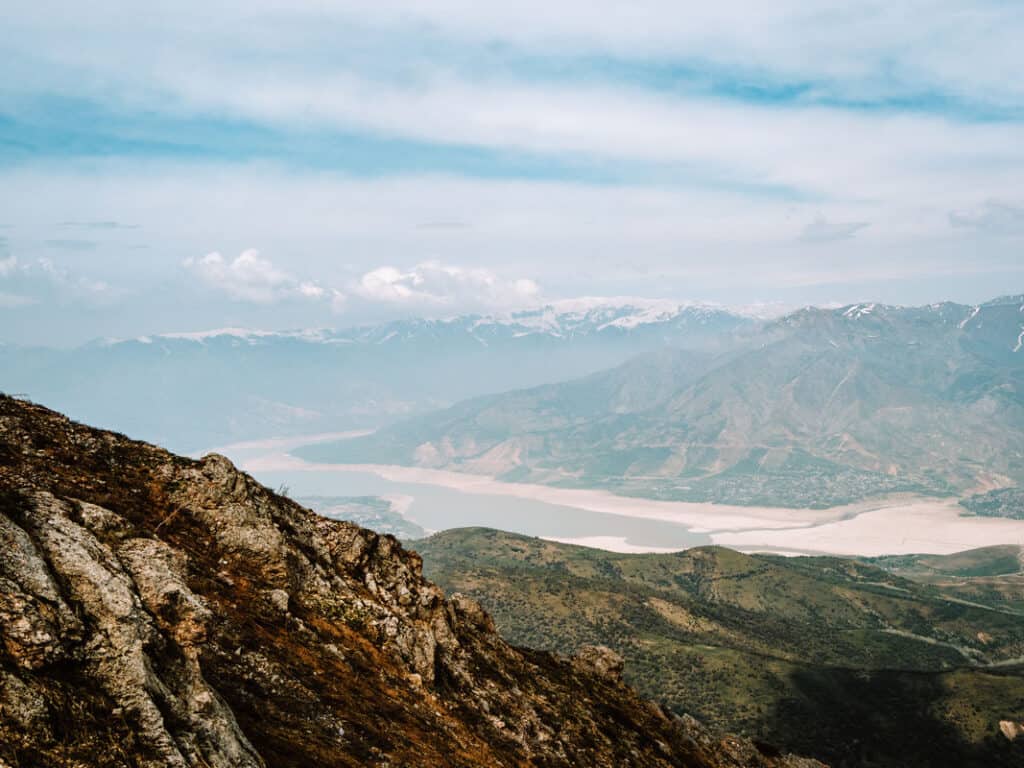
Ugam-Chatkal National Park is about 80km east of the capital and has endless hiking trails that wind between the valleys. One of the park’s mightiest attractions is the Greater Chimgan Mountain, which is Uzbekistan’s largest peak at 3,309m.
Many hikers train for this and it’s definitely not just a day trip. So as an alternative, why not try its sibling, the Small Chimgan Peak at 2,100m?
The Small Chimgan Peak takes about 4 hours to climb and offers stunning views of Lake Charvak, the lush green meadows of Chimgan, and the snow-dusted peaks of the Tien Shan mountains in neighboring Kyrgyzstan and Kazakhstan.
TIPS FOR VISITING SMALL CHIMGAN PEAK:
- I’d recommend spending at least two days in the park. You can either camp or stay in mountain huts.
- Some places in the park will need a permit, which you can obtain from a tourism agency or a mountain guide group.
- Feeling inspired? Hop on my 14-day Highlights of Uzbekistan tour! You could always tailor your trip with a mountain guide. I can also put you in touch with community-based tourism groups that will take your adventure to the next level.
- Here’s a day trip from Tashkent to the Chimgan Mountains that I recommend:
HOW TO GET TO SMALL CHIMGAN PEAK FROM TASHKENT:
There’s no single way to get into Ugam-Chatkal National Park, and many surrounding roads are dirt tracks. If you drive or are organizing a driver, remember it will take longer to reach your destination.
If you’re tight on time/budget, I’d recommend the below journey to Beldersay, and then you can access the Chimgan range. If you want to delve into the mountains for more of an adventure, I’d try looking into organizing a private driver or help from a guide.
Due to the Chimgan range being only 80km from Tashkent, it’s about a 1 hour 30-minute drive.
If you want to be picked up from a specific location, please contact an agency and be very clear about your plans, send an image of a GPS waypoint and ensure you’ve got the agency’s number and the driver’s.
You can reach the city of Gazalkent, which is close to the Chimgan Mountains by public bus. There are both electric trains and buses leaving Tashkent to Gazalkent.
From Gazalkent, there are two daily buses Gazalkent-Chimgan (10:30 and 14:30) and Chimgan-Gazalkent (06:30 and 13:30), which take around 50 minutes.
The road is accessible at any time of the year, but there can be limitations in spring because of landslides and mudflows.
4. Yodgorlik Silk Factory, Margilan
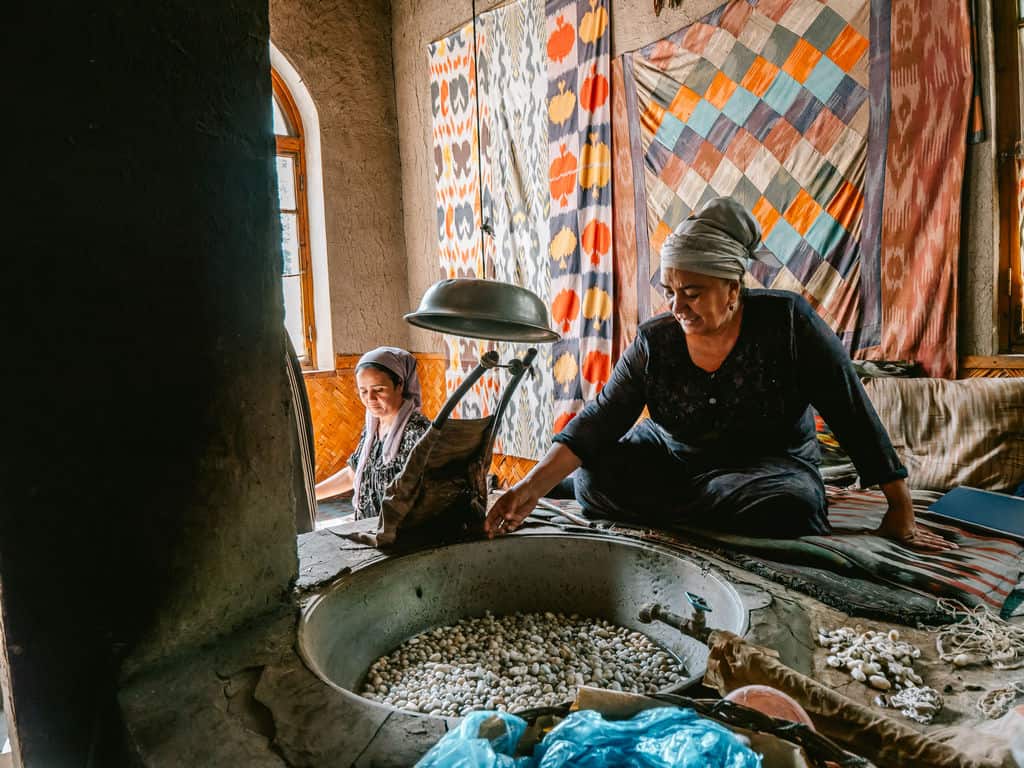
The art behind silk spinning (sericulture) is an integral part of mountain villagers’ heritage, with Uzbekistan being the world’s third-largest silk importer. It’s said people in the Fergana Valley have produced silk for around 1,000 years.
It’s really fascinating to learn about the process and watch the silkworms munch away on mulberry leaves. Silkworms are grafters… it takes around 2,500 of them to produce just one pound of raw silk!
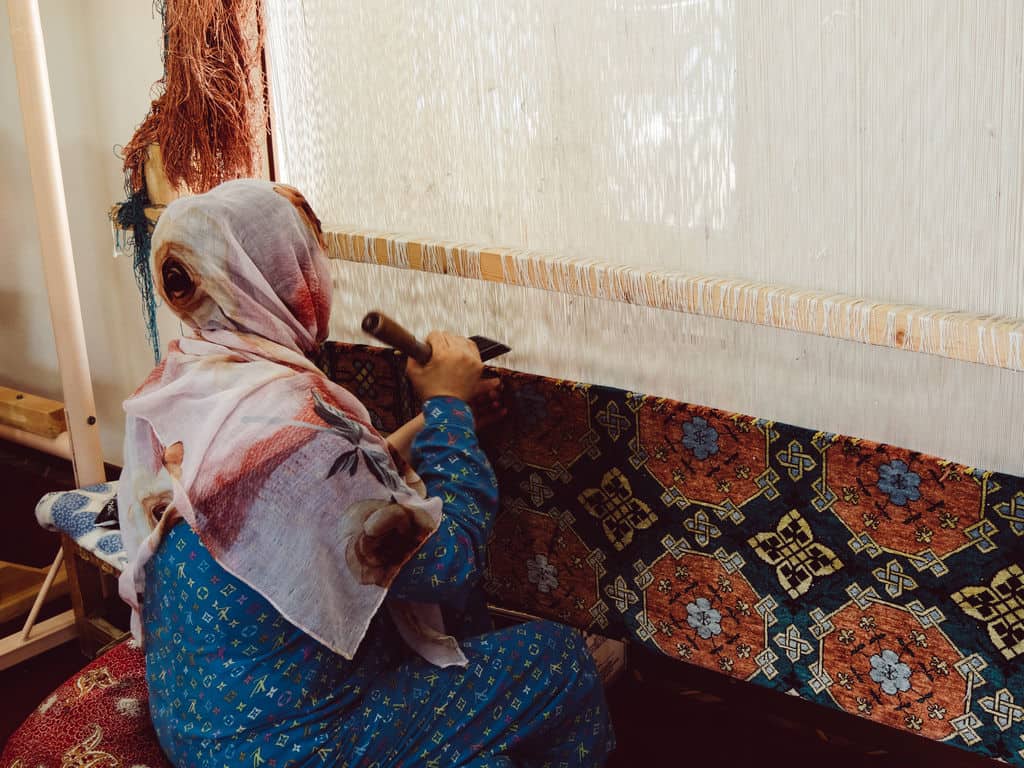
The Fergana Valley’s small village of Margilan is the place behind the country’s silk legacy. There are plenty of factories showing the process of spinning threads, but I’d really recommend Yodgorlik Silk Factory. You’re taught the entire manufacturing way – from how the silk is made, the traditional silk-weaving techniques, to the final product.

TIPS FOR VISITING YODGORLIK SILK FACTORY:
- While you’re in Margilan, l recommend meandering around the lively Kumtepa bazaar (only open Thursdays and Sundays). There is also the Said Akhmad-Khoja Madrasa and the Pir Siddiq Complex to check out.
ENTRANCE FEE TO YODGORLIK SILK FACTORY:
An entrance fee and a guided tour (included in the price) costs 30,000 USZ per person.
HOW TO GET TO YODGORLIK SILK FACTORY FROM TASHKENT:
To get to this mountain village, you’ll need to get to Fergana City first. You can take a direct train from Tashkent to Fergana City – take a look at train times and book tickets here.
The Silk Factory in Margilan is a 30-minute drive from Fergana City, so you’ll need to take a shared taxi for the final part of the journey.
You can visit the Silk Factory as part of a guided day trip from Tashkent to the Fergana Valley, which I would recommend if you’re on a tight schedule.
5. Chorsu Bazaar, Tashkent
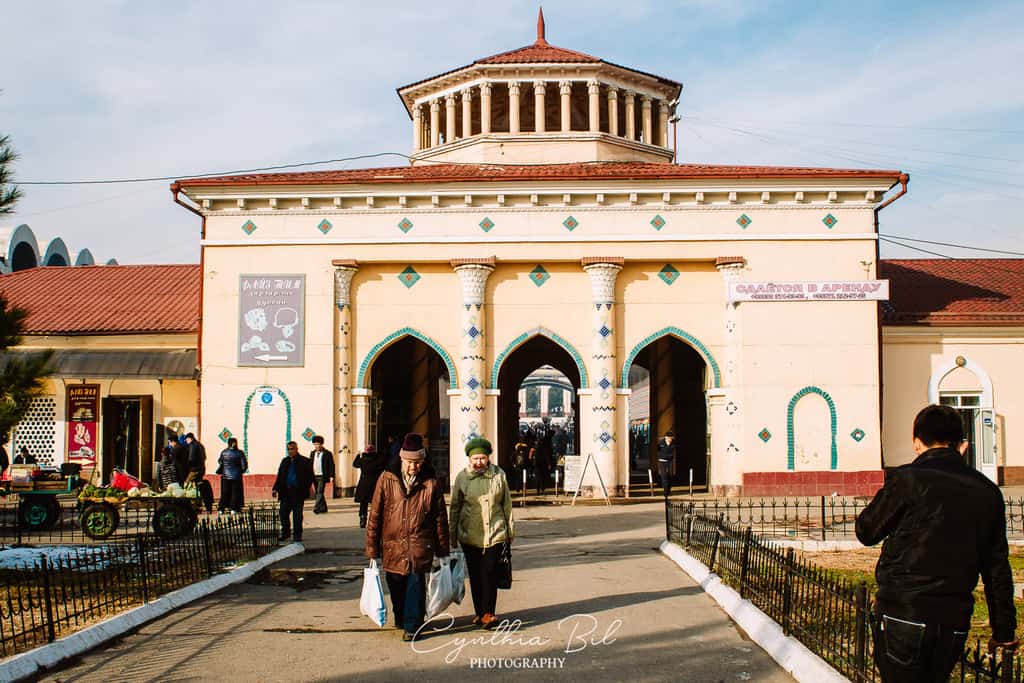
Got a spare few hours in Tashkent? I’d head down to the Chorsu Bazaar and meander in this market maze. It’s actually Uzbekistan’s largest bazaar! Spices, scarves, jewelry, trinkets, fruit and veg, beauty bits, meat, balloons, cakes… you name it, it’s here.
The main part of the market is shielded by a majestic azure-domed structure and the stalls continue to spread out to the surrounding streets and alleyways.
Pick up some street food, find a perch, and enjoy the sights and smells. It’s the perfect place to immerse yourself in Central Asian culture.

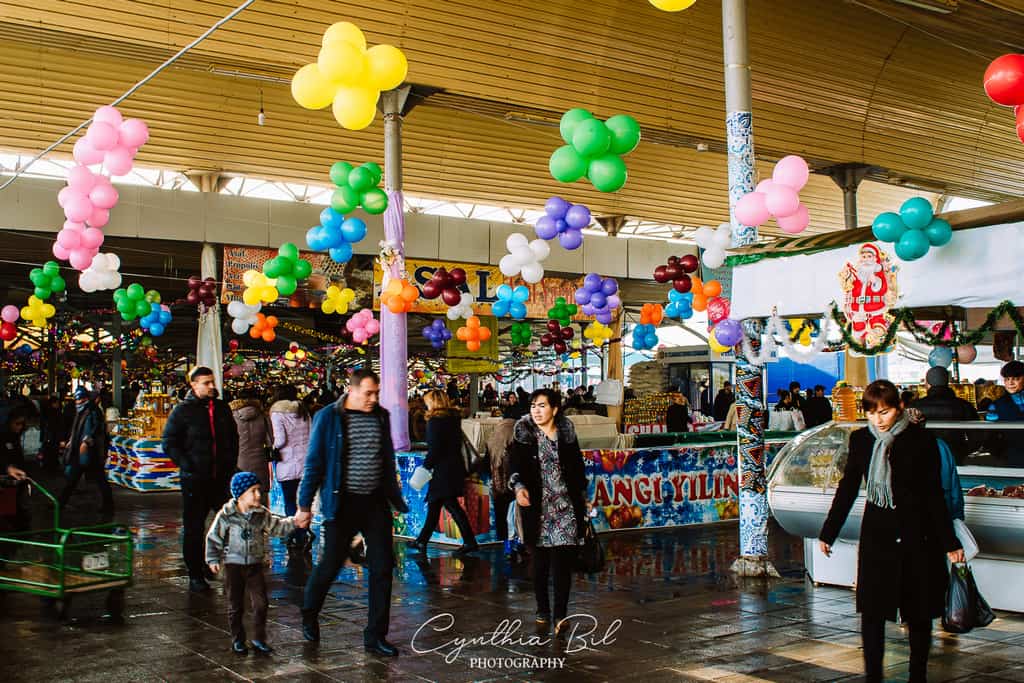
HOW TO GET TO THE CHORSU BAZAAR
Aside from walking, the easiest way to get to the bazaar is to use the metro and travel to Chorsu metro station. You’ll be in the thick of bakery sellers and Chinese trinket stalls when you reach the station. Look up that big blue dome I mentioned earlier… you won’t miss it!

6. The Registan, Samarkand
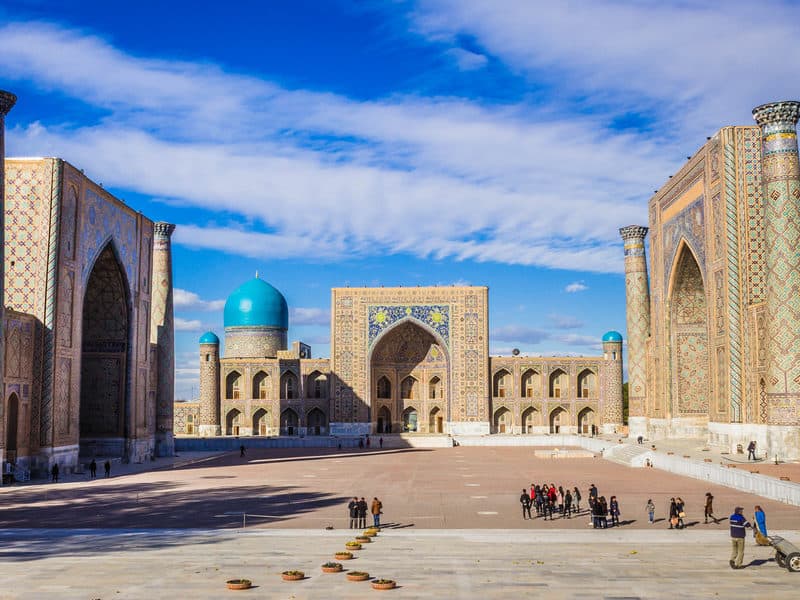
The Registan was once the beating heart of the Timurid dynasty and is THE most iconic sight of Samarkand, if not of Uzbekistan!
The public square was used for celebrations, market stall trading, royal proclamations and public executions (so behave). The space used to be laden with sand, hence why Resitan means ‘sandy place’ or ‘desert’ in Persian. Three magnificent madrasas frame the square, each famed for its educational function.
Once used as a lodging for students, the Tilya-Kori Madrasa (the middle building) is now home to souvenir shops for wandering tourists. It has a courtyard and mosque in the western section of the courtyard.
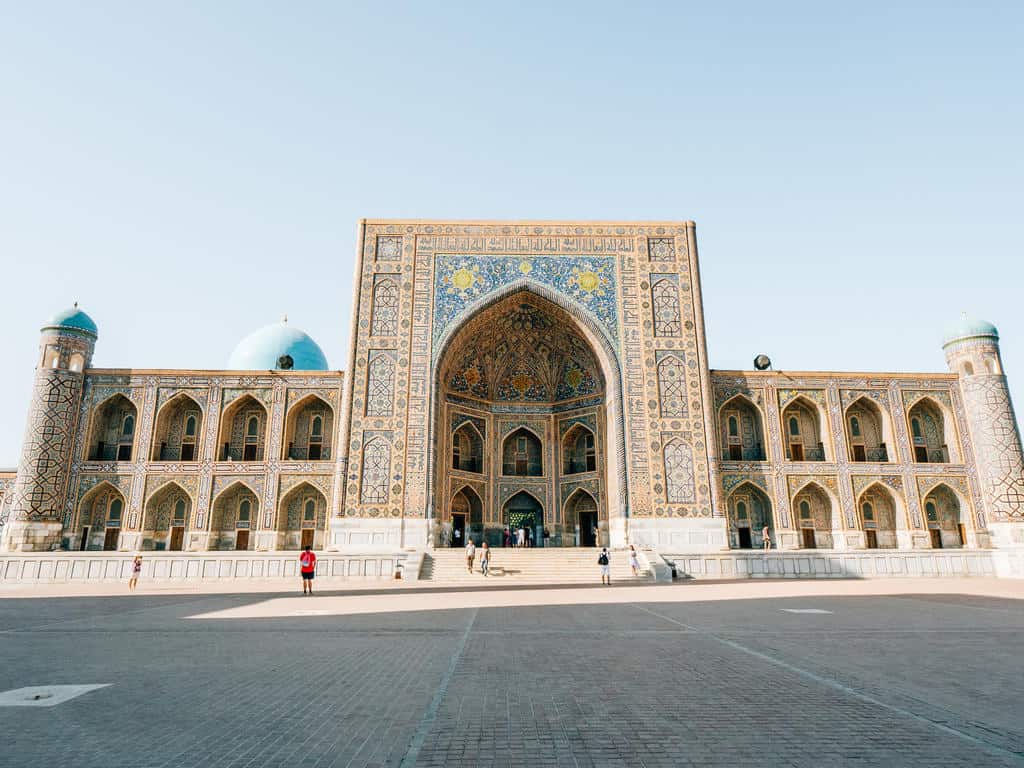
Tilya Kori translates to ‘gilded,’ and that’s exactly what you’ll be gifted with. The mosque’s interior walls glisten with gold and it’s pretty spectacular.
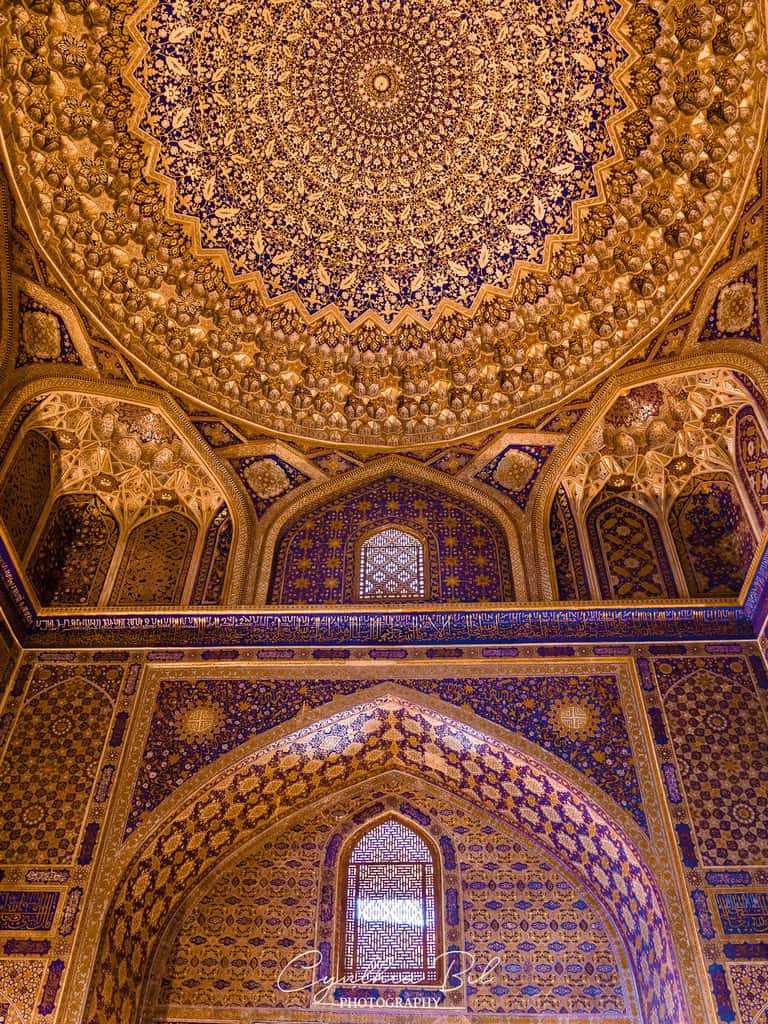

Facing the Tilya-Kori Madrasa, head left and you’ll see the oldest madrasa in Samarkand, the Ulugh Beg Madrasa!

I touched upon this bloke earlier, but to summarize, ruler Ulugh Beg was massively hot on astronomy, sciences and education. He was the driving force behind many of the ancient schools.
The Ulugh Beg Madrasa was one of the most admired universities of the Muslim Orient and Ulugh Beg himself would lecture there.
The final madrasa is called the Sher-Dor Madrasa.

Sher translates to tiger and the building’s name derives from some of the paintings at the entrance: two huge tigers carrying a sun on their backs. Painting living beings on religious buildings is strictly forbidden in Islam, so it’s interesting how this has come about.
TIPS FOR VISITING THE REGISTAN:
- I’d really recommend getting to the Registan either at sunrise or sunset. You can skip all the tourist queues (people start flocking to the site from 10:00-11:00) and you’ll have space to wander around and take pictures. At dawn, the sun’s rays shower over the complex, and it’s so stunning.
- If you decide to head down to the Registan at night, the lights come on after sunset and illuminate all three of the stunning buildings.
- During the tourist season from late spring to early autumn, there’s different events that happen in the evening. At 19:00, you can watch a traditional dance and music performance inside the Sher-Dor Madrasa, the right building framing Registan.
- You don’t need more than two hours to visit the whole complex.
- Probably stating the obvious, but this is a religious place so keep your boobs, shoulders and legs covered, even if it’s soaring hot.
- While it’s not advertised, you can climb the Ulug Bek Madrasa’s 40-meter-tall minaret. Head over to the madrasa, ask for the guard and tell him you would like to climb it. I paid him 80,000 UZS and the guard led me halfway up the staircases. It’s a steep and narrow climb so I wouldn’t recommend it if you get claustrophobic. It’s not one for disco-legs vertigo people and requires a good fitness level to climb it. Once you reach the top of the suitcase, pop your head out through the top of the minaret. The view is amazing!
- The Registan contains so much history that I would recommend visiting it at least once with an English-speaking guide. You can find guided city tours in Samarkand at the Samarkand Tourist Office or you can book a tour online. Here’s one that I would recommend:

ENTRANCE FEE FOR THE REGISTAN:
It costs 50,000 UZS for access to all of the Registan complex. Note: this is a one-entry ticket. Once you leave the complex, you have to pay again to re-enter.
OPENING HOURS OF THE REGISTAN:
The Registan is open daily from April to October from 8.00 am until 7.00 pm and from November to March from 9.00 am until 5.00 pm.
If you enter the Registan 15 minutes before closing time, they will allow you to stay for at least one hour longer. If you’re into photography, this is the moment to take beautiful captures of the lights illuminating the madrasas.
HOW TO GET TO THE REGISTAN FROM TASHKENT:
Hopping on a train is the easiest and fastest way to reach Samarkand from Tashkent. The Afrosiyob is a high-speed service which takes around two hours, running daily in the morning and in the evening.
There’s also the Sharq service which is so much cheaper and takes just a little over three hours. This one runs daily in the morning.
Read my Uzbekistan Railways Guide if you’re looking for all the details on how to get about by trains, and then book using the official Uzbek Railways website. Most importantly… don’t forget your passport!
Once you reach Samarkand station, the Registan is a 10-minute drive away. The #3 and #75 run from the station to near the Siyob Bazaar. Another option is taking a taxi for about 20,000 UZS. Install the Yandex Taxi app on your phone for a stress-free cab fix. The app is simple to use, and saves you hustling for a good price because it shows you the rate before booking.
7. Urungach Lake, Chimgan National Park

This one is for swimmers and nature lovers. Urungach Lake’s teal-tinted waters are known to Uzbek people as the Jade Lakes. It’s such a serene place to explore and is a real gem of Uzbekistan.
You can hike here through the mountain meadows or get cracking up on a nearby peak. The lake is located nestled way up high in the park, close to the Kazakhstan border. This also means it’s free from tourist infrastructure, which you won’t find further south near Beldersay Ski Resort.
TIPS FOR VISITING URUNGACH LAKE
- Due to its close location to the Kazakhstan border, you’ll need to sort a permit from the local tourism office or a tourist agency. It won’t cost loads, but you will need to organize this in advance of your trip.
- You’ll probably want to spend more than a few days exploring this part of the park because a) it will take you some time to get there b) it’s so beautiful and you won’t want to leave! I’d really recommend trying to either camp or stay in mountain huts. Both can be organized with local mountain guides.
HOW TO GET TO URUNGACH LAKE FROM TASHKENT
GPS waypoint: 41.923405, 70.308434
Unlike the Chimgan mountain range which is just 80km from Tashkent, the Urungach lake is 150km and it’s around a five-hour drive from the capital.
Most of the journey is on a dirt track, so you’ll need a 4×4 driver. Unless you’re doing a several days’ hike from Chimgan, you’ll need to organize a driver to get way into the mountains.
I can put you in touch with guides there or connect you with a community-based tourism group that works with clients with requests like these. Please drop me a message with any questions!
8. Necropolis of Mizdakhan, Karakalpakstan

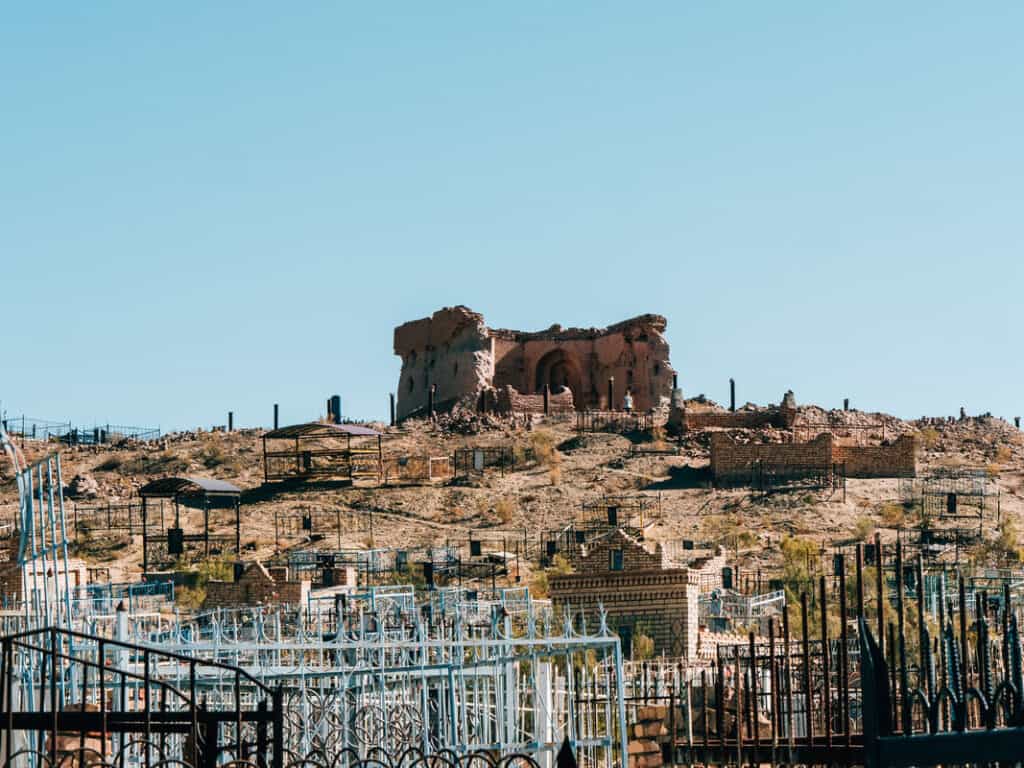
Uzbek people consider the Mizdakhan Necropolis to be one of the most sacred sites in Central Asia and the cemetery attracts pilgrims from all over the world..
The complex is a myriad of mausoleum ruins, burial grounds and citadel walls. The foundations date back as early as the 4th century B.C. so it’s very humbling to walk in the footsteps of thousands of others, from thousands of years ago.
The ancient grounds lie in the hills about 20km from Nukus in Karakalpakstan. Karakalpakstan is a self-governing province, which means it can politically ‘break away’ from Uzbekistan. Nukus is its capital.
Legend has it that there is an ‘apocalypse clock’ built on a wall that counts down to the end of the world. Every year, a brick crumbles from the wall and when the last brick falls, the Earth will combust. People who make their pilgrimages here, find the spot and carefully place stones and make their prayers.

TIPS FOR VISITING THE NECROPOLIS OF MIZDAKHAN
- The necropolis is free to visit.
- If you’re planning on making the journey to see Mizdakhan, there are also plenty of other fascinating fortresses to check out in the area. The Gyaur Kala is tucked right next door and there’s loads to learn about its pivotal links to the Silk Road history.
- Just like any holy site in Central Asia, you must cover up your chest, shoulders, knees etc. You’ll actually want to cover up for other reasons too – it’s very dusty and has desert-like temperatures here, which brings me to my next tip…
- Try to plan your day visiting these sites either at sunrise or sunset. Not only is the sky super beautiful, but you’ll avoid the soaring rays. There is NO shade here!
HOW TO GET TO THE NECROPOLIS OF MIZDAKHAN FROM TASHKENT
To get to the necropolis, you’ll need to travel to Nukus first. There are no public transport services running directly to the site, however, it’s a 30-minute drive from Nukus so grabbing a shared taxi from the central shopping complex is your best shot.
BY PLANE
If you’re short on time, you can book a domestic flight between Tashkent and Nukus. It takes 1 hour and 40 minutes.
You can easily book your tickets on the website of Uzbekistan Airways. It should cost around 60 USD if you book well in advance.
BY TRAIN
Taking a night train is cheaper on the pursestrings and is a cool way to chat with Uzbek people and see landscapes. You can book a 2-person private sleeper (Lux / CB), a 4-person private sleeper (Kupe), or a shared sleeper (Platzkartny).
Trains run from Tashkent to Nukus six days a week (not on Mondays). They leave at 14:00 and arrive early in the morning. Click here for timetable details.
9. Juma Mosque, Kokand

Kokand hugs the south-western part of the Fergana Valley, which is home to some of Uzbekistan’s finest artisans.
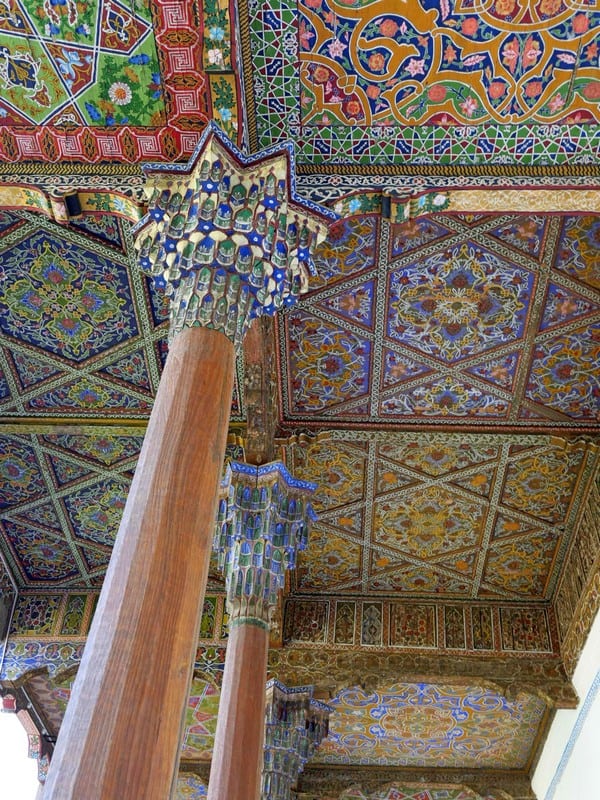
The Juma Mosque was founded by Umar Khan in 1812 on top of a similar structure, in exactly the same place in Kokand’s Chorsu square. The previous building has been referenced in history since the 9th century.
The site was (and still is!) famed for its beauty. Each architectural detail is intricately decorated and has been cared for for hundreds of years.
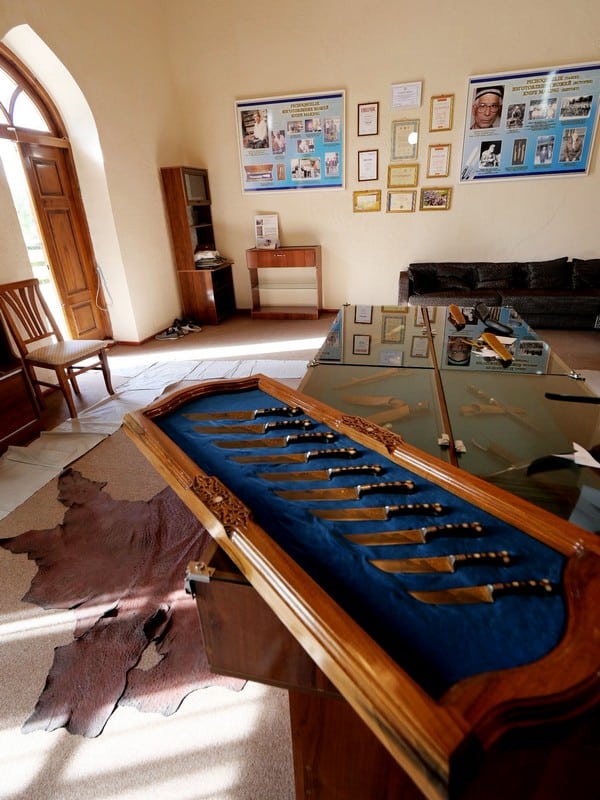
Inside the complex, there are a variety of workshops led by local artisans working with ceramics, silks, knives and wood. Each master is so proud with their practice and will stop to demonstrate their work.
What I adored about this place was that it combined Kokand’s history with its modern-day culture. I was taught so much here!
TIPS FOR VISITING THE JUMI MOSQUE:
- I’d spend at least 1.5 hours walking and chatting to the artisans.
- If you have a beasty camera, you may be charged a little more for entry.
ENTRANCE FEE FOR THE JUMA MOSQUE:
It should cost 25,000 UZS per person for entrance to both the mosque and the workshops.
HOW TO GET TO THE JUMA MOSQUE FROM TASHKENT:
Trains run daily from Tashkent to Kokand – services take around 4 hours. You can research times and book here.
From Kokand rail station, it’s a 30-minute walk to the mosque. You could also hop in a shared taxi.
10. Kosmonavtlar Metro Station, Tashkent

Until I visited the stations of Tashkent, I was tainted by grim memories of London, New York and Paris, where rats the size of chihuahuas roam the tracks. So when I say visit a metro station, I know it won’t immediately beckon you in.
However the metro stations in Tashkent are truly spectacular. You enter a basement ballroom with the shunting of trains ricocheting off the marble floors.
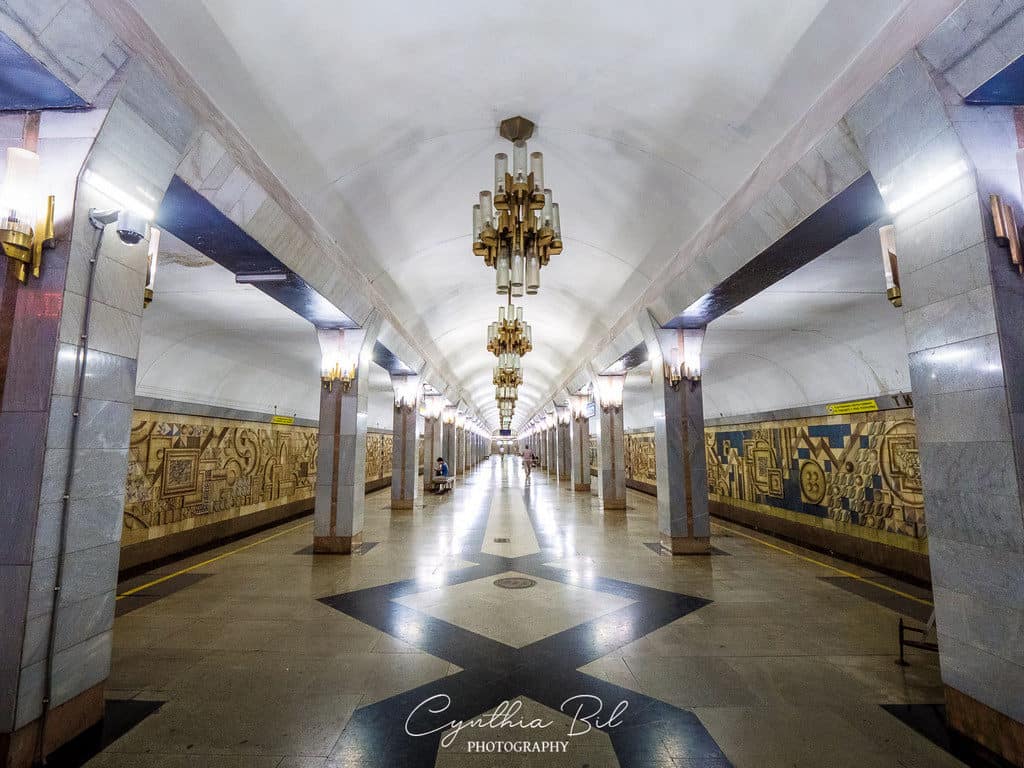
Each station portrays a story from Uzbekistan’s history, so you won’t be bored waiting for your train. I reckon Tashkent has the most breath-taking metro stations in the world (for anyone interested, I’ve written up a full guide of my favorite spots here).
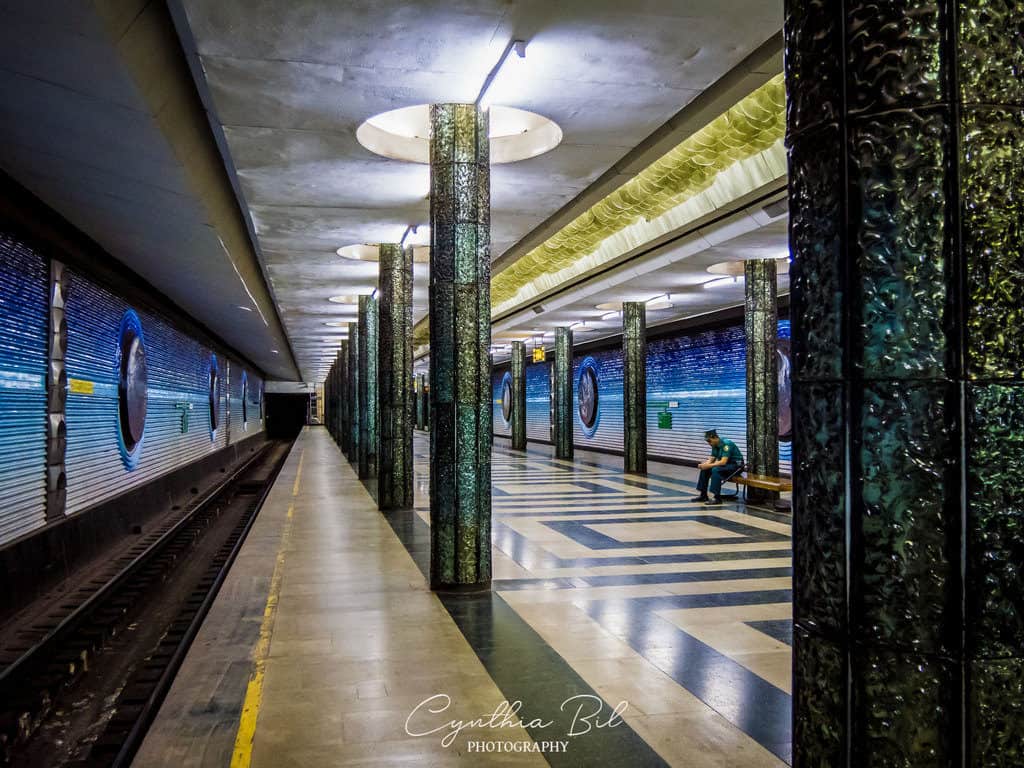
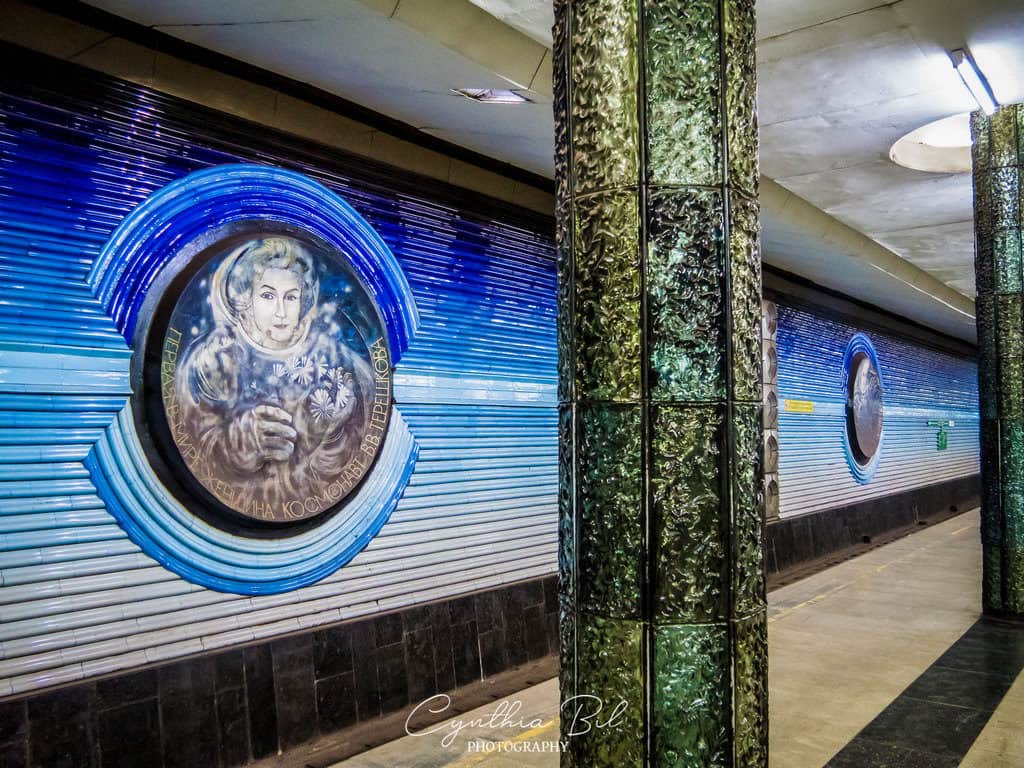
The ultimate station to blow your socks off is the Kosmonavtlar metro station. The whole place is kitted out in a space-theme, which was dedicated to the cosmonauts of the Soviet Union.
Opened in 1984, the ceiling reflects the Milky Way’s design while the walls fade from blue to black to imitate the Earth’s atmosphere. Gold plaques proudly show pioneers from the Soviet space programme, including the first woman sent into space, Valentina Tereshkova.
TIPS FOR VISITING KOSMONAVTLAR METRO STATION:
- Head to the station outside of rush hour – I’d recommend getting there early in the morning.
- In 2022, I visited every single metro station in Tashkent. If you have around five hours to kill, I really recommend you do the same! Each has its unique characteristic and story to tell. It reminded me of being in an immersive art exhibition.
HOW TO GET TO KOSMONAVTLAR METRO STATION:
Kosmonavtlar is pretty bang in the city center so you could walk to it depending on your location. Or, hop on your local metro train and get the full experience 😉

11. Tash Khauli Palace, Khiva
If you’re seeking out the most beautiful Silk Road spots, Khiva should definitely be on your list.
It’s baffling that with Uzbekistan’s turbulent history with invasions that many of its holy buildings have stood strong. Particularly with Khiva, you really feel like you’re stepping back in time to hundreds of years ago. Khiva’s crenulated city walls were its first line of defense and they now are a huge part of its characteristics.
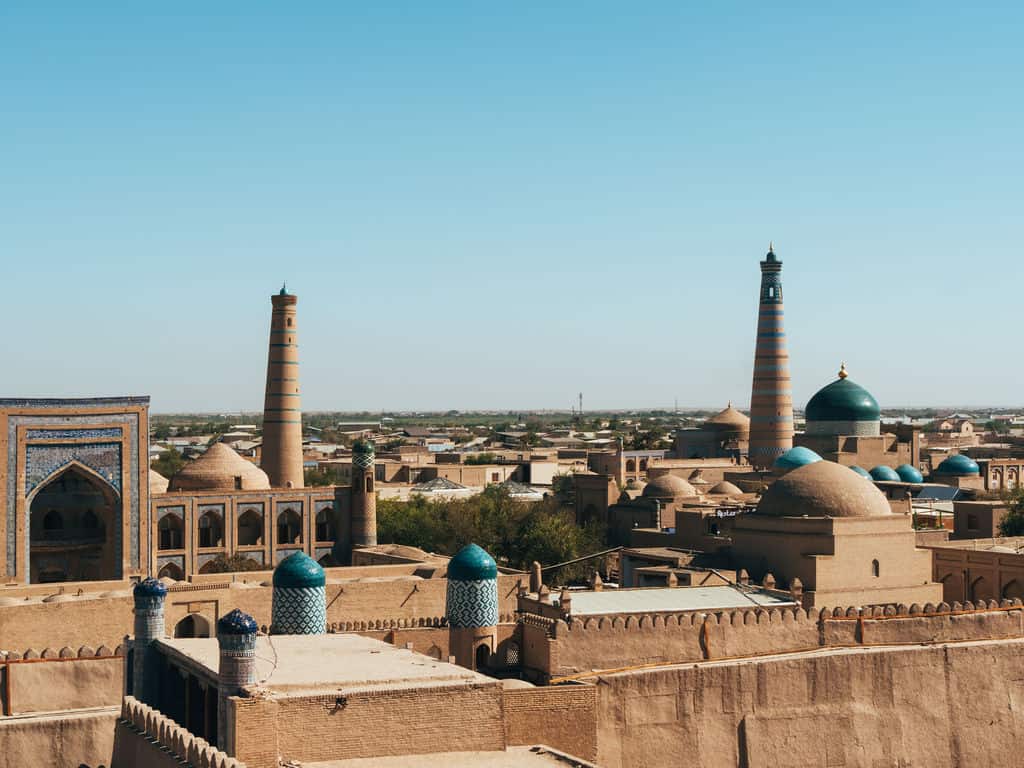
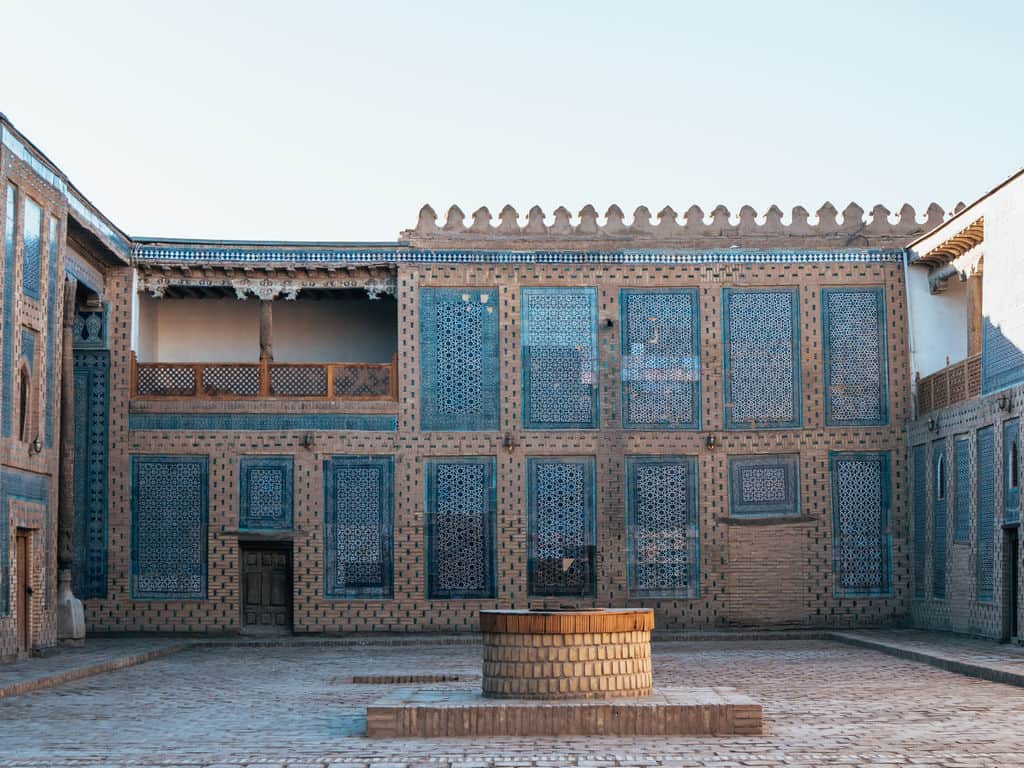
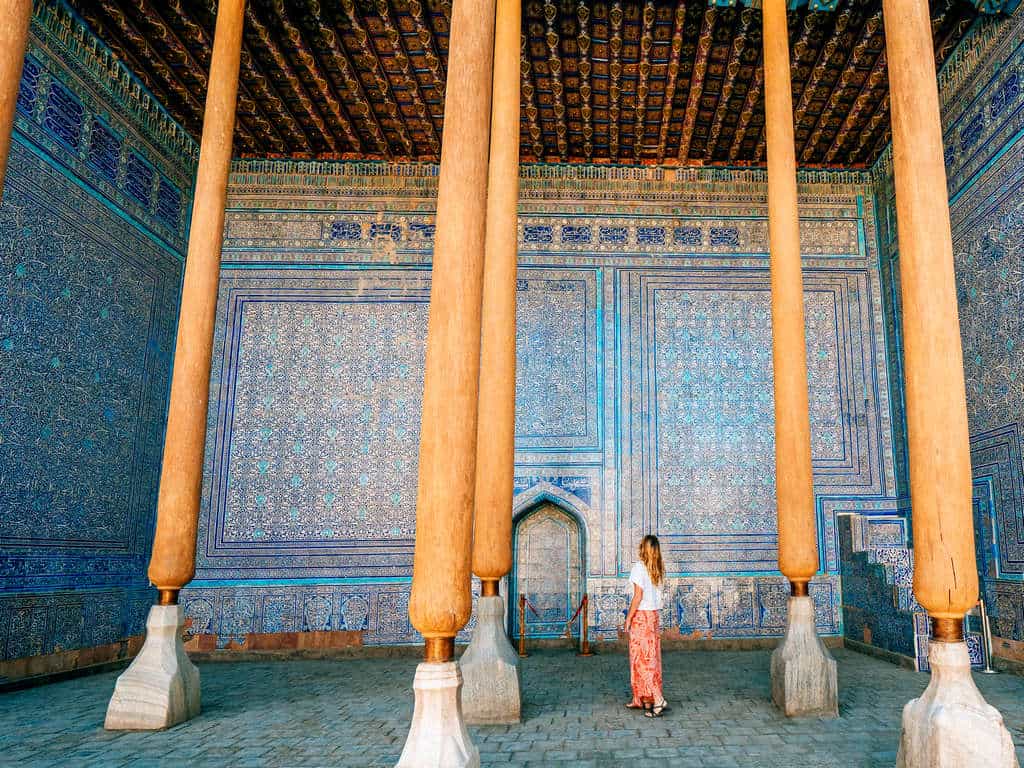
True to Uzbek aesthetics, each detail of the Tash Khauli Palace has been meticulously thought about. Translated as ‘Stone House’, the complex was once the summer home of the Khan in Khiva.
I spent ages gazing at the dazzling tiles and delicately carved furniture. There are hundreds of rooms and nine courtyards which you can totally just get lost in. I can hear you wondering what the Khan got up to…
I think the most intriguing section is the Harem. It’s said the Khan had five wives… and 41 concubines. That’s a flipping eye-watering amount of women living with him. He must have been skipping every day… The concubines shared the rooms on the right side of the palace, with his wives living to the left.
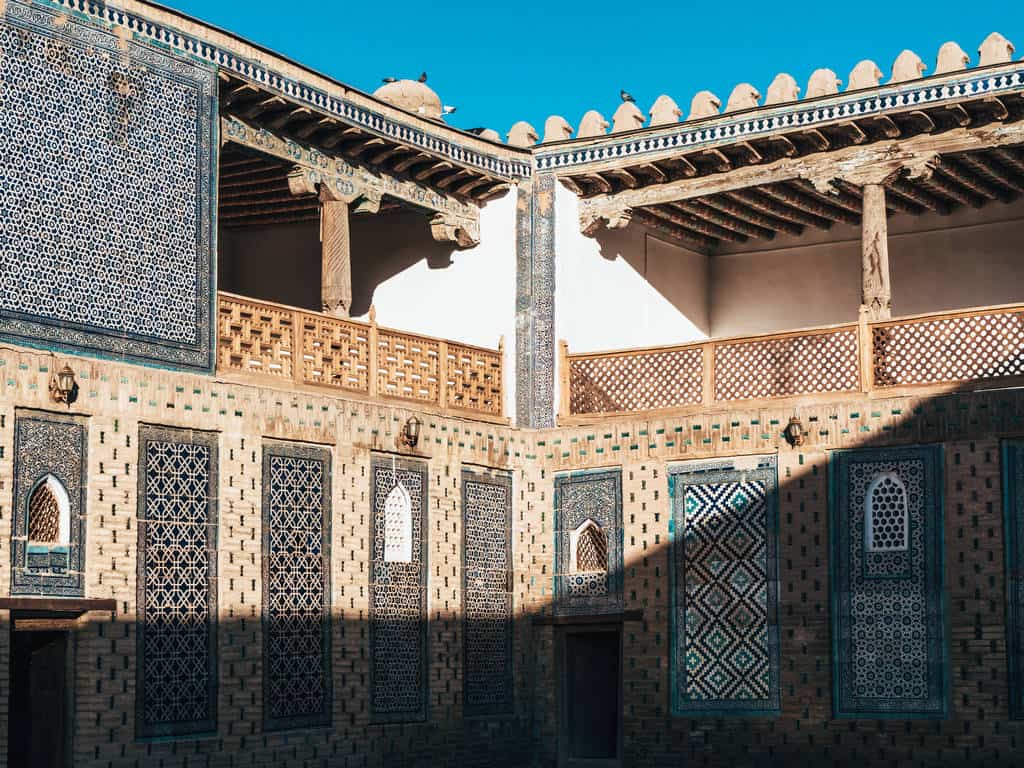
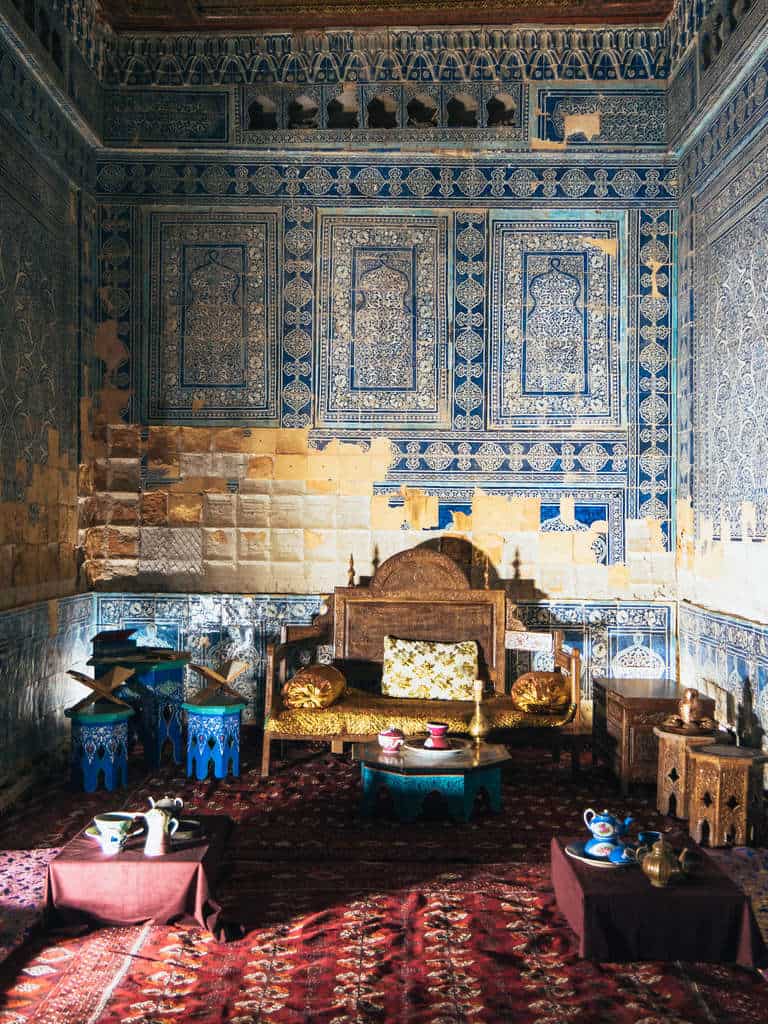
TIPS FOR VISITING TASH KHAULI PALACE:
- This place is truly a maze – go get lost in it and leave a few hours for your visit.
- The palace opens from 09:00 to 18:00, I’d recommend you get yourself there for 09:00 before all the tourists arrive.
- I’ll explain below, but Khiva is a bit of a schlep to get to (you definitely cannot get there and back in one day)! So I’d recommend planning an adventure in Khiva and properly having some time to explore! I’ve written a comprehensive travel guide for Khiva here.
- As the palace contains so many stories, I’d recommend visiting it with a guide. You can join a 4-hour guided walking tour in Khiva, visit all its highlights (including this place) and learn all about the city’s history. You can then always return to the palace at your own pace (Khiva is very small). I recommend this guided walking tour in Khiva:
ENTRANCE FEE FOR TASH KHAULI PALACE:
The entrance fee to the Tash Khauli Palace is included in the standard Itchan Kala ticket which you buy for all the attractions in Khiva.
The standard ticket price is 150,000 UZS which includes all museums.
HOW TO GET TO TASH KHAULI PALACE FROM TASHKENT:
You can book yourself onto a night train (roughly a 14-hour ride) from Tashkent to Khiva. Read my Uzbekistan Railways Guide if you’re looking for all the details on how to get about by trains, and then book using the official Uzbek Railways website.
From Khiva rail station, it’s an 8-minute taxi ride or a 30-minute walk to the palace.
12. Chor Chinor Garden, Urgut
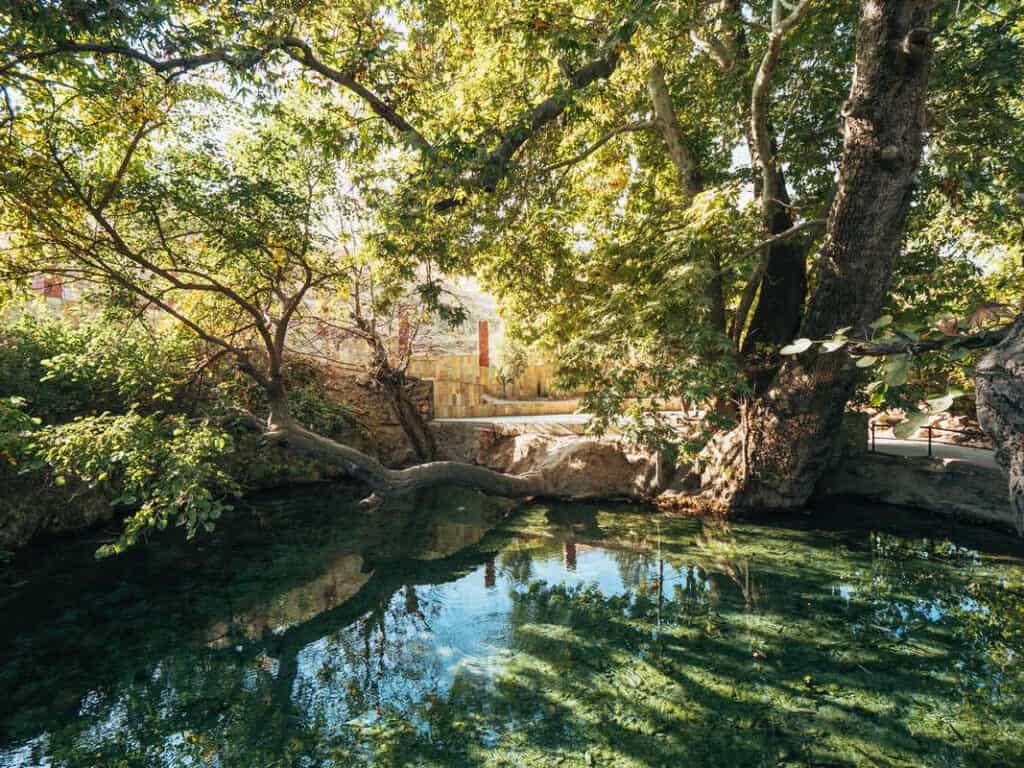
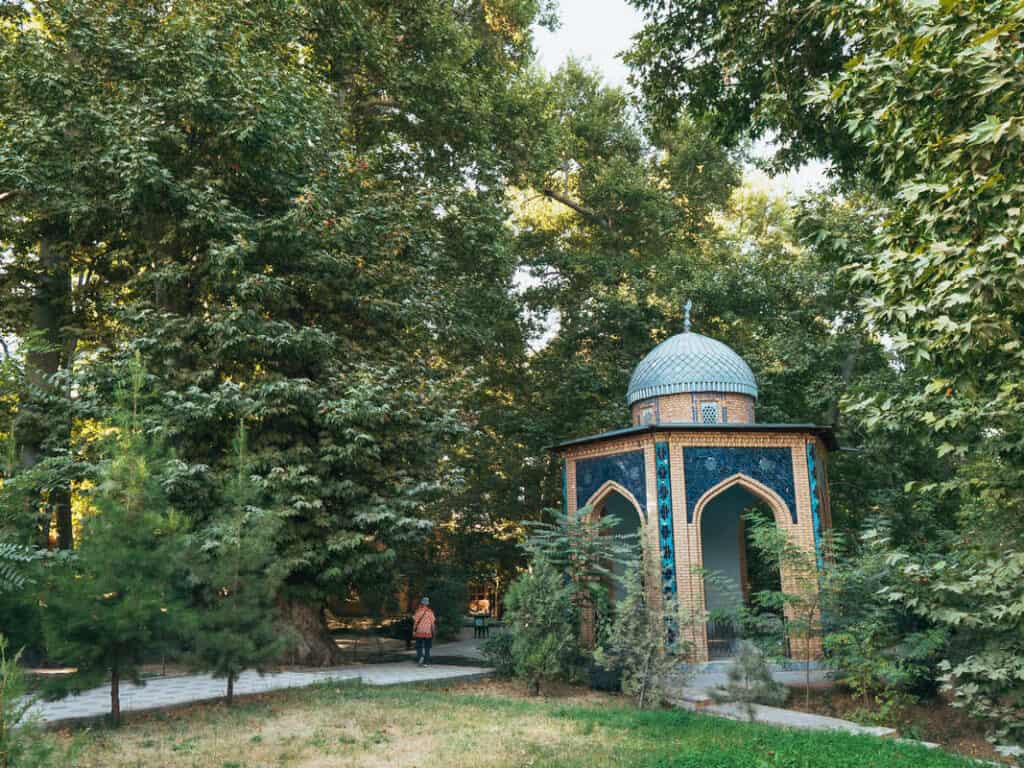
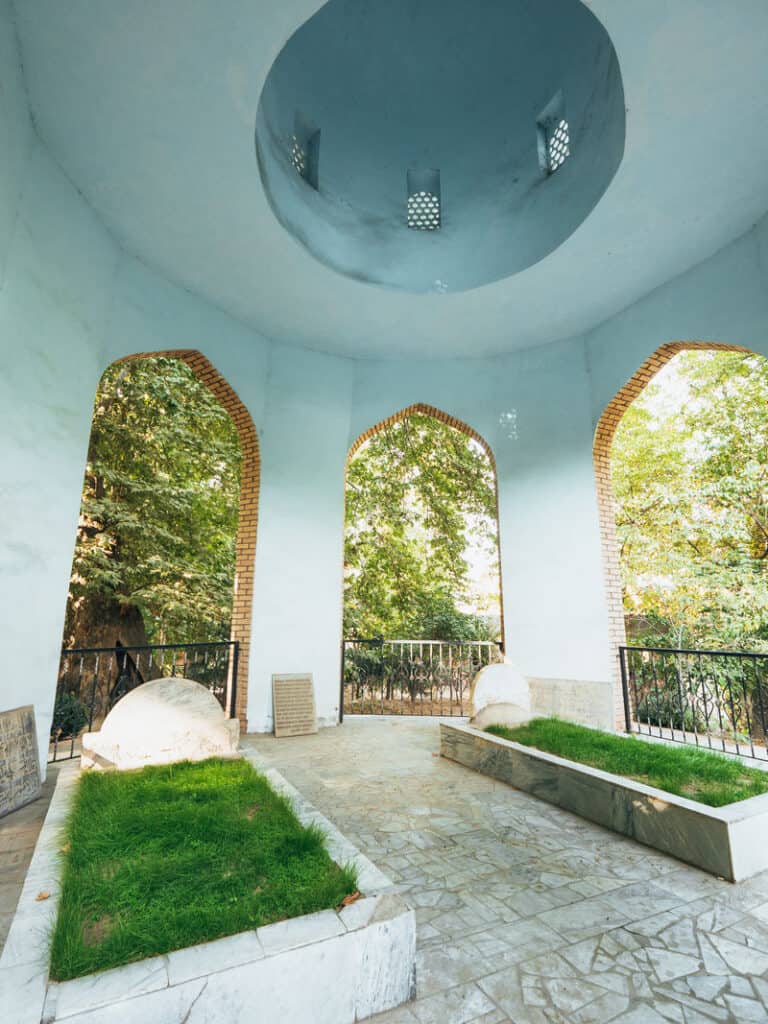
The Chor Chinor Garden will hit the spot if you’re seeking some solitude and time for reflection. Its name translates as ‘four sycamore trees’, because it’s home to species of trees that are more than 1,000 years old. Some of the older trunks measure a hunky 10-metres in circumference!
The largest tree stands at 35-meters and has a tiny shelter encased in its roots which was once used for prayer. It’s said that the garden was used for holy worship and forms of schooling.
It’s very humbling to be in the presence of organisms which have lived for so long and I adored this place for its peaceful energy.
Urgut is about 40km south-east from Samarkand, which makes the garden a great getaway from the bustling tourist spots. It’s also pretty close to the border of Tajikistan so you will likely see a mix of cultures in the valley.
TIPS FOR VISITING CHOR CHINOR GARDEN:
- I touch on this below, but the garden is 3km from Urgut and Urgut is 40km from Samarkand. You’ll have to stop in Samarkand, so I’d recommend checking out this ancient city as part of your trip. Read my guide here for things to do.
ENTRANCE FEE FOR CHOR CHINOR GARDEN:
It costs 25,000 UZS per person.
HOW TO GET TO CHOR CHINOR GARDEN FROM TASHKENT:
To get to the garden, you’ll need to stop in Samarkand. Samarkand is super simple to get to from Tashkent because there are trains that run daily. Hop on the high-speed Afrosiyob and it will take just over 2 hours.
Read my Uzbekistan Railways Guide if you’re looking for all the details on how to get about by trains, and then book using the official Uzbek Railways website. Most importantly… don’t forget your passport!
From Samarkand, you can either take a shared taxi or a bus. The C001 Shaharlararo Avtobus runs from Samarkand to Urgut. You can hop on at the Samarkand Rowing Complex.
Buses often are the cheaper solution, but it will cost you more of your travel time. You’ll also have to walk the 3km to the garden from the Urgut bus stop (which is a sweet way to explore the area).
13. Ak-Saray Palace, Shahrisabz
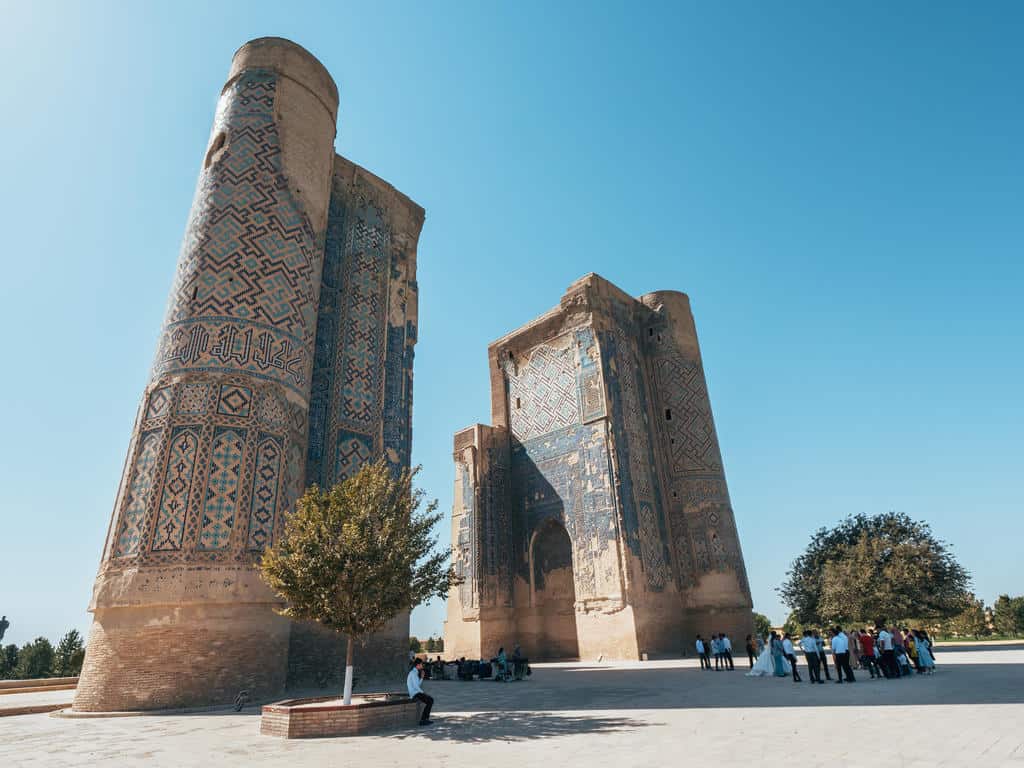
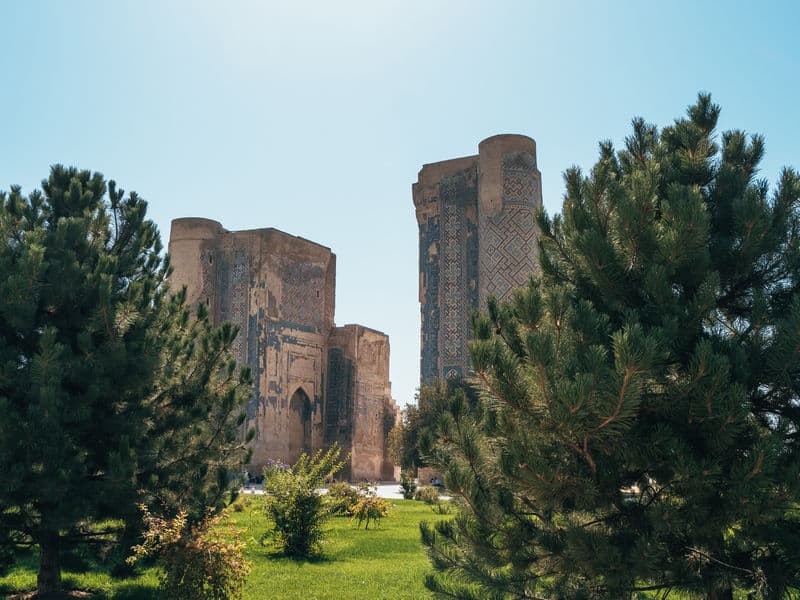
The Ak-Saray Palace in Shahrisabz is a staggering place. Ruler Amir Timur ordered the complex to be built immediately after he won a battle in 1380. The builders back then really knew a thing or two considering how flipping old it is… but that’s probably because their lives depended on it.
The 50,000 people involved in the construction weren’t considered builders by Timur, they were all slaves. There’s a lot to say about Timur, but he’s regarded as one of the country’s national heroes. Timur’s legacy is echoed in Uzbekistan’s ancient cities and you can identify this with the architecture that was built during his ruling.
Ak-Saray translates to ‘white, light, magnificent’ and it looks like it would be some sort of heaven for Temur. The irony is that he actually died months after the construction was finished in 1404.
Walking on slabs of marble in the shadows of the complex, you really get a feel for how luxurious this place once was. Records suggest that some of the towers reached around 80-meters high. All that remains now is parts of the entrance portal, which has delicate remains of its previous dazzling designs.
TIPS FOR VISITING AK-SARAY PALACE:
- To enter the ancient city of Shahrisabz, you’ll need to pay a small fee which gives you access to the site so I’d make it into a full day of exploring! I’ve put together a full guide for Shahrisabz here.
- The way I visited this beautiful site was by booking a guided day tour to Shahrisabz from Samarkand so that could be an option if you wanted to combine both areas.
ENTRANCE FEE FOR AK-SARAY PALACE:
The entrance to the city of Shahrisabz is 30.000 UZS per person and this ticket allows you to visit the Ak-Saray Palace.
Entrance fees for the Dorut Tilovat Complex or the Dorus Siyadat Complex each cost 30,000 UZS per person.
HOW TO GET TO AK-SARAY PALACE FROM TASHKENT:
If you wish to get straight from Tashkent to Shahrisabz, you’ll need to book to Kitob station, which is in Shahrisabz. There is a weekly train which takes around 4 hours 30 minutes. From there, hop in a shared taxi to the palace. It’s a 15-minute journey.
*Update: As of March 27th, 2026, the Afrosiyob high-speed train runs 3 times a week (Friday, Saturday and Sunday) between Tashkent and Shahrisabz.
Alternatively, you could plan to get to Samarkand, stop there and hang out, and arrange a driver to take you from there.
Samarkand is super simple to get to from Tashkent because there are trains that run daily. Hop on the high-speed Afrosiyob and it will take just over 2 hours.
Read my Uzbekistan Railways Guide if you’re looking for all the details on how to get about by trains, and then book using the official Uzbek Railways website. Most importantly… don’t forget your passport!
14. Juma Mosque, Khiva
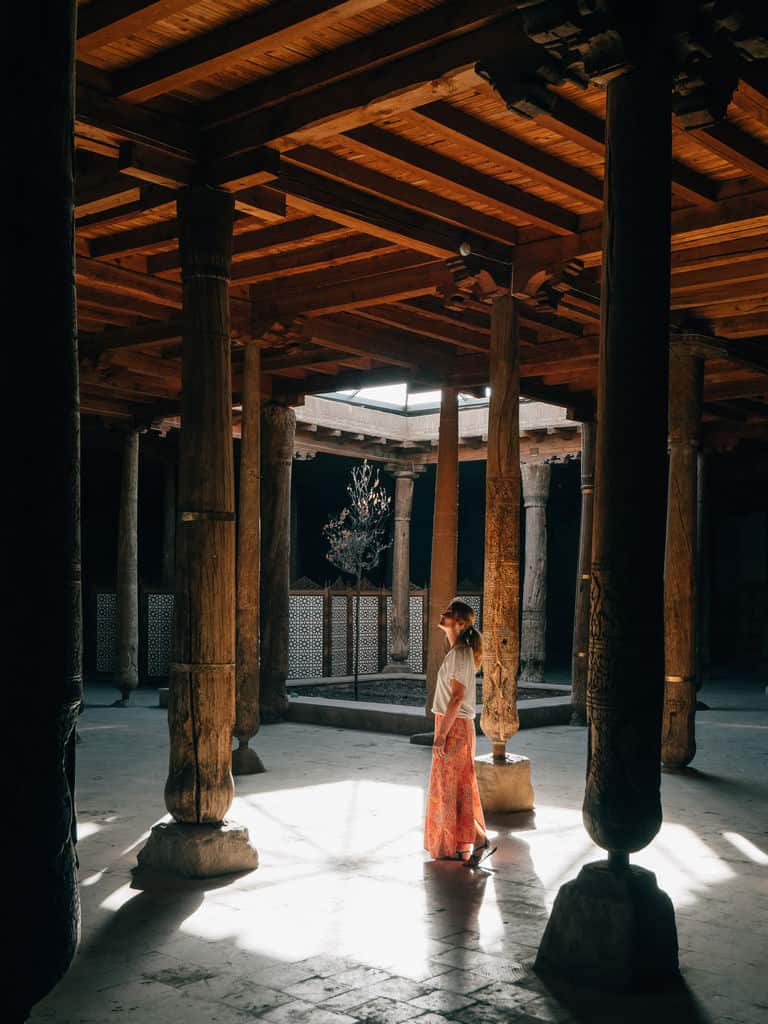
After seeking out spots in many Muslim countries, I’ve seen hundreds of historical mosques but none were as unique as this place.
The Juma Mosque is known as the ‘Friday’ mosque because of prayer and you can definitely feel its peaceful atmosphere. It was built at the end of the 18th century on top of previous religious ruins.
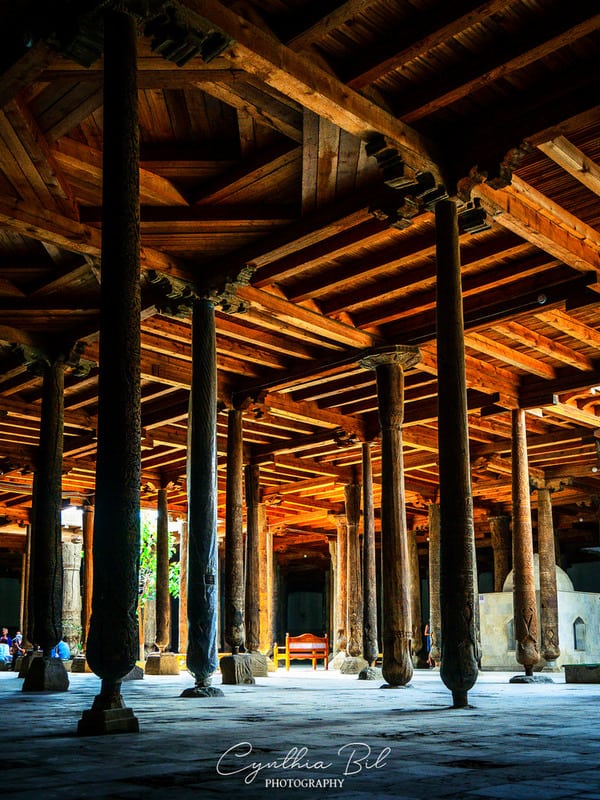
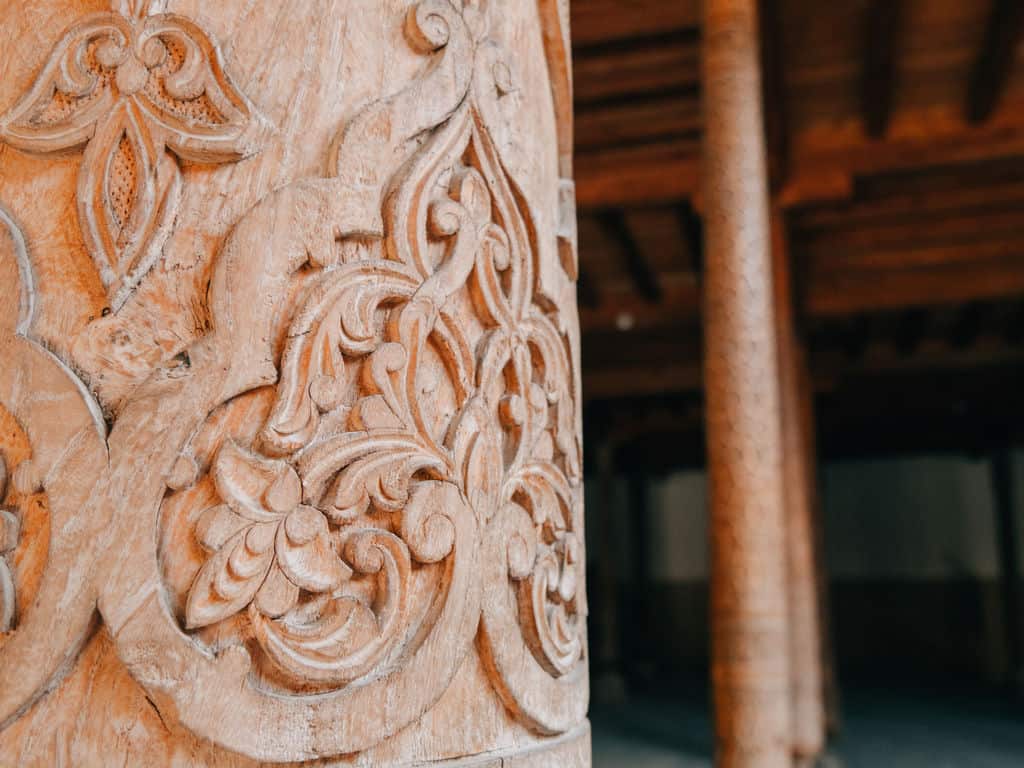
Visually, you must check out the prayer hall which has around 218 wooden columns, each delicately carved. Reports suggest that the wood was either taken from local trees or collected from destroyed medieval buildings.
Its design is said to be based on ancient Arabian mosques. In the soaring heat of summer, the space keeps cool and traps a golden light from the center of the ceiling.
The hall could once host up to 500 worshippers so there’s a lot to explore. While meandering between the columns, I felt like I was in some sort of spiritual forest.
TIPS FOR VISITING THE JUMA MOSQUE:
- Although the mosque is inactive, the same rules apply for covering up. Make sure you dress respectfully!
- I’ll explain below, but Khiva is a bit of a schlep to get to (you definitely cannot get there and back in one day)! So I’d recommend planning an adventure in Khiva and properly having some time to explore! I’ve written a comprehensive travel guide for Khiva here.
- The mosque is actually next to the Tash Khauli Palace (which I’ve covered above in number 11) so definitely make time for seeing these both.
ENTRANCE FEE FOR THE JUMA MOSQUE:
The entrance fee to the Tash Khauli Palace is included in the standard Itchen Kala ticket which you buy for all the attractions in Khiva.
The standard ticket price is 100,000 UZS which includes all museums. If you wanted to get up the watchtower and the minaret too, I’d just buy a VIP ticket at the price of 150,000 UZS.
HOW TO GET TO THE JUMA MOSQUE FROM TASHKENT:
BY TRAIN
You can book yourself onto a night train (roughly a 14-hour ride) from Tashkent to Khiva. Read my Uzbekistan Railways Guide if you’re looking for all the details on how to get about by trains, and then book using the official Uzbek Railways website.
From Khiva rail station, it’s an 8-minute taxi ride or a 30-minute walk to the mosque.
BY PLANE
If you’re short on how much time you have to spare, domestic flights run between Tashkent and Nukus. They take around 1 hour and 40 minutes.
If you book your tickets in advance on the Uzbekistan Airways website, it should cost around 60 USD. From the airport, you can hop in a shared taxi to Khiva and follow the directions to get to the mosque.
15. Chilpik Kala, Karakalpakstan
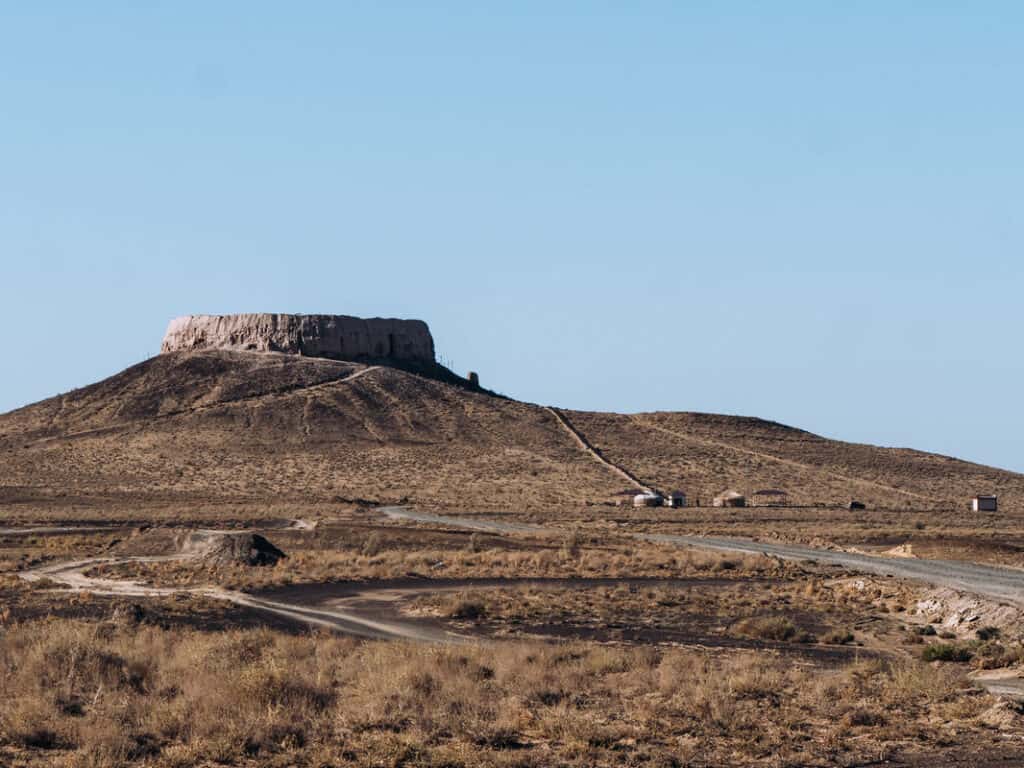
The region of Karakalpakstan used to be a bustling hub for ancient Central Asia, which became the barren sands of the Kyzyl-Kum desert.
More than 50 fortresses protected the area, which was known as Khorezm. In recent years, archeological digs identified castle ruins, dwellings and royal palaces which unlocked how its people habited here.
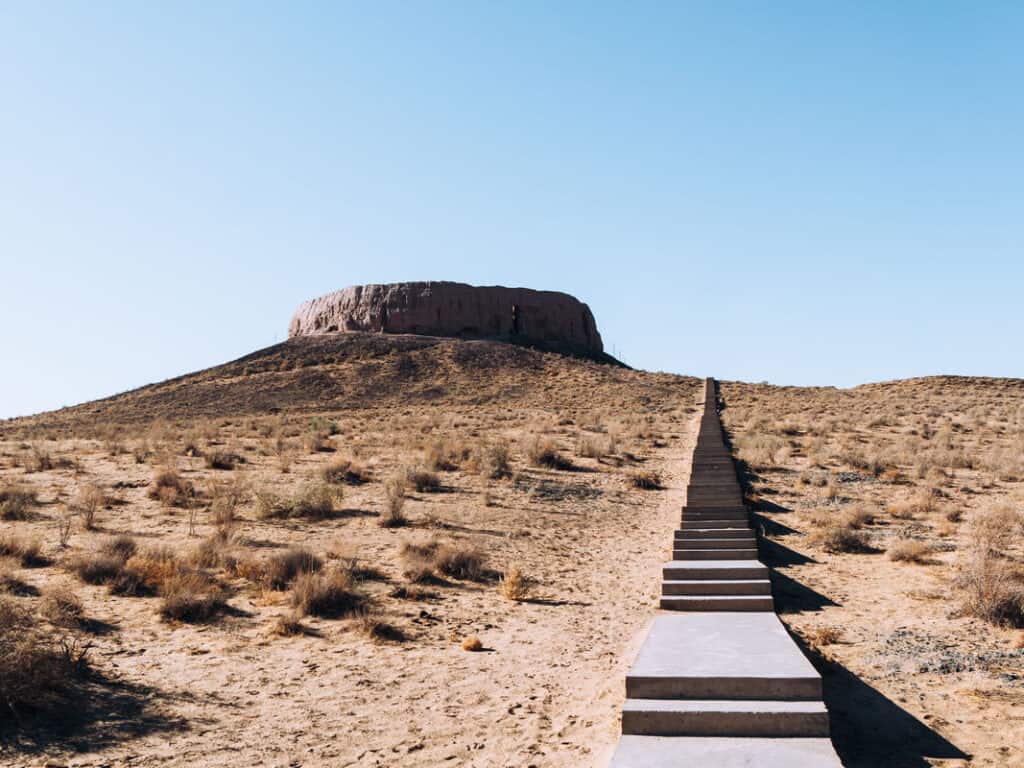
The Chilpik Kala was a structure constructed atop of a hill by the river banks of the Amu Darya Delta.
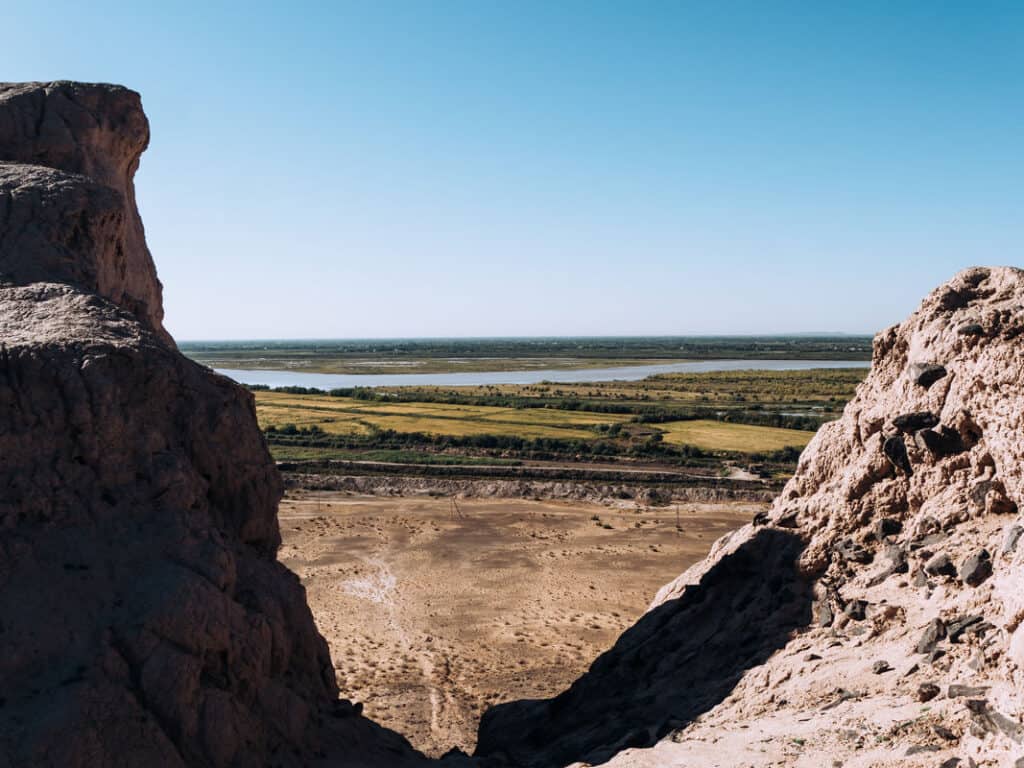
What’s interesting about this place is that it was used by the Zoroastrians (one of the world’s oldest faiths) for sky burials.
Reports suggest that in about 200 BC, bodies were laid up on the highest part of the tower so vultures could munch on flesh and clean the bones. The bones then would be taken to a place of rest. Scientists have said this is one of the earliest examples of traditional funeral rituals. It is also known as the ‘Tower of Silence’… eerie ;).
TIPS FOR VISITING CHILPIK KALA:
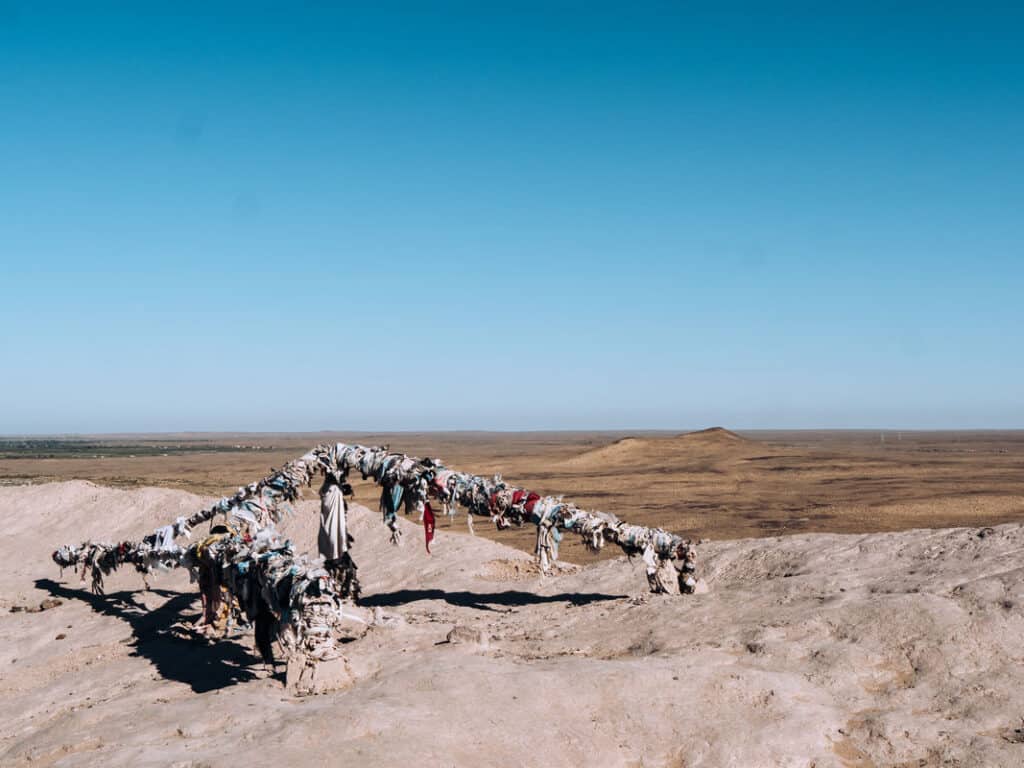
- You’ll be bang in the middle of the Kyzyl-Kum desert, so stating the obvious, but prepare for soaring heat. You will cook like a chip if you don’t bring a hat, sunglasses, sunscreen, water etc.
- It is so stunning if you head here for sunrise/sunset. It will also be far more manageable with the heat.
- You maaaay have guessed but getting to the desert isn’t something you can do in a day trip from the capital. I’d incorporate Chilpik Kala if you’re exploring Nukus or Khiva. Scroll below for travel tips, or click on my Nukus / Khiva guides to find somewhere to stay.
ENTRANCE FEE FOR CHILPIK KALA:
It costs 5,000 UZS per person for access to the structure.
HOW TO GET TO CHILPIK KALA FROM TASHKENT:
The most appropriate cities to base yourself at before travelling to Chilpik Kala are Nukus or Khiva. I’ve included how to make the full journey to both areas below.
- Tashkent to Nukus:
- By plane: If you’re short on how much time you have to spare, domestic flights run between Tashkent and Nukus. They take around 1 hour and 40 minutes. If you book your tickets in advance on the Uzbekistan Airways website, it should cost around 60 USD.
- By train: A cheaper option is booking yourself onto a night train. The night train is called Passenger (Пассажирский). You can book a 2-person private sleeper (Lux / CB), a 4-person private sleeper (Kupe), or a shared sleeper (Platzkartny). At the time of writing this, trains run from Tashkent to Nukus on Tuesdays through Sundays. They leave at 14:00 and arrive early in the morning. Click here for timetable details or read my Uzbekistan Railways Guide for some handy hints.
- Nukus to Chilpik Kala: If you’re staying for a few days in Nukus, you will be able to organize a private driver to take you to the site. Ask at your hotel or hostel. Prices average around 40 USD for the full day.
- Tashkent to Khiva:
- By train: Similar to Nukus, you can book yourself onto a night train (roughly a 14-hour ride) from Tashkent to Khiva. Click here for timetable details or read my Uzbekistan Railways Guide for some handy hints.
- Khiva to Chilpik Kala: From Khiva, you’ll need to organize a private driver to the Khorezm fortresses (which is what I did). You can organize this with your hotel/hostel.
16. Hayat, Nuratau Mountains
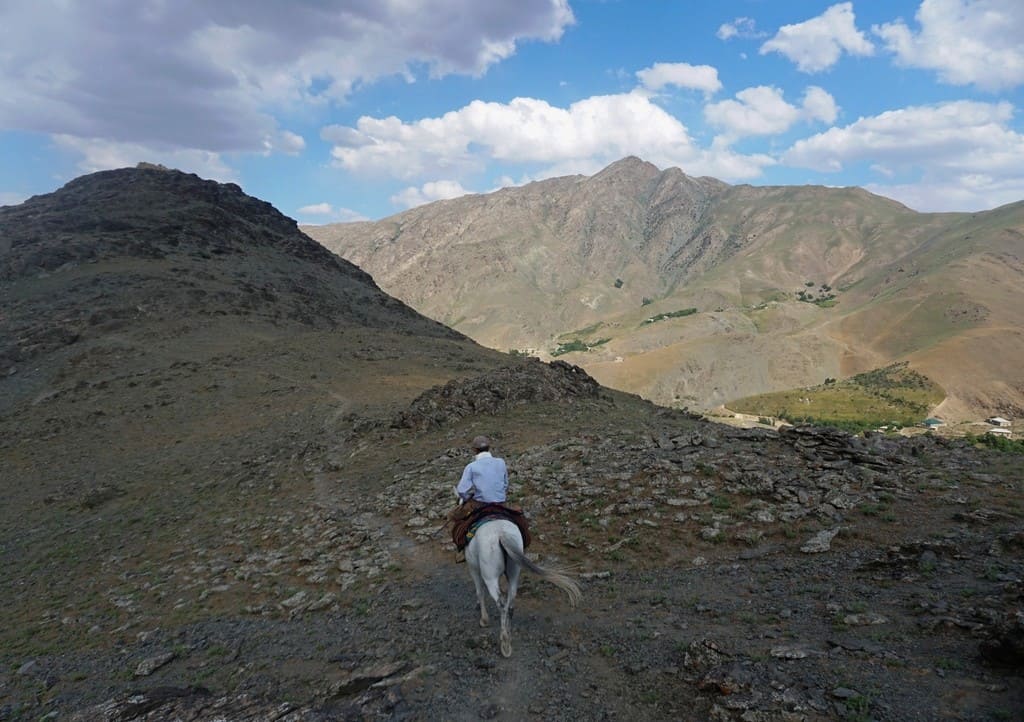
Here are some words from my assistant writer/nomad, Samantha. I sent her to explore the Nuratau Mountains in May 2023 and she had heaps to say about the area.
There are hundreds of hamlets nestled in the Nuratau Mountains, but Hayat stole my heart. The valley’s rolling hills provide thousands of possible trails which are ideal for horse riding and hiking.
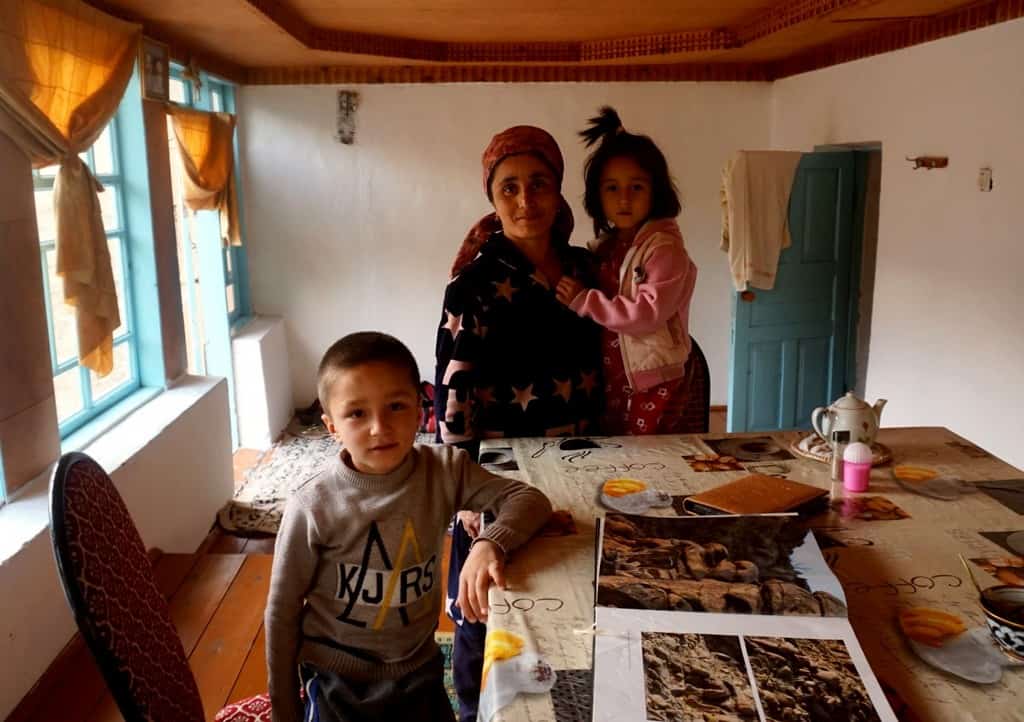
Accompanied with a horseman, I was able to link up the villages and stay in gorgeous guest houses along the way. Staying in guest houses here is a totally different experience than to Western Europe.
You are welcomed into the family, laugh, play and eat with them. In my eyes, it was the best form of tourism because I learned so much about the nature around me, while being culturally aware of village life. This was such a beautiful experience and I’m keen for you to have the same!
Hayat is a tiny hamlet that teeters on the border of the Nuratau nature reserve, which is home to a rare species of mouflon goat. Most of the village is sheltered by walnut and mulberry trees which provide welcome shade from the sun. I loved this place for its tranquil energy and its spectacular mountainous landscapes.

TIPS FOR VISITING HAYAT:
- I’d make this into a trip lasting more than a few days. Why not try some horse riding and hiking in the mountain range? There are guest houses in the village that you can base yourself at, or travel from hamlet to hamlet. Contact me if you’d like some help starting planning your adventure!
- For information about Hayat and horse riding here, read my guide here.
HOW TO GET TO HAYAT FROM TASHKENT:
From Tashkent, you’ll need to hop on the train to Jizzakh. I ended up on a longer service which took 2 hours 30 minutes but there is a high-speed service which takes 1 hour 30 minutes. They run daily. You can book on the official Uzbek Railways website.
From Jizzakh, you’ll need to organize a private driver to take you to Hayat. You’ll have to do this from a tourism agency, which I can help you with. Just drop me a message.
Alternatively if you have the cash, you can pay for a private driver to take you all the way from Tashkent to Hayat. This will take around 5-hours, but I have no idea how much this would cost!
17. Bolo Khauz Mosque, Bukhara
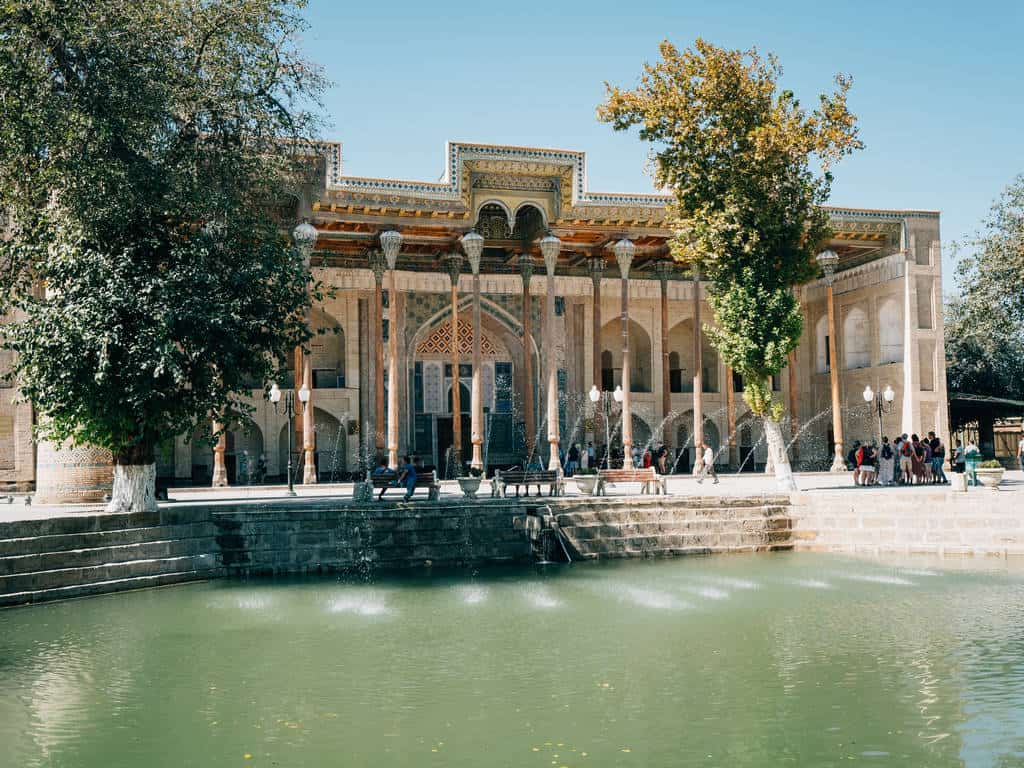
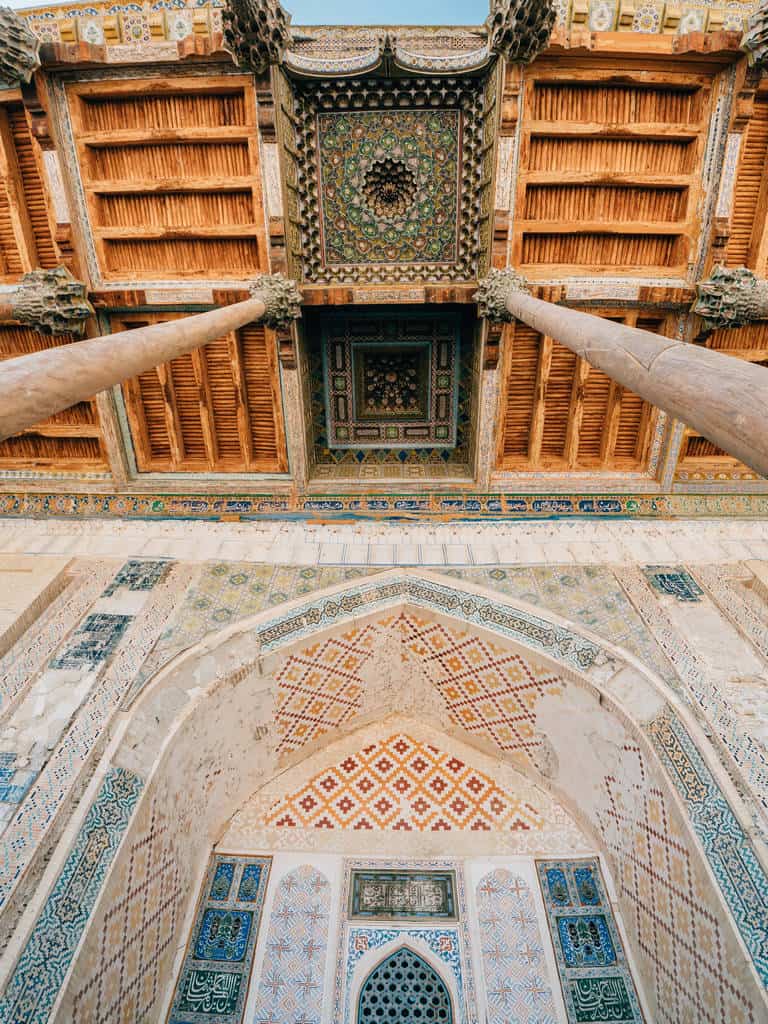
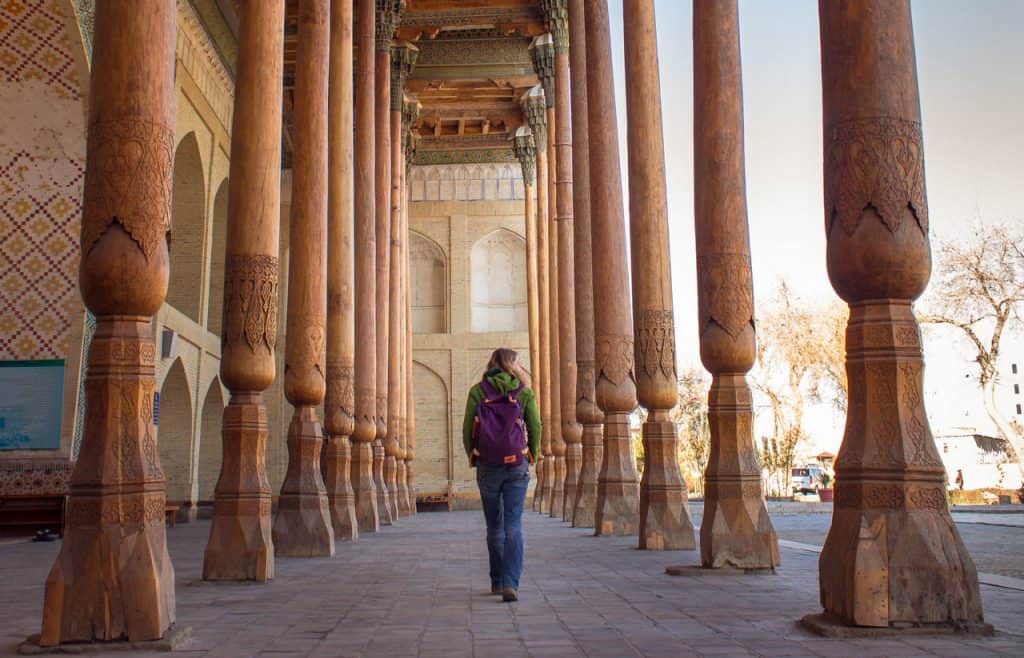
There’s no doubt that exploring Uzbekistan’s ancient cities is a lively experience for your eyes (so many dazzling designs!), but the Bolo Khauz Mosque takes intricate detail to another level.
The ruler Emir Shahmurad ordered the construction of Bolo Khauz in 1712. Legend has it that he had red carpets laid out for him to walk down the road to the fortress Ark Citadel… **the sass**.
The oldest part of this site is the pond, which is where the name Khauz derives from. Many of Bukhara’s ancient holy buildings had a water feature which served as a reservoir.
However, the pools were also a petri dish for diseases, which is why many of them have been drained in recent times (don’t go drinking the water, you’ll be on the toilet for months). It now is used as a mini-oasis for residents, who chill out by the glistening waters.
Twenty beautifully carved pillars stand by the veranda. Look out for the reflections in the water! It’s said to be super lucky if you spot 40 pillars as that number is sacred.
TIPS FOR VISITING BOLO KHAUZ MOSQUE:
- The mosque is open to absolutely everyone and it’s free, but this is still an active mosque so do not enter during prayer time.
- Same rules go with clothing in mosques, please cover up and be super respectful!
- If you’re feeling peckish, there’s a smashing restaurant called Bolo Khauz Chaikana. It serves some delicious shashlik (kebab-like meat).
HOW TO GET TO BOLO KHAUZ MOSQUE FROM TASHKENT:
It’s super simple to get to Bukhara from the capital. There are two trains, a high-speed and a standard, that connect the two cities. You’ll find the schedule and times on the official Uzbekistan Railway website. Check out my Uzbekistan Railways Guide to learn how to book the train tickets and select your seats.
From the train station in Kagan, (the new part of Bukhara where you’ll get off), you can catch a 30-minute taxi to the mosque. Taxi drivers waiting at the station are cheeky and some like to overcharge tourists but you shouldn’t pay more than 30,000 UZS.
Top tip: Install the Yandex Taxi app on your phone for a stress-free cab fix. The app is simple to use, and saves you hustling for a good price because it shows you the rate before booking.
You could get a bus from Tashkent to central Bukhara but it’s more than a 12-hour journey and the price difference isn’t much off what a train is. You can buy tickets from the bus station near the Olmazor metro station. Bus prices tend to change quite regularly but they generally cost around 66,000 som.

18. Amir Temur Square, Tashkent

I touched on the big boss Timur earlier, but he is widely-regarded as a national hero of Uzbekistan. He is probably Central Asia’s most notorious conqueror, and his legacy weaves into so much of Uzbek culture.
There’s a lot to read about Timur’s battle tactics and his influence on architecture (he was a flipping great builder). It’s clear he did a lot for the country at the time, and the people have since created their own ways of thanking him.
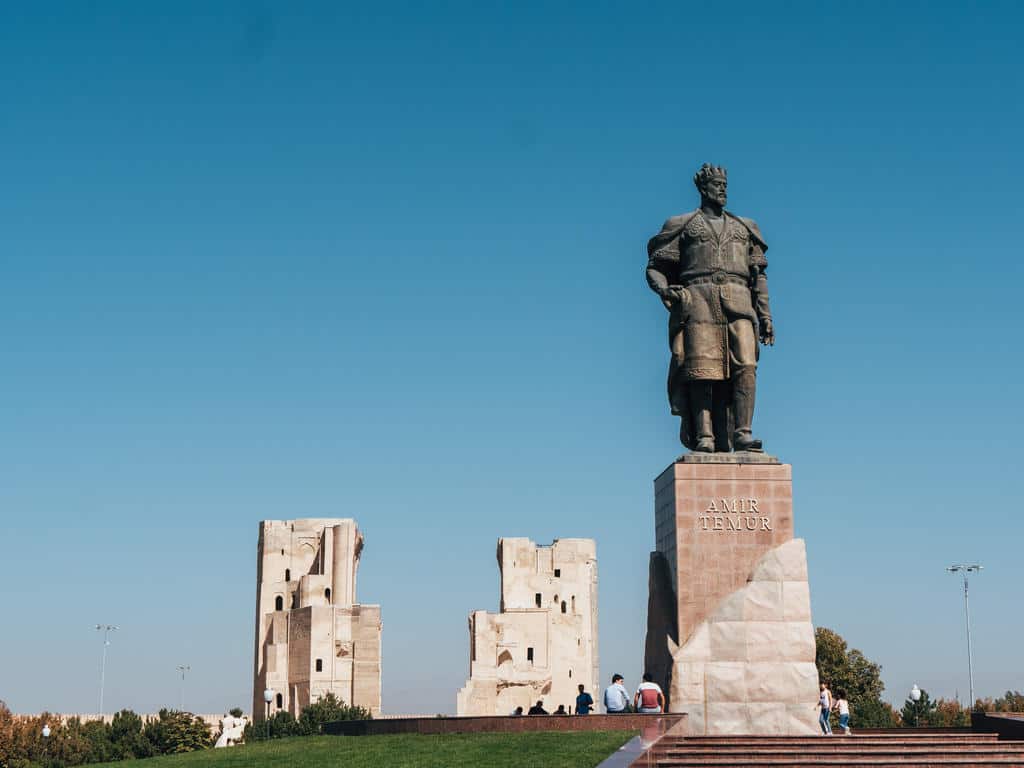
The Amir Temur Square is a peaceful park in Tashkent’s city center. It’s a perfect secluded spot to take a break for a few hours. The main feature is the whopping seven-meter-high statue of Timur on his horse. As statues go, it’s very impressive. Also check out how muscly his horse is.


HOW TO GET TO AMIR TEMUR SQUARE:
- You can’t get lost – the closest metro station is called Amir Temur metro station. Get out here and follow the road straight for around seven minutes along Sailkogh Street.
- The park is west of the central part of the city, so depending on where you’re staying, you could either walk or hop in a shared taxi. Install the Yandex Taxi app on your phone for a stress-free cab fix. The app is simple to use, and saves you hustling for a good price because it shows you the rate before booking.
19. Toprak-Kala, Karakalpakstan
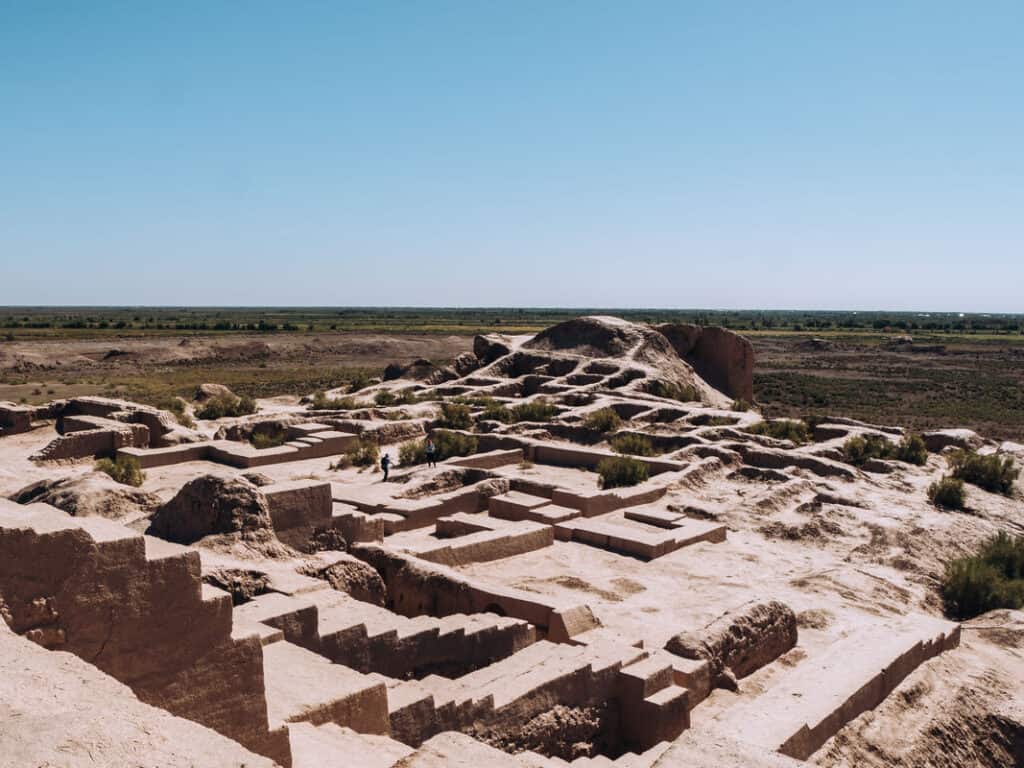
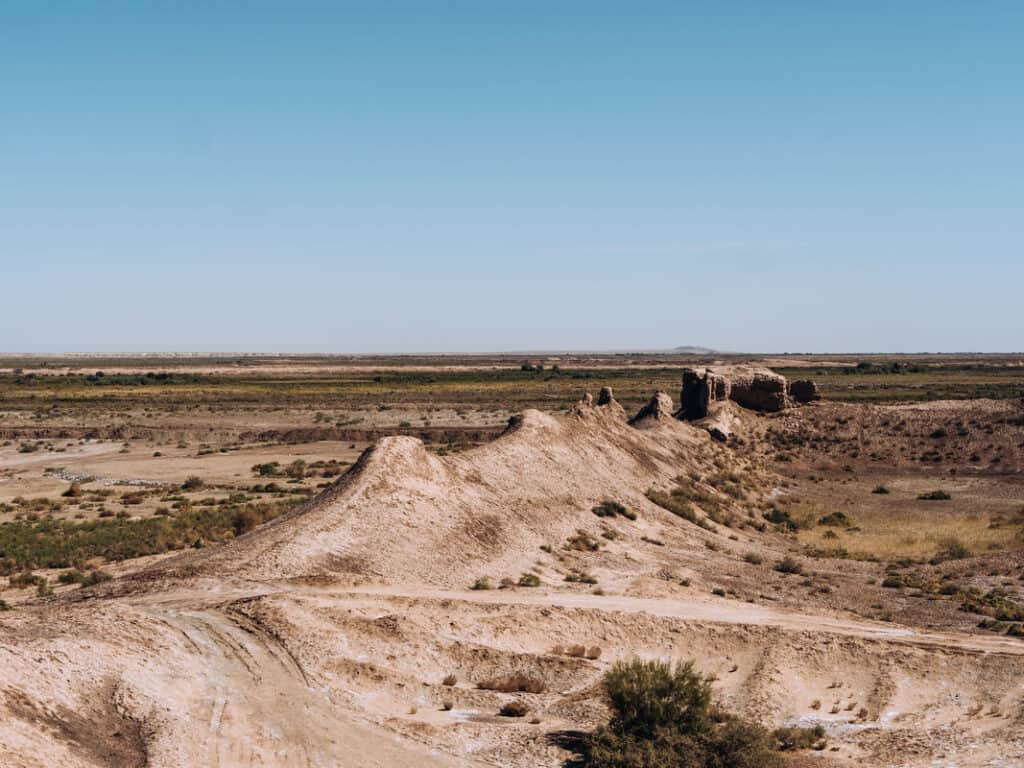
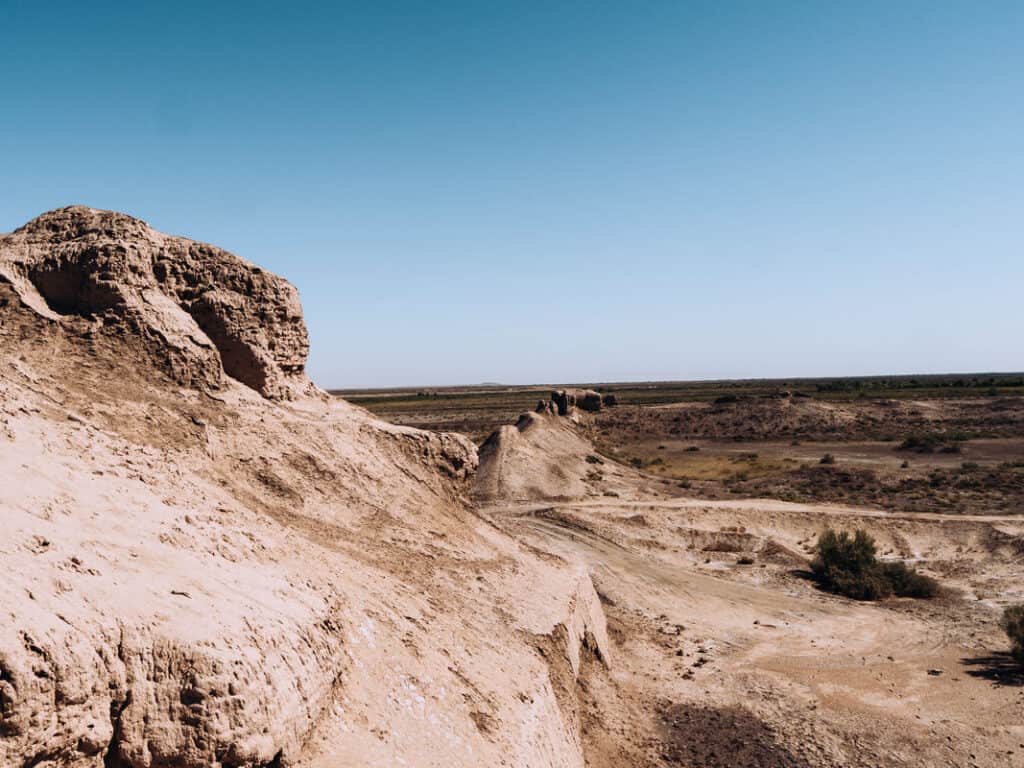
We touched on the Khorezm fortresses above with number 15’s Chilpik Kala tower, but I also want to talk about Toprak-Kala too. While the Chilpik Kala was a dwelling for its people, Toprak-Kala was a palace for the Khorezm kings and dates back to the 1st century.
The place has yielded so much for archeologists, who have unearthed their hidden riches. Gold, silks, ceramics, art pieces, coins, necklace beads and wool were all discovered there, leading to the site being named the Museum of Fine Arts of Khorezm.
Those who were closer to the royal hierarchy were found in more extravagantly decorated living spaces and bedrooms closer to the inner center of the palace (sort of like a queen bee’s hive).
TIPS FOR VISITING TOPRAK-KALA:
- You’ll be bang in the middle of the Kyzyl-Kum desert, so stating the obvious, but prepare for soaring heat. You will cook like a chip if you don’t bring a hat, sunglasses, sunscreen, water etc.
- It is so stunning if you head here for sunrise/sunset. It will also be far more manageable with the heat.
- You maaaay have guessed but getting to the desert isn’t something you can do in a day trip from the capital. I’d incorporate Chilpik Kala if you’re exploring Nukus or Khiva. Scroll below for travel tips, or click on my Nukus / Khiva guides to find somewhere to stay.
ENTRANCE FEE FOR TOPRAK-KALA:
It costs around 5,000 UZS per person.
HOW TO GET TO TOPRAK-KALA FROM TASHKENT:
The site sits around 58 km by the road from Urgench. The most appropriate cities to base yourself at before travelling to Toprak-Kala are Nukus or Khiva. I’ve included how to make the full journey to both areas below. Contact me if you’re baffled by all the information out there – I can help tailor your journey and give advice.
- Tashkent to Nukus:
- If you’re short on how much time you have to spare, domestic flights run between Tashkent and Nukus. They take around 1 hour and 40 minutes. If you book your tickets in advance on the Uzbekistan Airways website, it should cost around 60 USD.
- A cheaper option is booking yourself onto a night train. The night train is called Passenger (Пассажирский). You can book a 2-person private sleeper (Lux / CB), a 4-person private sleeper (Kupe), or a shared sleeper (Platzkartny). At the time of writing this, trains run from Tashkent to Nukus on Tuesdays through Sundays. They leave at 14:00 and arrive early in the morning. Click here for timetable details or read my Uzbekistan Railways Guide for some handy hints.
- Nukus to Toprak-Kala:
If you’re staying for a few days in Nukus, you will be able to organize a private driver to take you to the site. Ask at your hotel or hostel. Prices average around 40 USD for the full day. It should take around a two-hour drive.
- Tashkent to Khiva:
Similar to Nukus, you can book yourself onto a night train (roughly a 14-hour ride) from Tashkent to Khiva. Click here for timetable details or read my Uzbekistan Railways Guide for some handy hints.
- Khiva to to Toprak-Kala:
From Khiva, you’ll need to organize a private driver to the Khorezm fortresses (which is what I did). You can organize this with your hotel/hostel. It should take around 1 hour and 40 minutes.
20. Po-i-Kalyan, Bukhara
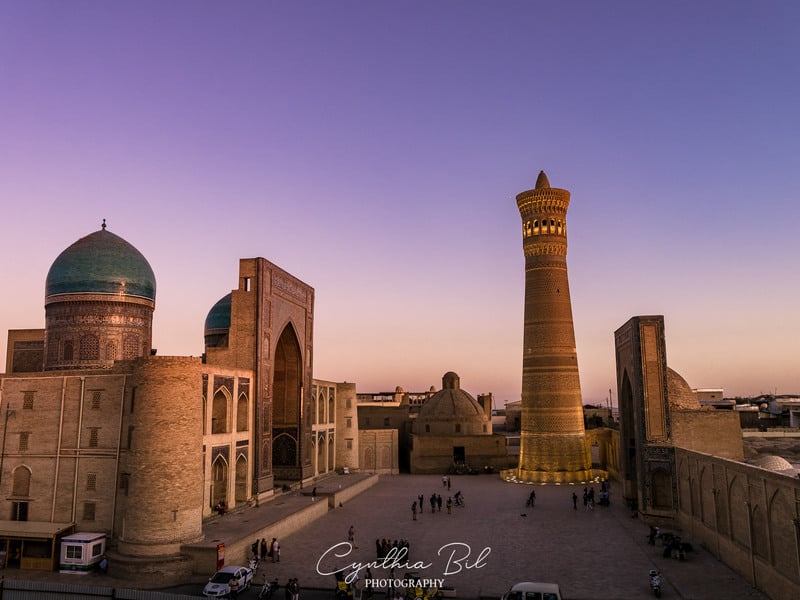
It’s no wonder this complex is considered the crown of Bukhara. The Po-i-Kalyan is made up of the Kalyan Minaret, the Miri Arab Madrasa, the Kalyan mosque and the small Amir-Allimkhan Madrasa, which are all in their own right, little architectural masterpieces. It’s treasured by many people across the globe, who make regular pilgrimages here.
The Kalyan Minaret was built in 1127 AD which translates as ‘great’. It was so great that after Genghis Khan conquered the city, he spared the tower. All of its 47-meters have stood tall since, without the need for any restoration!
The Kalyan mosque is Bukhara’s largest mosque and has served its people for more than 500 years. Check out its architectural design… it’s the same layout from what it would have been in the Timurid dynasty.

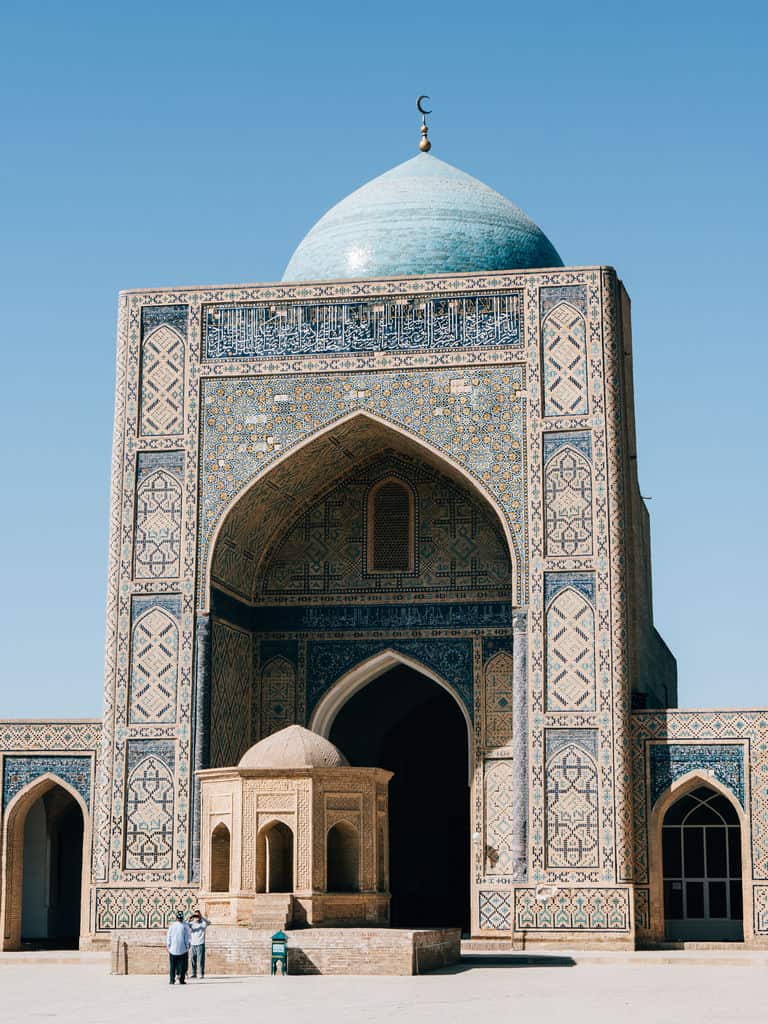
At sunrise and sunset, the madrasa’s teal cupola illuminates in a metallic sheen, while the minaret glistens with gold.
Even if city exploring isn’t your thing, I’d really recommend making the journey to Bukhara because you’ll be rewarded with some unforgettable views, while learning about Uzbek heritage.


TIPS FOR VISITING PO-I-KALYAN:
- Visit this place at sunrise. There are a few reasons for this! If you arrive earlier than the official opening time you can visit the mosque for free. Its opening times are 08:00-20:00. It’s also crazy beautiful at this time – you’ll catch the sky glowing in all sorts of shades.
- This place is very holy and means so much to many people. Please bear this in mind and dress appropriately – no boobs, shoulders, knees etc on show!
- If you decide to wander over later in the day, grab a drink at Minor House located right in front of the square and watch the sunset.
- The Po-I-Kalyan has such an interesting history that I would recommend visiting the site at least once with a guide. There aren’t any English-speaking guides at the complex itself so you’ll have to take a guided city tour in Bukhara. I really recommend going on a guided walking tour in Bukhara to learn all about its history:
PO-I-KALYAN Entrance Fee:
If you get to the mosque after 08:00, you’ll have to pay an entrance fee of 20,000 UZS per person.
HOW TO GET TO PO-I-KALYAN FROM TASHKENT:
It’s super simple to get to Bukhara from the capital. There are two trains, a high-speed and a standard, that connect the two cities. You’ll find the schedule and times on the official Uzbekistan Railway website. Check out my Uzbekistan Railways Guide to learn how to book the train tickets and select your seats.
From the train station in Kagan, (the new part of Bukhara where you’ll get off), you can catch a 20-minute taxi to the mosque. Taxi drivers waiting at the station are cheeky and some like to overcharge tourists but you shouldn’t pay more than 25,000 UZS.
Top tip: Install the Yandex Taxi app on your phone for a stress-free cab fix. The app is simple to use, and saves you hustling for a good price because it shows you the rate before booking.
21. Beldersay Ski Resort, Chimgan National Park
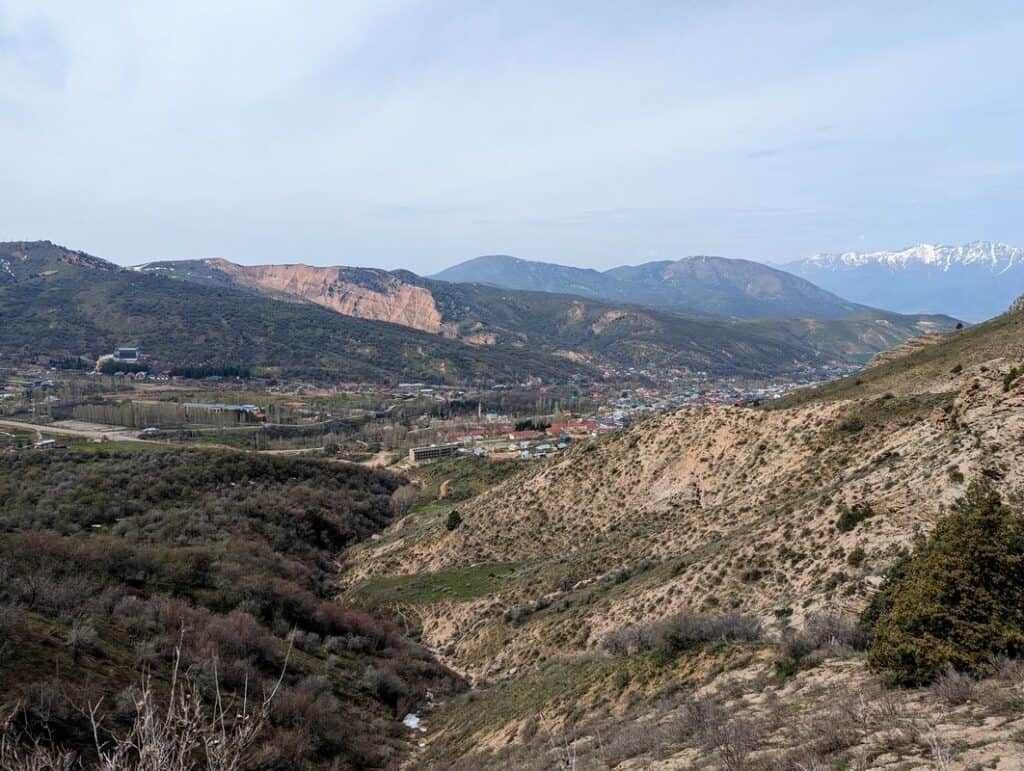
The town of Beldersay is a stunning place to base spring and winter adventures in the Chimgan mountains.
The silhouette of the magnificent Greater Chimgan Peak at 3,309m hugs the landscape, while its steep slopes offer a huge playground for skiers. There are 3.2 km of slopes across elevations of 1,500 and 2,350m.
Beldersay is considered for more experienced skiers as the climate is extreme with heavy snow. It’s actually known as Uzbekistan’s ‘Switzerland’… just less crazy expensive.
Winter sports are becoming more and more popular here. I’ve read lots about the Soviet-style cable cars which are apparently worth it for the ride alone 😉
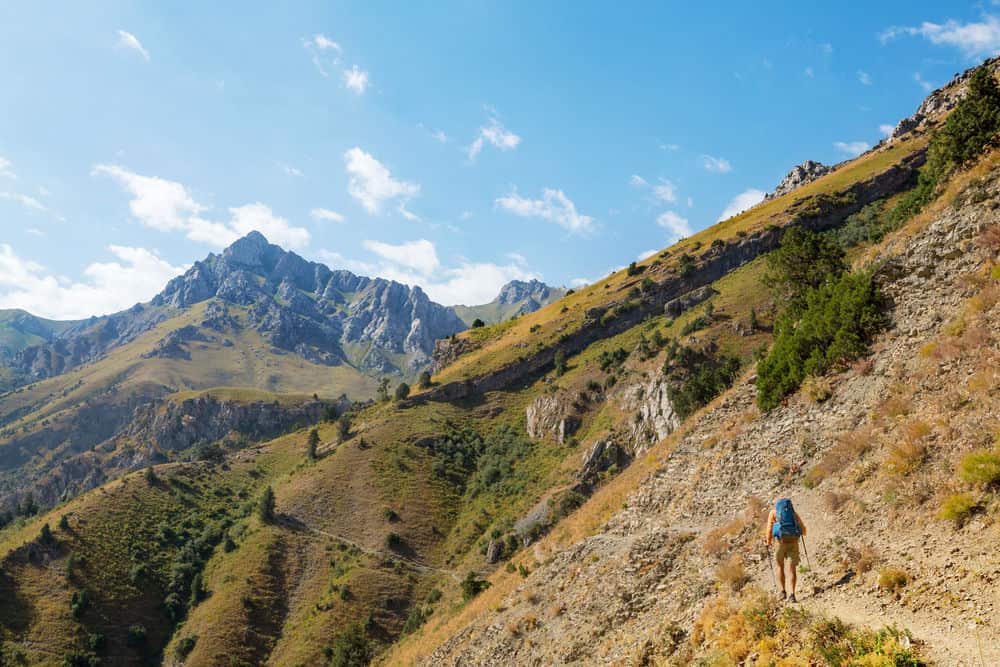
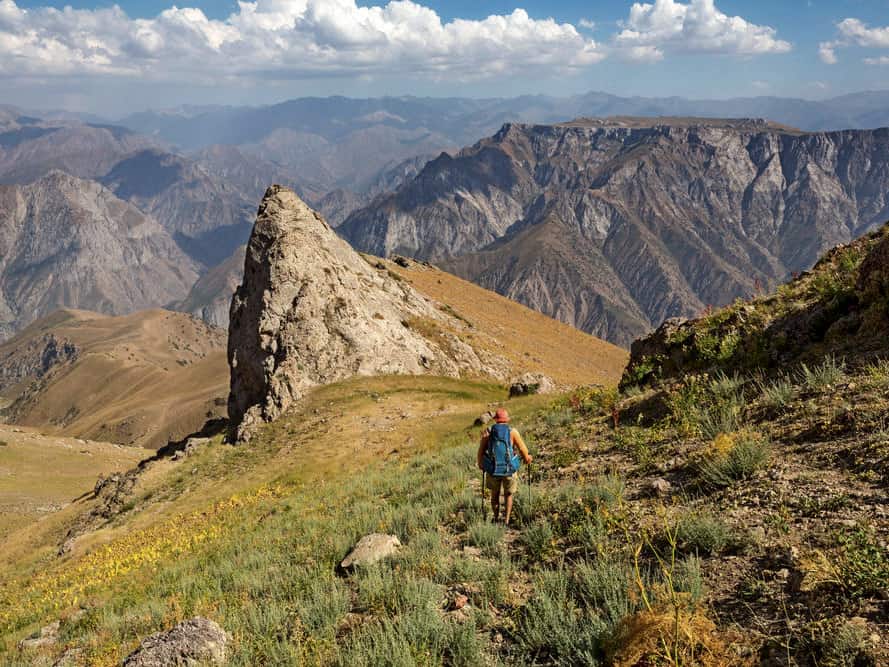
The Chimgan Mountains also gift hikers with roaring glacial rivers, alpine meadows and snow-capped summits in spring and autumn.
As the snow melts, Beldersay becomes a gateway for hikers, offering hundreds of trails and endless wild camping spots. Read more about hiking in the mountains here.
TIPS FOR VISITING BELDERSAY:
- The ski resort is open from December to March 09:00-16:00. You can find out more details about the resort here.
- Uzbek winters are pretty extreme – temperatures regularly drop to -10 degrees celsius. Up in the mountains, this will only be magnified so make sure you are dressed correctly and have the right equipment!
- Feeling inspired? Hop on my 2023 14-day Highlights of Uzbekistan tour! You could always tailor your trip with a mountain guide. I can also put you in touch with community-based tourism groups who will take your adventure to the next level.
- Any hiking-related questions? Drop me a message!
HOW TO GET TO BELDERSAY FROM TASHKENT:
Winter:
With the extreme snowfall in the colder months, you’ll need to hire an experienced 4×4 driver to navigate through the dangerous routes! Drop me a message if you’re struggling to find someone, I can put you in touch with tourism agencies.
Spring until Autumn:
There’s no single way to get into Ugam-Chatkal National Park and many of its surrounding roads are dirt tracks. If you drive or are organizing a driver, keep in mind it will take you more time to get to your destination.
If you’re tight on time/budget, I’d recommend the below journey to Beldersay and then you can access the Chimgan range. If you want to delve into the mountains for more of an adventure, I’d try looking into organizing a private driver or help from a guide.
Due to the Chimgan range being only 80km from Tashkent, it’s about an 1 hour 30 minute drive. If you want to be picked up from a specific location, please contact an agency and be very clear about your plans, send an image of a GPS waypoint and ensure you’ve got the agency’s number and the driver’s.
You can reach the city of Gazalkent which is close to the Chimgan mountains by public bus. There are both electric trains and buses leaving Tashkent to Gazalkent.
From Gazalkent, there are two daily buses Gazalkent-Chimgan (10:30 and 14:30) Chimgan-Gazalkent (06:30 and 13:30) which take around 50 minutes. The road is accessible any time of the year, but in spring there can be limitations because of landslides and mudflows.
22. Kalta-Minor minaret, Khiva

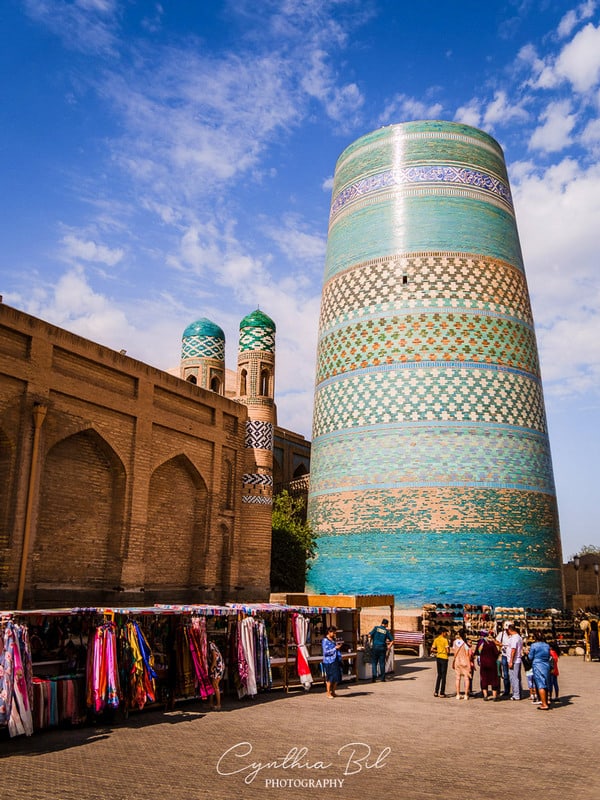
The Kalta-Minor minaret is pretty mighty as minarets go, but it actually was meant to be even more spectacular. In 1851, nobleman Muhammad Amin-Khan ordered its creation and instructed it to be built tall enough for its residents to see all the way to Bukhara.
It was supposed to be the tallest minaret in Uzbekistan but that went out the window when Amin-Khan popped his clogs, a mere four years later.
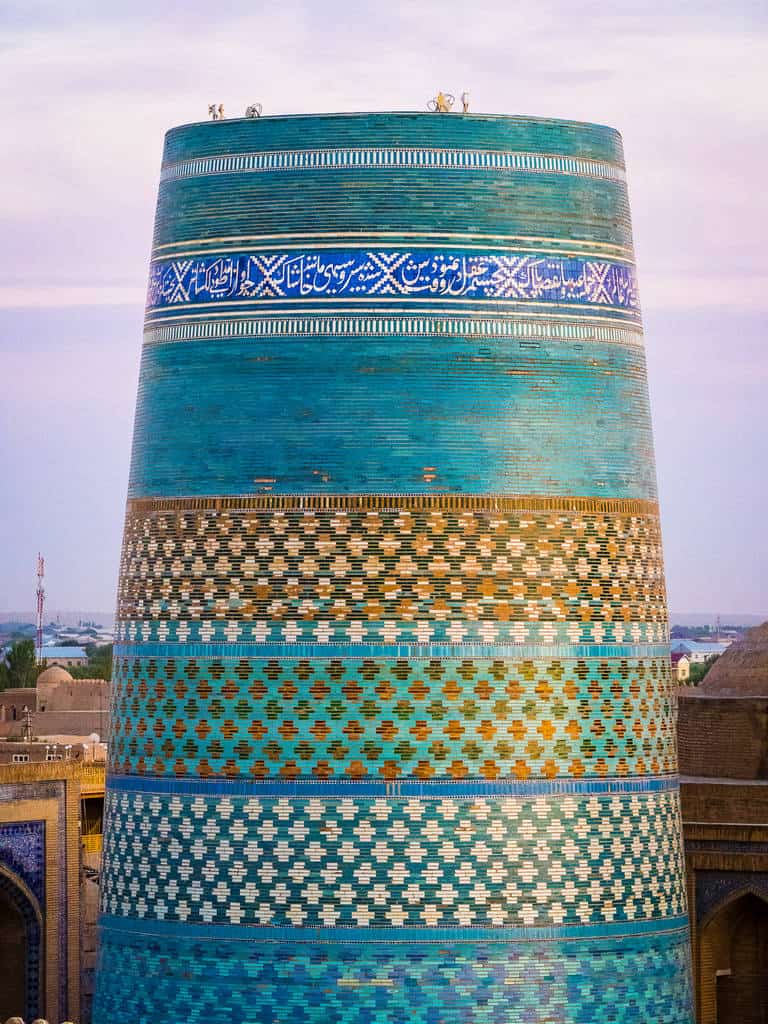
The construction also stopped dead in its tracks, which is why Kalta-Minor actually translates as ‘short minaret’. In my opinion, its stockiness adds to its charm.
Legend also has it that the architect *who literally had his neck on the line* was thrown off the building because he apparently accepted an offer from a khan in Bukhara who was planning an even higher tower…
The minaret is totally embellished with teal and golden tiles which shimmer in a red glow at sunset. What I love about this structure is that you can spot the minaret from different places across Khiva.
TIPS FOR VISITING THE KALTA-MINOR MINARET:
- I’ll explain below, but Khiva is a bit of a schlep to get to (you definitely cannot get there and back in one day)! So I’d recommend planning an adventure in Khiva and properly having some time to explore! I’ve written a comprehensive travel guide for Khiva here.
- I’d head here for sunset – the way the sun projects onto Khiva’s buildings is spectacular.
ENTRANCE FEE FOR THE KALTA-MINOR MINARET:
The entrance fee to the Kalta-Minor is included in the standard Itchen Kala ticket which you buy for all the attractions in Khiva. The standard ticket price is 100,000 UZS which includes all museums.
HOW TO GET TO KALTA-MINOR MINARET FROM TASHKENT:
You can book yourself onto a night train (roughly a 14-hour ride) from Tashkent to Khiva.
Read my Uzbekistan Railways Guide if you’re looking for all the details on how to get about by trains, and then book using the official Uzbek Railways website. From Khiva rail station, it’s an 8-minute taxi ride or a 30-minute walk to the minaret.
If you’re short on how much time you have to spare, domestic flights run between Tashkent and Nukus. They take around 1 hour and 40 minutes.
If you book your tickets in advance on the Uzbekistan Airways website, it should cost around 60 USD. From the airport, you can hop in a shared taxi to Khiva and follow the above directions to get to the minaret.
23. Alisher Navoi Metro Station, Tashkent
Exploring the metro stations of Tashkent is a cool way to spend an afternoon, especially if you’ve short on cash or you need to walk off some plov.
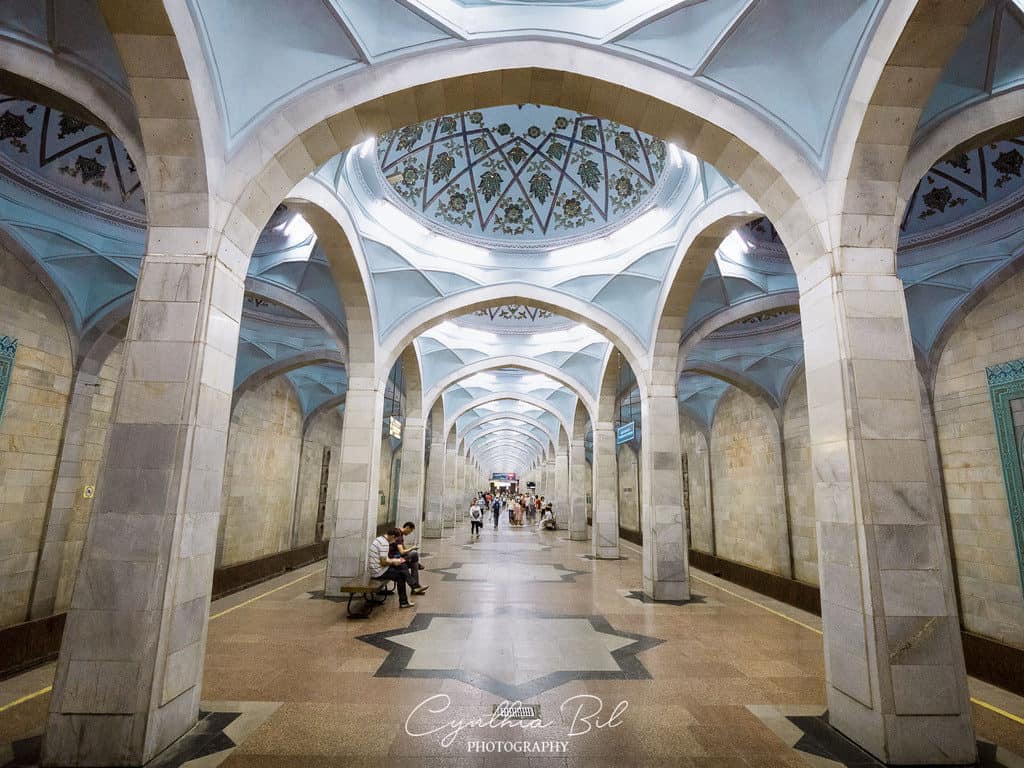
I talked about the dreamy delights of the Kosmonavtlar metro station above, which celebrated Soviet cosmonauts, but the Alisher Navoi metro station celebrates an Uzbek poet from the 15th century. Alisher Navoi is considered to be one of the pioneers of Uzbek literature, and his legacy continues to shine in the country’s arts today.
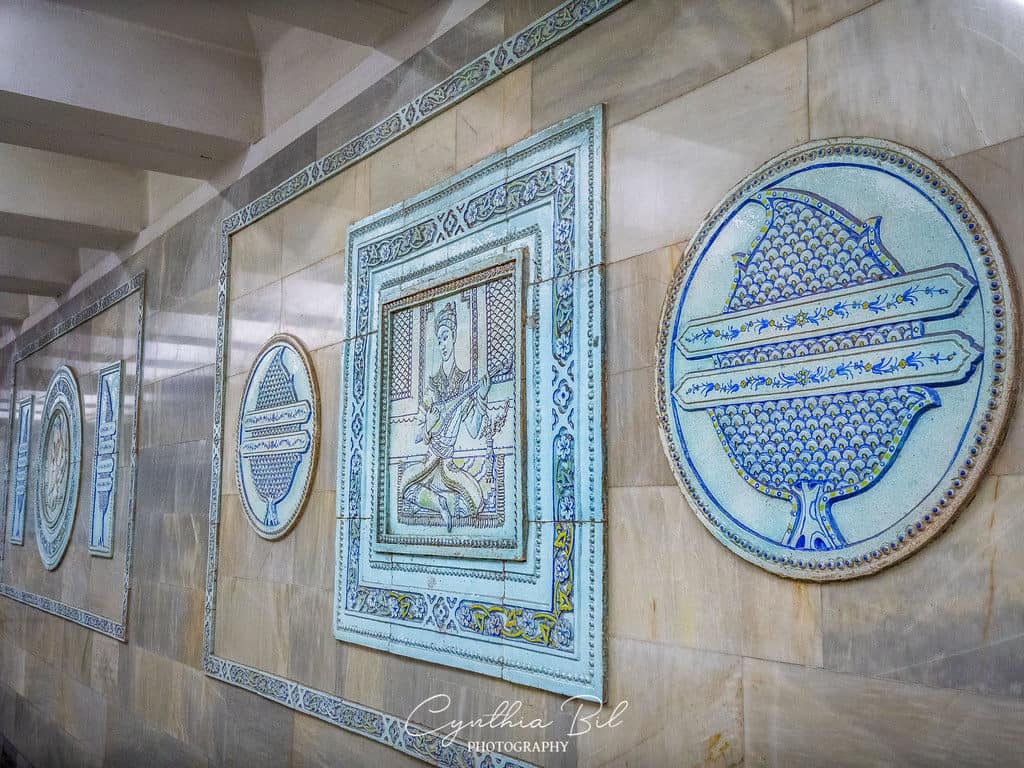
The plaques picture stories of Navoi’s poems and make sure you crane your neck up because there’s a lot to see. There are thousands of gilded patterns which glisten in beautiful blue domes. This resembles the Silk Road’s footprint on Uzbek culture.

TIPS FOR VISITING ALISHER NAVOI METRO STATION:
- Head to the station outside of rush hour – I’d recommend getting there early in the morning.
- In 2022, I visited every single metro station in Tashkent. If you have around five hours to kill, I really recommend you do the same! Each has its unique characteristic and story to tell. It reminded me of being in an immersive art exhibition.
HOW TO GET TO THE ALISHER NAVOI METRO STATION IN TASHKENT:
Alisher Navoi is the interchange station between the Ozbekiston (blue) Line and Chilonzor (red) Line.
24. Gur-e-Amir Mausoleum, Samarkand

References to Amir Timur have been scattered throughout this guide so it’s only fair we leave him with his final resting place. If you’ve been to Uzbekistan before, you’ll no doubt have gathered how loved Timur is. It seems only fitting that his tomb is furnished to the gods.
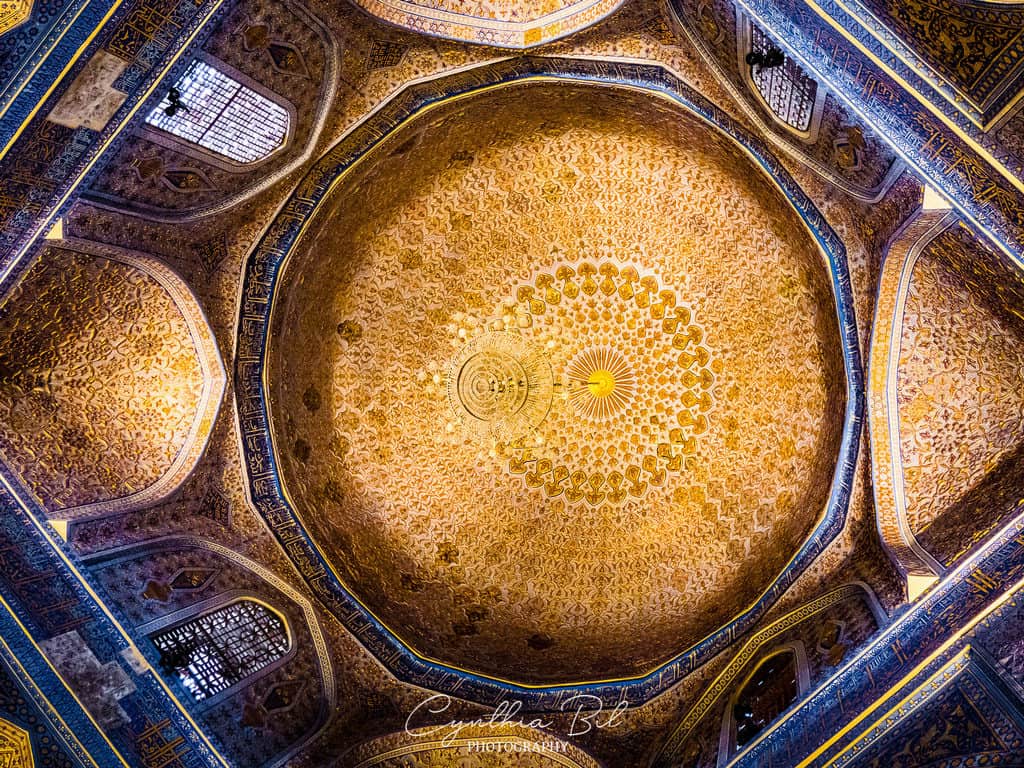
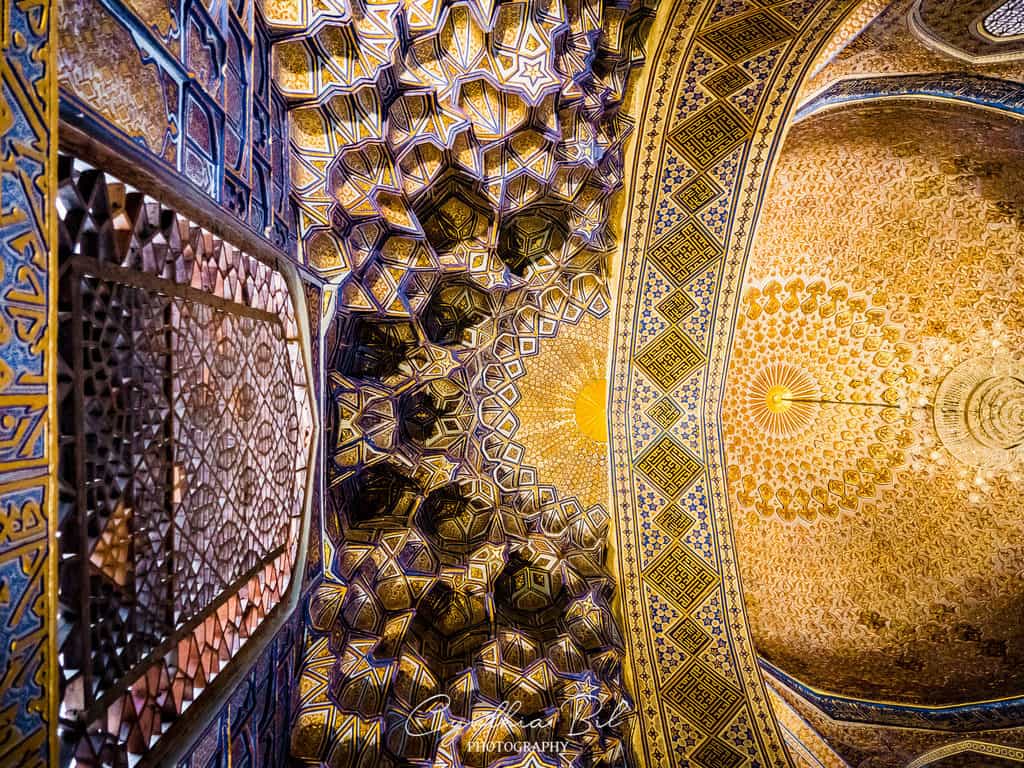
The Gur-e-Amir Mausoleum is widely considered a masterpiece of Central Asian medieval architecture. ‘Gur-e-Amir’ translates as ‘tomb of the king’ – it holds headstones of Timur’s sons and grandsons.
Geometric glazed tiles engulf the building and a huge teal dome fans into 64 ribs, which totals the number of years the Prophet Muhammad lived.
Inside the mausoleum, there are ornately carved headstones that mark the tombs beneath. Careful you don’t strain your neck because you’ll want to do a lot of looking up! There are hundreds of dazzling papier-mache muqarnas, also known as ‘honeycomb work’, marble and onyx panels and geometric lattice window covers.
TIPS FOR VISITING THE GUR-E-AMIR MAUSOLEUM:
- As you can imagine, this place gets packed so quickly. The mausoleum may be large, but the noises from tourist guides and groups ricochet off the walls and it gets hectic. My advice would be to avoid this traffic and arrive as soon as doors open.
- The mausoleum is open daily from April to October from 08:00 until 19:00 and from November to March from 09:00 until 17:00.
- Don’t miss the chance to document Gur-e-Amir in all its glory. This is another building which illuminates during sunrise and sunset.
ENTRANCE FEE FOR GUR-E-AMIR MAUSOLEUM:
The entrance fee for the mausoleum is 50.000 UZS (around € 4 or $4.50).
HOW TO GET TO THE GUR-E-AMIR MAUSOLEUM FROM TASHKENT:
Hopping on a train is the easiest and fastest way to reach Samarkand from Tashkent. The Afrosiyob is a high-speed service which takes around two hours, running daily in the morning and in the evening.
There’s also the Sharq service which is so much cheaper and takes just a little over three hours. This one runs daily in the morning.
Read my Uzbekistan Railways Guide if you’re looking for all the details on how to get about by trains, and then book using the official Uzbek Railways website. Most importantly… don’t forget your passport!
Once you reach Samarkand station, it’s an 1hr 18min walk or you can hop in a taxi which takes around 15mins to get to the mausoluem, which should cost about 25,000 UZS.
Install the Yandex Taxi app on your phone for a stress-free cab fix. The app is simple to use, and saves you hustling for a good price because it shows you the rate before booking.
25. Chor Minor Madrasah, Bukhara
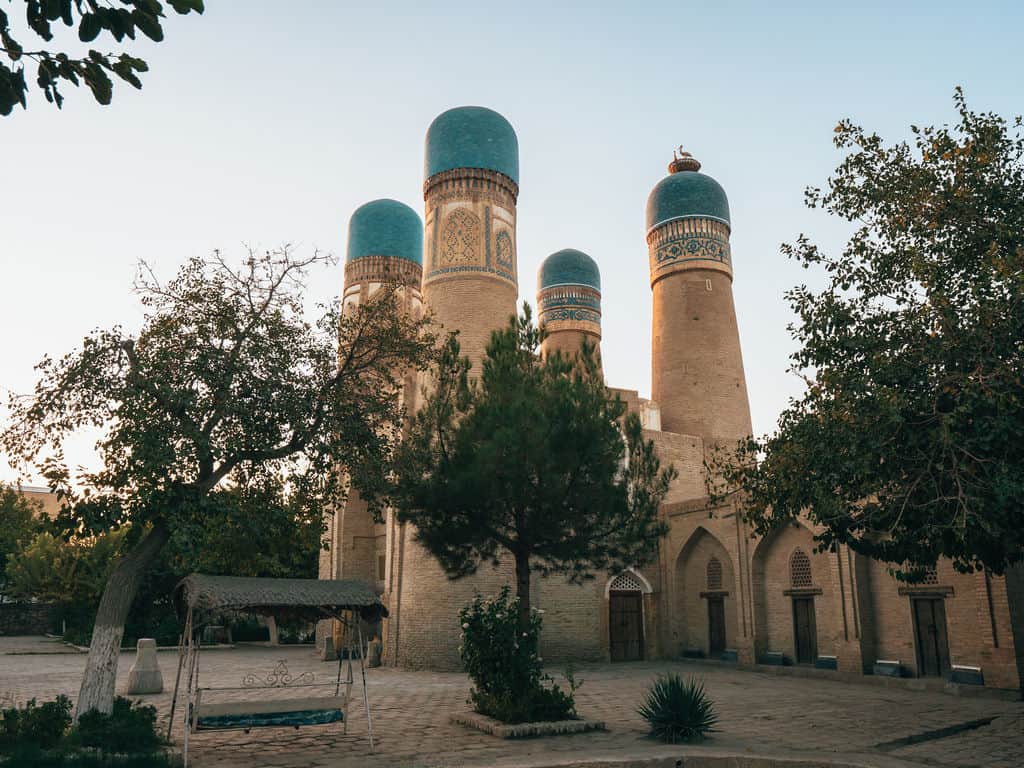
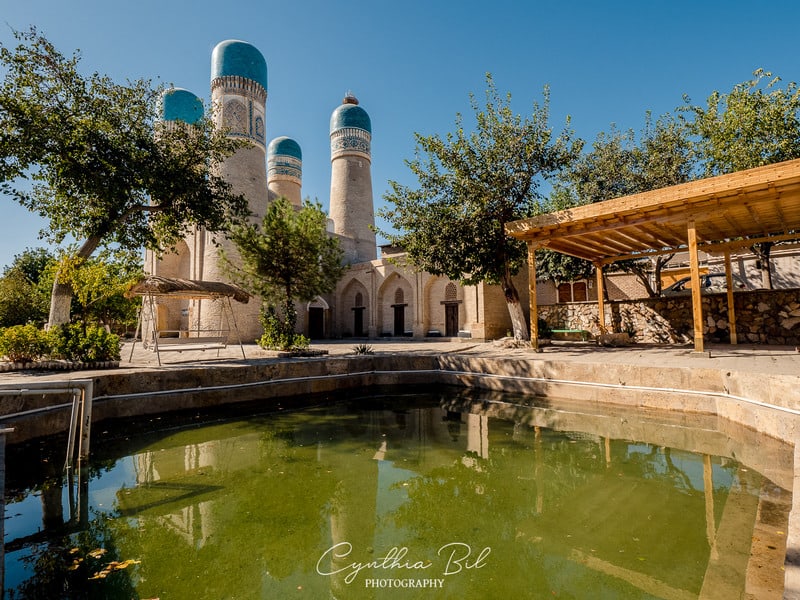
Not just the beauty of the Chor Minor Madrasah wowed me, but its history did too.
In the 19th century, a wealthy Turkmen merchant called Caliph Niyazkul-Beg arrived back from India. He was energized by the Taj Mahal and strived to have something similar on his land where fellow merchants could pause their travels and visit. In 1807, Niyazkul-Beg sourced astronomers and architects and instructed them that the design must reflect how all religions of the Earth are equal.
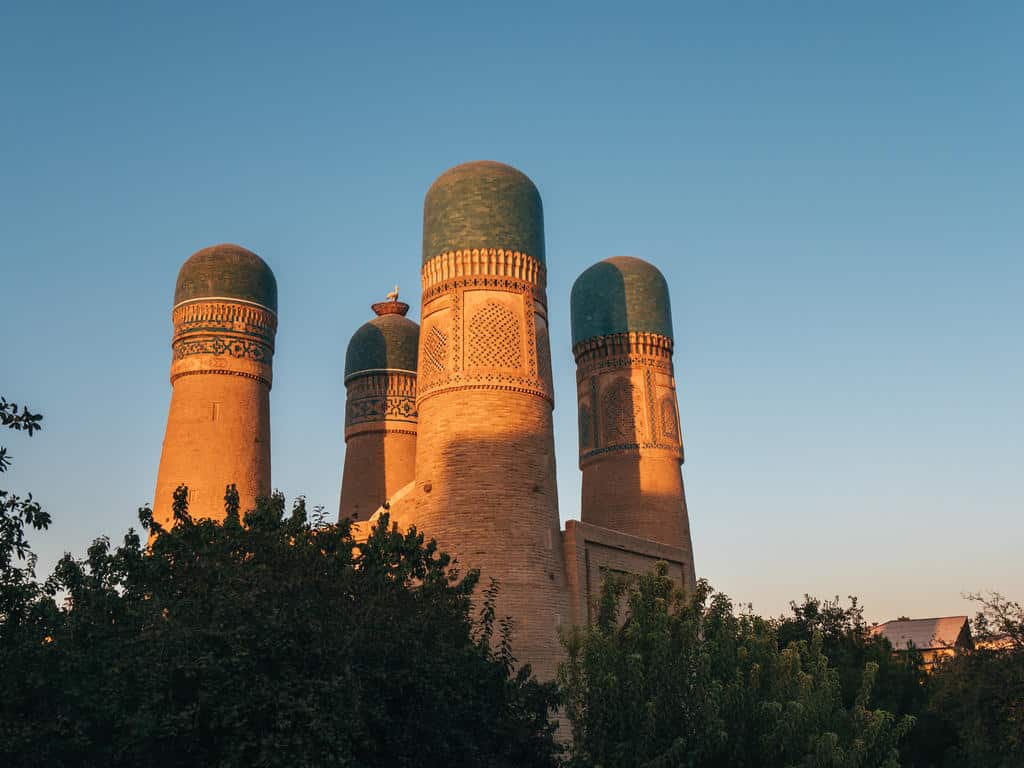
‘Chor Minor’ translates to ‘four minarets’ in Tajik *no prizes for how many towers it has*. The four represent the different religions and if you look closely, you can see hints of a Christian fish inscribed on one and a Buddist’s praying wheels on another. Neat, right?
These ‘minarets’ are technically just very lavish towers, used not for religious prayer but as an entrance portal to the madrasa. Only parts of the portal remain, including a hall which now functions as a shop. Only parts of the portal remain, including a hall which functions as a mosque. The towers now provide a cozy home for storks, who make their nests there.
TIPS FOR VISITING CHOR MINOR MADRASAH:
- The turquoise cupolas of this building glimmer at sunset so I’d definitely make your trip in the later hours of the day.
- The entrance here is free. You have to walk through a little souvenir shop and head up the stairs to the roof.
HOW TO GET TO CHOR MINOR MADRASAH FROM TASHKENT:
It’s super simple to get to Bukhara from the capital. There are two trains, a high-speed and a standard, that connect the two cities. You’ll find the schedule and times on the official Uzbekistan Railway website. Check out my Uzbekistan Railways Guide to learn how to book the train tickets and select your seats.
From the train station in Kagan, (the new part of Bukhara where you’ll get off), you can catch a 25-minute taxi to the madrasa. Taxi drivers waiting at the station are cheeky and some like to overcharge tourists but you shouldn’t pay more than 25,000 UZS.
Top tip: Install the Yandex Taxi app on your phone for a stress-free cab fix. The app is simple to use, and saves you hustling for a good price because it shows you the rate before booking.
Chor Minor is located further west from the other holy sites in Bukhara, so you’ll maybe have to factor that in when planning.
26. Pahlavon Mahmud Mausoleum, Khiva
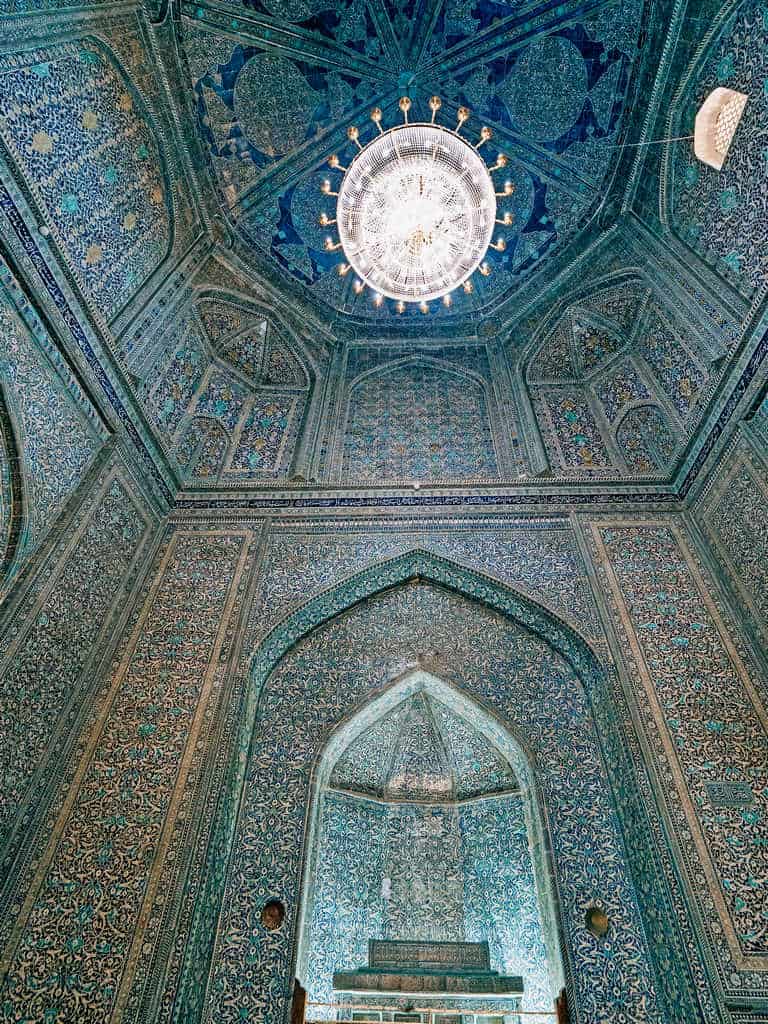
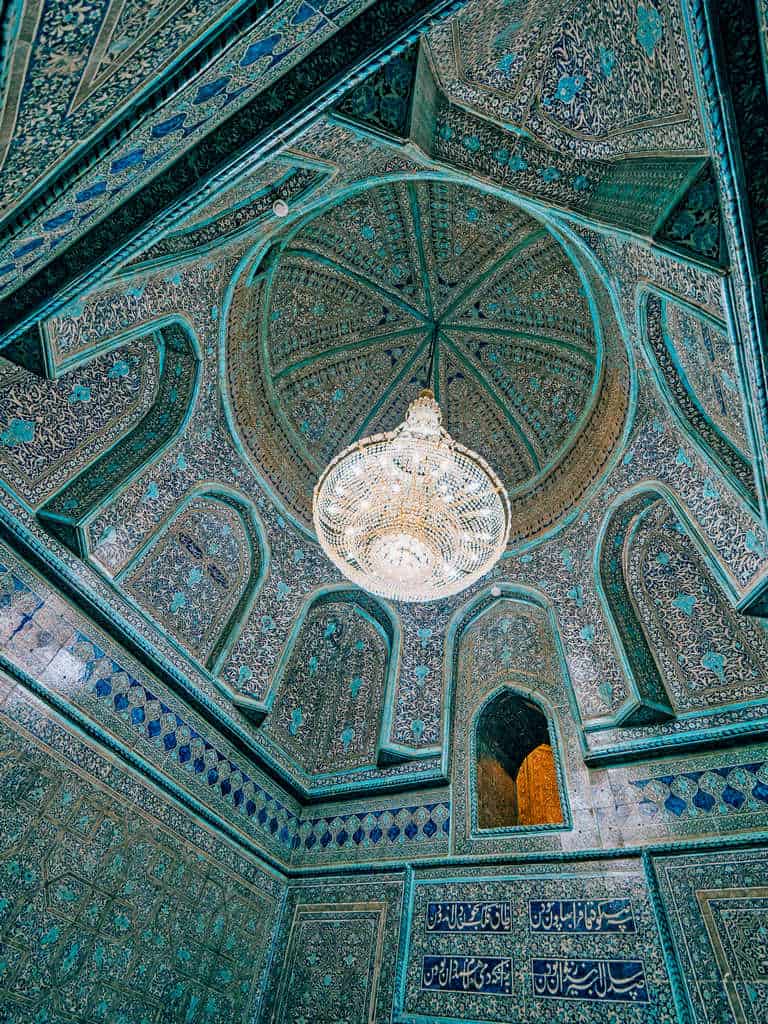
The Pahlavon Mahmud Mausoleum was built in memory of a man with many talents. In the 14th century, Pahlavon Mahmud was a celebrated Iranian poet and writer… and a flipping good wrestler.
Legend has it that Mahmud was defeated only once in a wrestling match, after he discovered that learning that his opponent would be executed if he lost.
He was widely known for being compassionate and loving. Don’t we love a man with *emotions*. It’s believed he rescued hundreds of slaves who were captured and kept in Khiva. Professional Iranian wrestlers continue to make prayers to Mahmud just before starting a match.
In the 14th century, Mahmud’s tomb was pretty modest and served its purpose for pilgrims and prayer. After a khan’s interception of the city in the 1800s, he decided the place needed some serious opulence and so radically revamped the site.
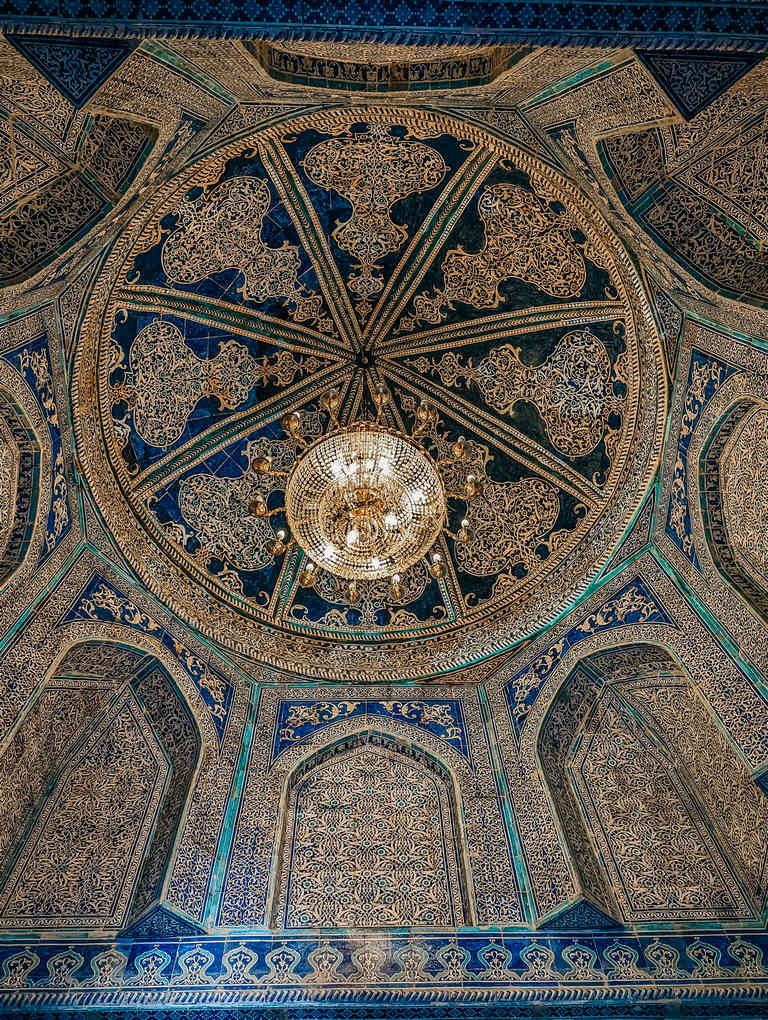
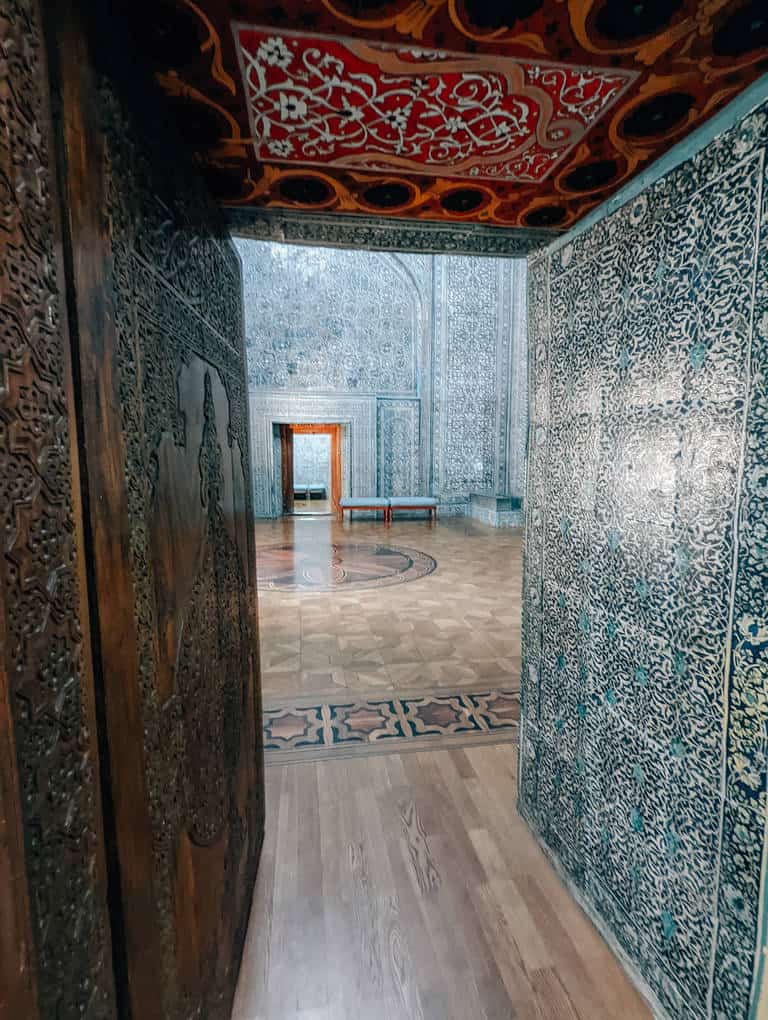
From across Khiva, you can see the majestic blue dome perched atop of the mausoleum. Inside is a spectacle in itself. The walls are adorned with an ocean of blue tiles, lit up by extravagant chandeliers.
TIPS FOR VISITING THE PAHLAVON MAHMUD MAUSOLEUM:
- It’s still the case now that many people come here as a holy pilgrimage. Please be respectful in all manners and don’t have dead loud conversations. Absolutely no Instagram photoshoots either… noone needs to see that 😉 This also means dressing suitably so no boobs, knees, thighs, shoulders, etc on show!
- You must remove your shoes to enter.
ENTRANCE FEE FOR THE PAHLAVON MAHMUD MAUSOLEUM:
You will have to buy a standard Itchen Kala ticket to gain entry to the city of Khiva which costs 100,000 UZS. To enter the mausoleum, it will cost an extra 25,000 UZS, but it is absolutely worth it!
HOW TO GET TO THE PAHLAVON MAHMUD MAUSOLEUM FROM TASHKENT:
You can book yourself onto a night train (roughly a 14-hour ride) from Tashkent to Khiva.
Read my Uzbekistan Railways Guide if you’re looking for all the details on how to get about by trains, and then book using the official Uzbek Railways website. From Khiva rail station, it’s an 8-minute taxi ride or a 30-minute walk to the mausoleum.
If you’re short on how much time you have to spare, domestic flights run between Tashkent and Nukus. They take around 1 hour and 40 minutes.
If you book your tickets in advance on the Uzbekistan Airways website, it should cost around 60 USD. From the airport, you can hop in a shared taxi to Khiva and follow the directions to get to the mausoleum.

Handy tips to visit Uzbekistan
And finally, some pearls of wisdom to pass on.
> Bread is sacred in Uzbekistan. Try not to leave chunks on your plate or drop on the floor. Especially don’t put it under your lap and save for later.
> In the mountain village homes, guest houses, homes and holy places, remove your shoes before going inside. Even if you don’t need to, it’s a sign of respect in Islam.
> Uzbekistan is very religious. Don’t be that person with your thighs/ shoulders/ chest/ breasts out. In Tashkent it’s a little more chilled, but as soon as you head out into the mountains, cover up. You can wear leggings that come down to your calf.
> Try to learn some basic Uzbek and Tajik phrases. I learned from many villagers that while they were happy to speak Russian, they absolutely loved it when I spoke their language. Also, download the Google Translate app. This was SO helpful. You can download languages offline which enables you to chat to people when there’s no signal.
> Don’t blow your nose at the table. Apparently it’s incredibly disrespectful and it will not go down well. By all means, itch your nose or wipe away snot with a tissue, but don’t go gung-ho and start emptying the bats in the cave. It’s actually pretty rude to blow your nose in public too so watch out for that!
> Veggies/vegans! If you stay with a family, it’s a huge sign of honour to present the guest with meat at dinner. You could try not eating the meat but it would be pretty disrespectful. Same goes for the other dishes with dairy etc really. Staying with mountain villagers, it’s near impossible to be vegan.
> Download a reliable GPS map app. Even if you’ve booked a guide, I think it’s sensible to plot where you’re headed for the day and if you’re hiking, send it to someone. You can also measure the elevation, distance and time there too. And also God forbid, you may accidentally wander off and get lost.
> SIM cards. If you’re desperate to get one at the airport, UCELL is your best bet. If you’ve got time to find a SIM shop, get a Uzmobile SIM. Everyone was using Uzmobile in the mountains and they got a signal really regularly. I found that (and was warned that) Beeline only works in the cities.

I hope this guide gave you the information and inspiration you were looking for to plan your trip to Uzbekistan. If you’d have any more questions, updates or concerns, let me know in the comments below or send me a message. I wish you a fantastic journey to Uzbekistan!
More USeful resources

Hiking in Uzbekistan – 6 best Hiking Trails in the Nuratau and Chimgan Mountains in Uzbekistan

How to get from Bishkek to Tashkent by bus – Travel from Kyrgyzstan to Uzbekistan

The 9 Best Things to do in Samarkand Uzbekistan – The 2026 Travel Guide to Samarkand City

Metro Tashkent – The Complete Guide to the 13 Most Beautiful Tashkent Metro Stations
The 20 Best Things to do in Bukhara Uzbekistan – The Complete Bukhara Travel Guide

Hi Cynthia, loving your blog with all these amazing tips, thank you so much! Would it be a good time to visit during the first week of December? Or would it be too cold? Too cold for me would be windy and below 8C.
Hi Di, it’s cold in Uzbekistan in December. Average temperatures are between 5° and 10°C so I think it will be too cold to your liking. From March on, it gets warmer so maybe that would be a better time for you weather-wise? Hope this helped.
Hi Cynthiya,
I really enjoyed reading your post! I’ve been living in Uzbekistan for the past five years, and I must say, I haven’t come across such a well-written and detailed guide before. The information you shared about commuting, historical facts, and local etiquette was truly outstanding! This just shows you the OG traveller! My sis is visiting in a couple of days and I have book marked your post for ref.
Keep up the great work. XOXO
Hi Fatima, thank you so much for your kind words! This really means a lot to me! Warm wishes, Cynthia
Hi Cynthia,
I am very much intrigued by Chimgan National Park, is it advisable to visit in January, especially the lake & hiking the Small Chimgan Peak.
Hi Kalyan, the Chimgan National Park will be covered in snow in January so it won’t be a good time to go hiking there. You can go skiing there if you like 🙂
Hi Cynthia,
What an amazing blog! Informative and practical, while on the other hand colourful and inspiring. I feel that I have received answers to all my questions about Uzbekistan! Your photos are also impressive and I can’t wait to see these beauties with my own eyes. Thanks
Thank you so much for your kind words Ildiko!
hi, do i need to book online for my train tickets from samarkand to tashkent and bukhara? and which site? or i can buy the tickets at the stations?
Yes, you can book them online or at the train station itself. I explain everything in this guide.
Hi Cynthia, thank you so much for your update info as I feel so much better after viewing your blog to Uzbekistan. I can feel your passion towards the places you have gone and how well you organized the useful info for the viewers, especially for those who will visit the Uzbekistan first time. I am a solo traveler around the world and will go to Uzbekistan in mid May for two weeks. It is very enjoyable to read your description and exceptional photos. Two thumbs up !!
Hi Caterlina, thank you so so much for your kind words! It’s my pleasure to help travelers planning and finding their way in destinations that stole my heart. Have a fantastic time in Uzbekistan!
Bukhara Khiva train timetable has changed.
Thanks for the update Samy. Best is indeed to check the train timetable directly on the Uzbek Railway website as the timetables might change depending on the season.
Hi Cynthia – I have to say I LOVE your blogs! I carefully reviewed the ones for Kyrgyzstan and Tajikistan so no wonder I came straight to yours for Uzbekistan! I am on a mission to see every country in the world and this summer I am planning a 2 week trip through these countries. Thanks to your blog I feel a lot more prepared! Thank you Cynthia and keep up the exceptional work!
~ Hamada (Final50.world)
Hello Hamada, thank you so much for your kind words! I’m really glad my blog is helping you preparing your trip! Have a great time in Uzbekistan!!
This is so incredibly helpful, thank you!!
Happy to help Laura! 🙂
Hi Cynthia
The effort you have put in to share your knowledge of the country is commendable. I can’t tell you how helpful your blog has been.
Im planning a trip to Uzbekistan next month and was curious that Termiz hasn’t figured in any of your suggested itineraries. Since it’s way down south , do you think it would be still worth considering ?
Hi Naghma, I haven’t been to Termiz yet or know other travelers who’ve been so I can’t tell if it’s worth considering. However, if you’d decide to go there, please let me know how your visit was and if I should add it to the itineraries!
Hi Cynthia,
thanks for this detailed compilation – very inspiring and informative!
I have two questions:
+ Do you know what travel is like at the moment due to covid? Are there still restrictions in travelling between provinces? Are all tourism sites, restaurants, bars, clubs already open as usual?
+ Is June a good time to travel there or is it too hot? (I generally take the heat quite well)
Thanks a lot!
Hi Melanie, thank you! To answer your questions:
1) Everything should be open now. Just keep in mind that it can change quickly and randomly but at this point in time, traveling between the provinces shouldn’t be a problem
2) June is a good time to travel. The average temperature in the Uzbekistan cities will be between 30°C – 35°C but it’s a dry heat. So if you can take the heat well, you should be fine.
Have a great trip!
Wow! A true complete and detailed itinerary indeed! Would love to travel here soon when all is well. Amazing photos! Which among top 4 places is best to travel with kids in tow? Thanks!
Hi Sharon, thank you! You could bring your kids to any of these cities. I think they’ll like Khiva and Bukhara best as those cities have something fairytale-like 🙂