
Are you an independent traveler and planning to visit Kyrgyzstan soon? Then this is the Kyrgyzstan Travel Guide you’re looking for! Here is everything you need to know about traveling to Kyrgyzstan!
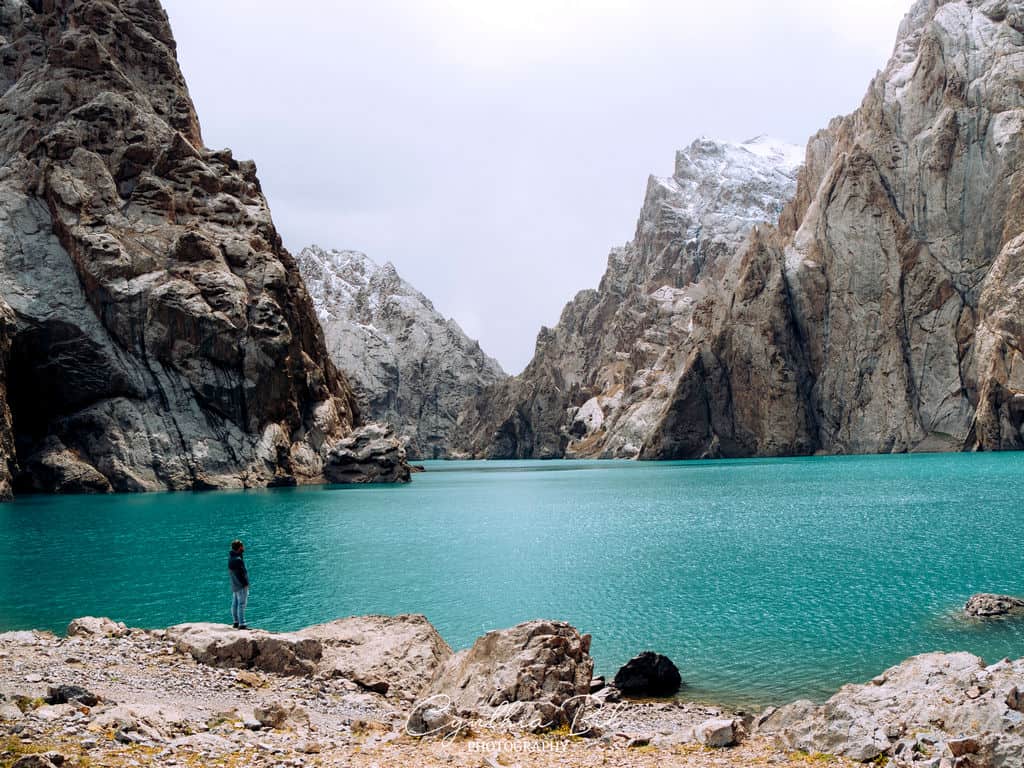
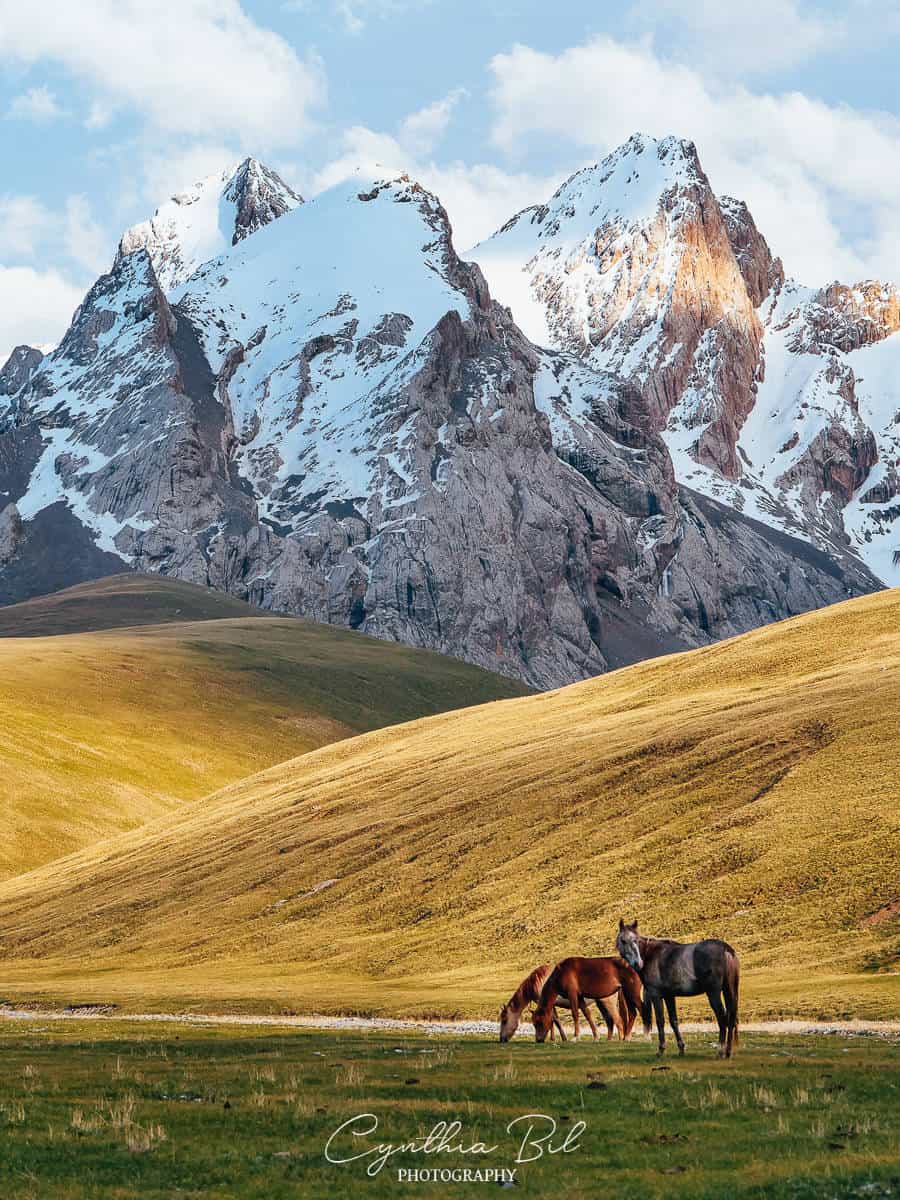
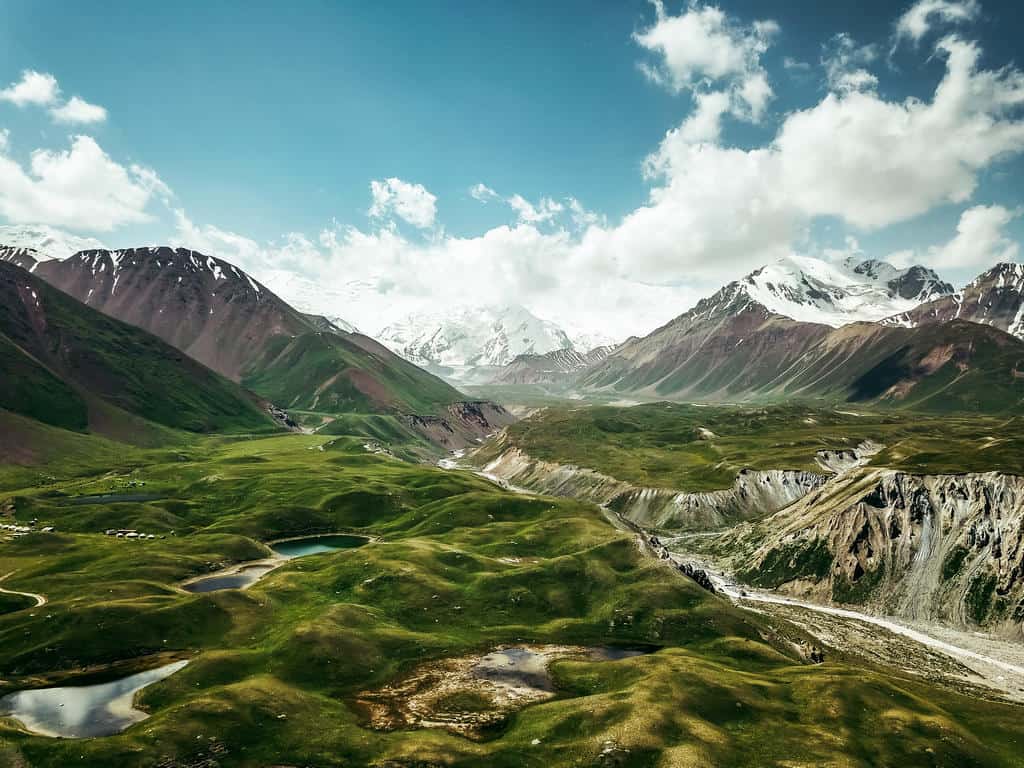
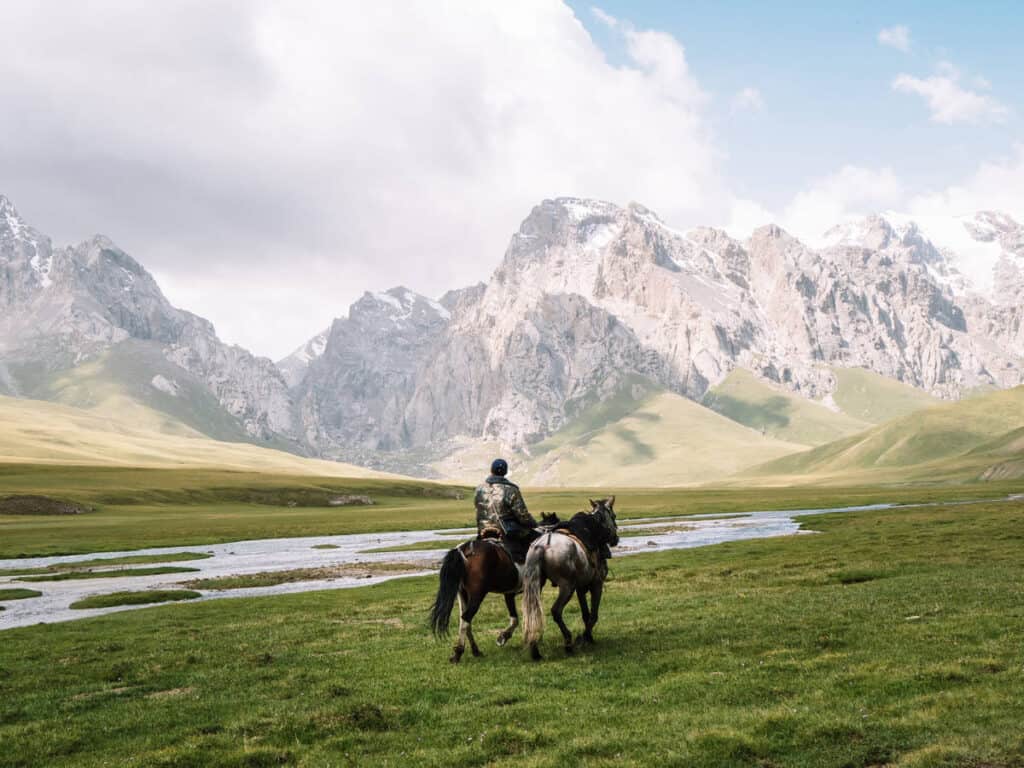
The Kyrgyz Republic – or simply Kyrgyzstan – is a small landlocked country in Central Asia. The country is defined by the beautiful Tien Shan mountain range which occupies 80% of the country, lush valleys, and hundreds of crystal-clear alpine lakes.
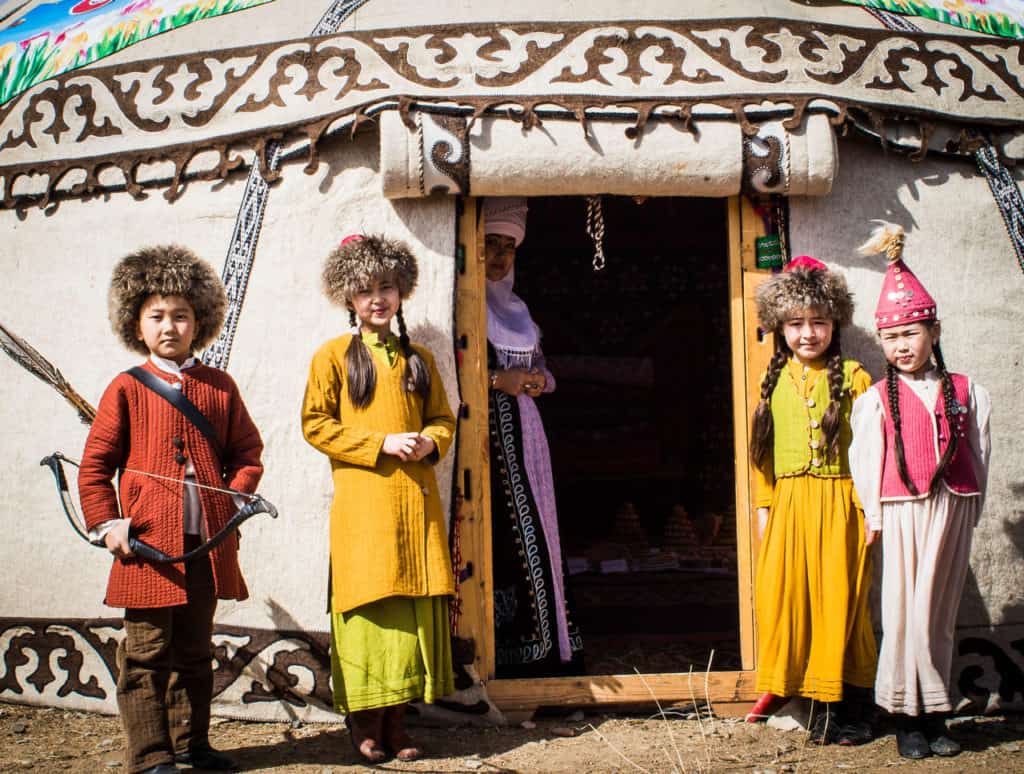
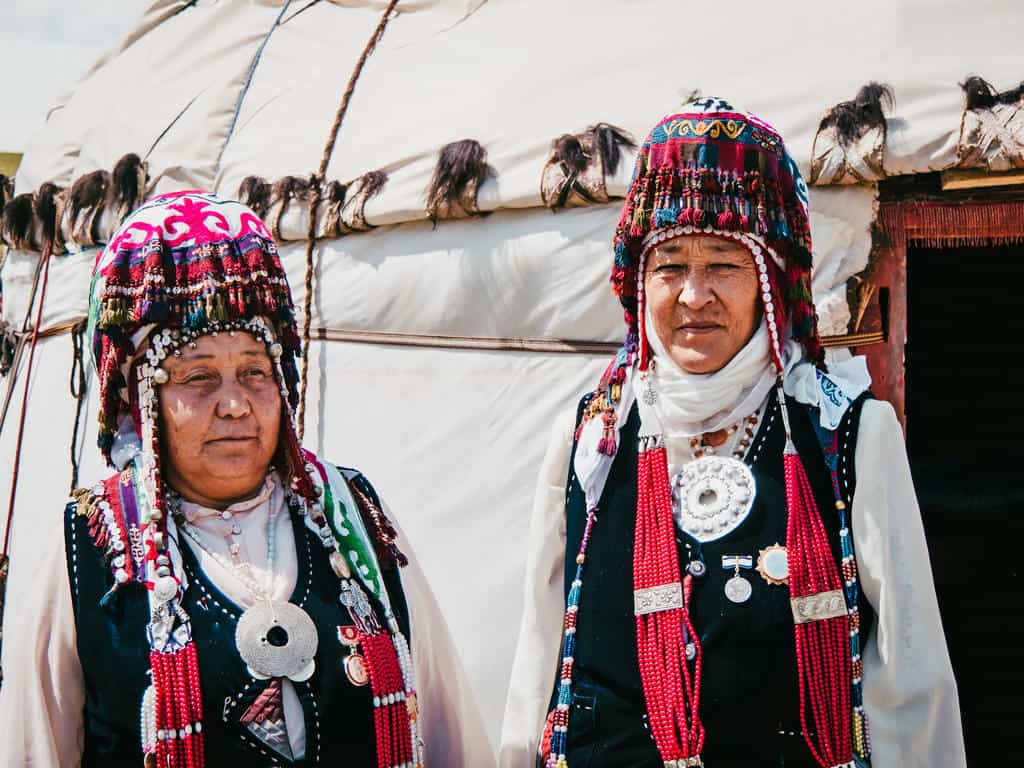
Kyrgyzstan is also a land of nomads who still strongly value their centuries-old nomadic traditions.
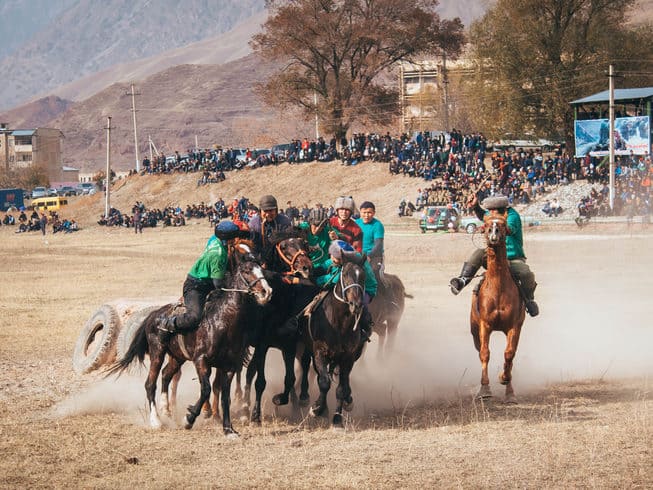
They are expert horsemen and national games in which they demonstrate their equestrian skills, such as Dead Goat Polo, which are an integral part of the Kyrgyz culture.
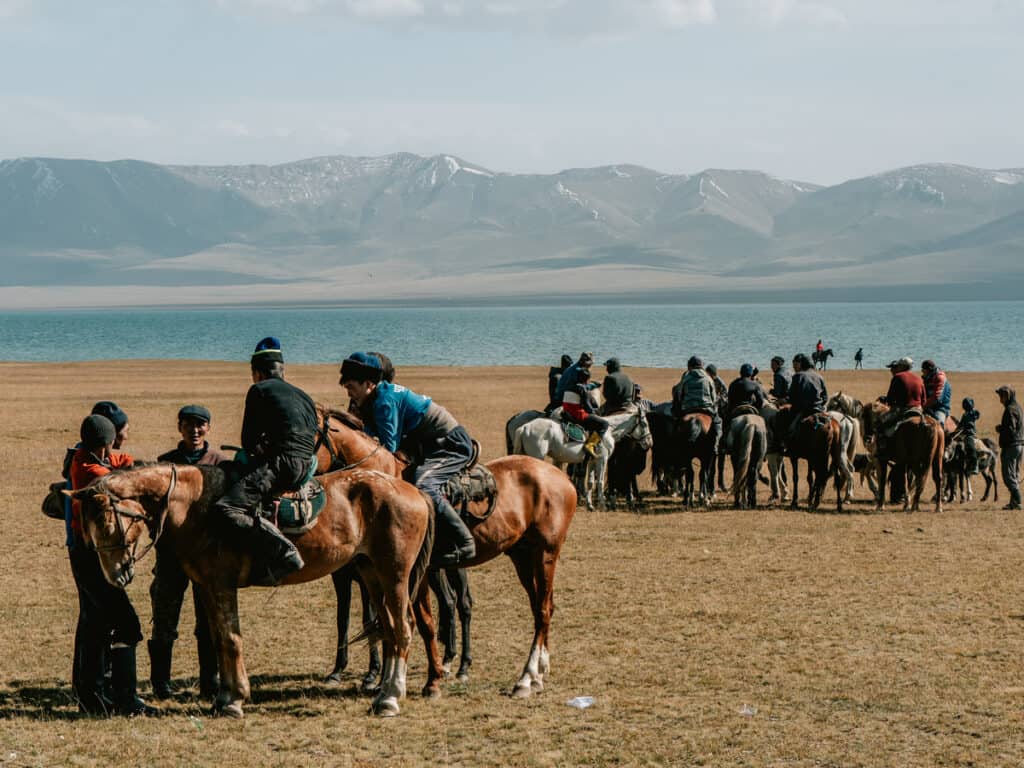
If you like being in the wilderness and you’re interested in learning more about the nomadic lifestyle in Central Asia, then you’ll absolutely love Kyrgyzstan! It’s one of the few off-the-beaten-path countries where you can still get a taste of the authentic nomadic culture.
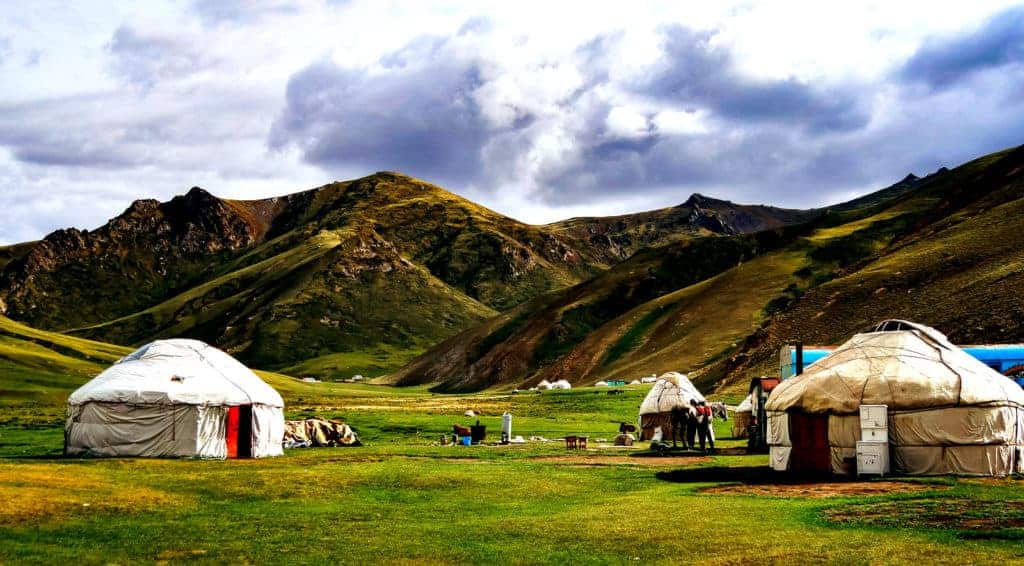
I lived and traveled in Kyrgyzstan for 11 months and keep returning yearly to organize adventure tours and explore new destinations in the country. I consider it as my second home.
At this point, I’d say I became an expert when it comes to Kyrgyzstan travel and like to share my love for it with you.
This Kyrgyzstan Travel Guide brings together all my knowledge and experience. I cover everything from visas, entry requirements and safety to transport, accommodation, food, useful apps and cultural etiquette to help you prepare your Kyrgyzstan trip to the fullest!
Are you looking for a customized guided tour in Kyrgyzstan or elsewhere in Central Asia? Or would you like help with planning your itinerary and organizing your trip with confidence?
👉 Explore my Central Asia tours and itinerary planning services!
Disclaimer: This posts might contain affiliate links, meaning that if you make a purchase through these links, I may earn an affiliate commission. Thank you for helping to support this website!
Plan your trip to kyrgyzstan!
✈️ Find the cheapest flights → Check fares to Bishkek or Osh
🏨 Find hotels & yurt stays → Browse the best accommodation deals
📱 Stay connected → Get a Kyrgyzstan eSIM
🛡️ Travel insurance → Don’t travel Central Asia without coverage
🎒 What should you pack? → Read my Kyrgyzstan packing list
🥾 Want to go hiking? → Discover the most beautiful hiking trails in Kyrgyzstan
🐎 Want to go horse riding? → Check out my favorite horse trekking experiences
🗺️ Need help planning your route? → Learn about my itinerary planning services
⛰️ Prefer traveling with a group? → Join one of my Kyrgyzstan adventure tours
1. Visiting Kyrgyzstan in 2026 – Kyrgyzstan Entry Requirements
You don’t need any mandatory vaccinations to travel to Kyrgyzstan. Vaccinations for Hepatitis A and Typhoid are recommended, especially if you are visiting smaller cities or rural areas, or if you are an adventurous eater.
The government of Kyrgyzstan requires proof of yellow fever vaccination only if you’re arriving from a country with a risk of yellow fever.
2. Do I need a visa to travel to Kyrgyzstan?
Most nationalities can enter Kyrgyzstan on a free tourist visa and remain there for 30 days within a time frame of 60 days. Here’s the list of nationalities that can enter Kyrgyzstan visa-free. All other nationalities have to apply for an e-Visa.
Citizens from Mongolia and Ukraine can stay up to 90 days within 180 days without a visa and citizens from Malaysia and Turkey are allowed to stay visa-free in Kyrgyzstan for up to 30 days.
Travelers from Armenia, Azerbaijan, Belarus, Cuba, Georgia, Japan, Kazakhstan, Moldova, North Korea, Russia, Tajikistan, and Vietnam can stay for an indefinite time!
All the other countries have to obtain a visa. Check this website to see what visa you’re eligible for.
Since 1 September 2017, the Ministry of Foreign Affairs of Kyrgyzstan has launched the e-Visa system, for which you can apply here. The e-visa for Kyrgyzstan costs US$61 and it takes about one week to get it.
However, sometimes these things take longer in Kyrgyzstan so apply at least one month ahead to be certain! Some nationalities will also need a Letter of Invitation (LOI) while applying for the visa.
You can check your visa requirements for Kyrgyzstan here:
Can I extend my Kyrgyzstan visa?
It used to be possible to renew the Kyrgyzstan visa by doing a visa run into one of Kyrgyzstan’s neighboring countries. However, the law changed in October 2023 and visa runs aren’t possible anymore.
If you want to stay longer than 30 days within 60 days or 90 days within 180 days, you’ll need to apply for an e-visa or visit a Kyrgyz Embassy outside of the country. Almaty in Kazakhstan is probably the best place to apply for a new visa.
What happens if I overstay my Kyrgyzstan Visa?
If you’re overstaying , you need to pay a fine and get an exit visa at the Department of Registration located at 58 Kievskaya street in Bishkek. The total cost of overstaying is currently around $60 USD.
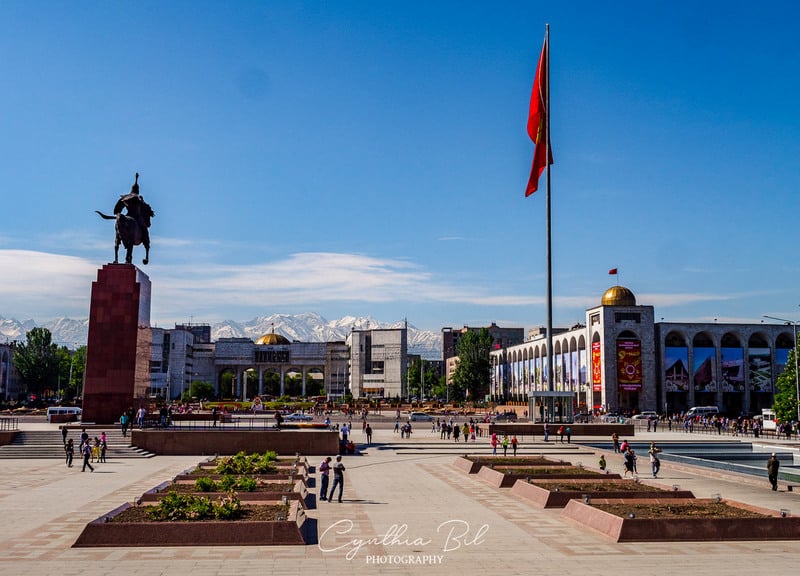
3. When is the best time to visit Kyrgyzstan?
The best time to visit Kyrgyzstan is from late spring (mid-June) to early autumn (end of September) if you want to do some hiking and horseback treks in the mountains and stay at the yurt camps of the Kyrgyz nomads.
However, you can visit Kyrgyzstan all year round, depending on what you want to see and do during your trip.
3.1 Why Is summer the best time to visit Kyrgyzstan?
Summer (July and August) is the high season in Kyrgyzstan.
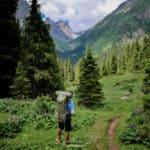
This is the time when all the mountain passes are accessible so ideal if you want to go for day hikes or multiple day-treks, camping, mountain biking, or horse riding.

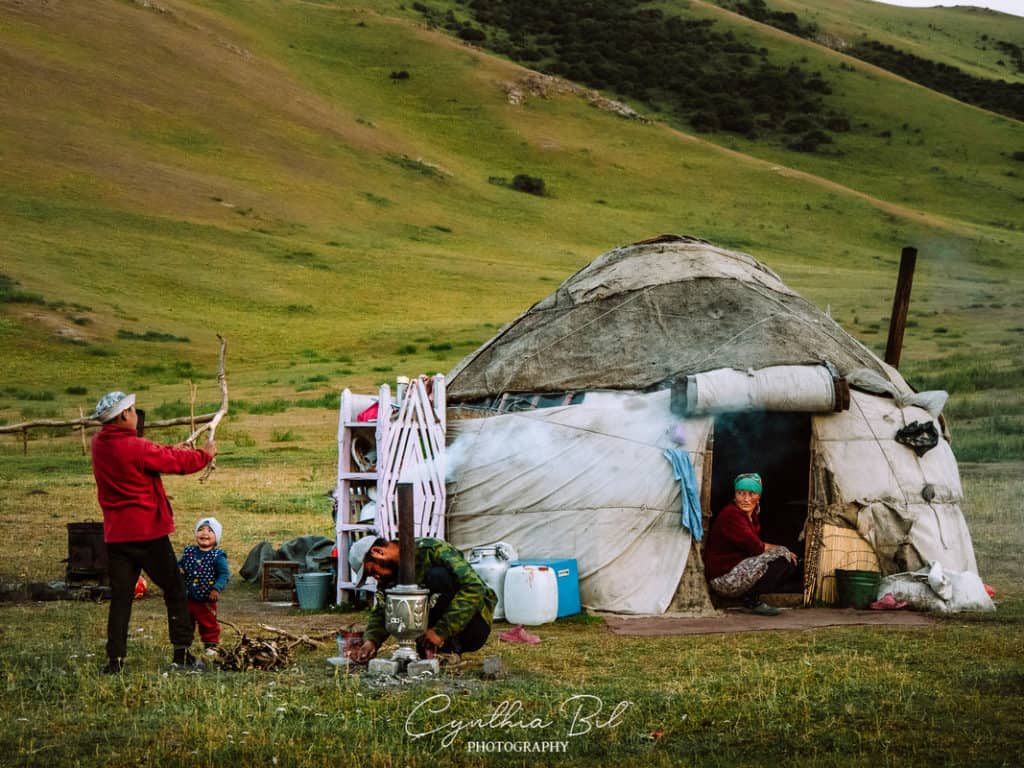
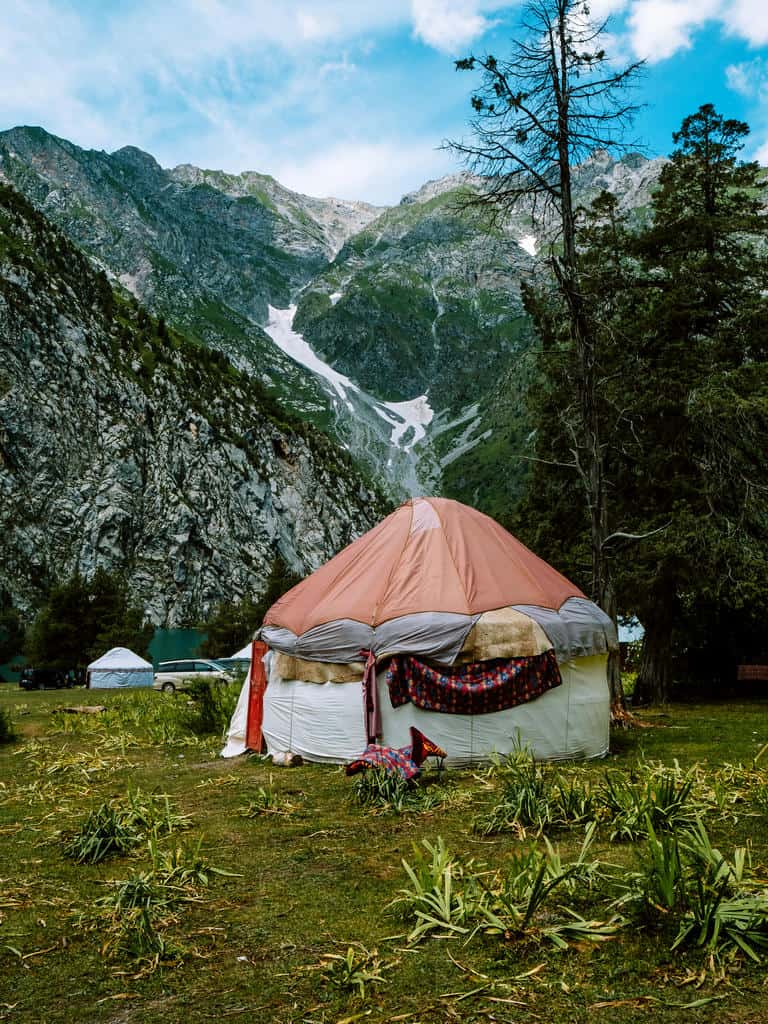
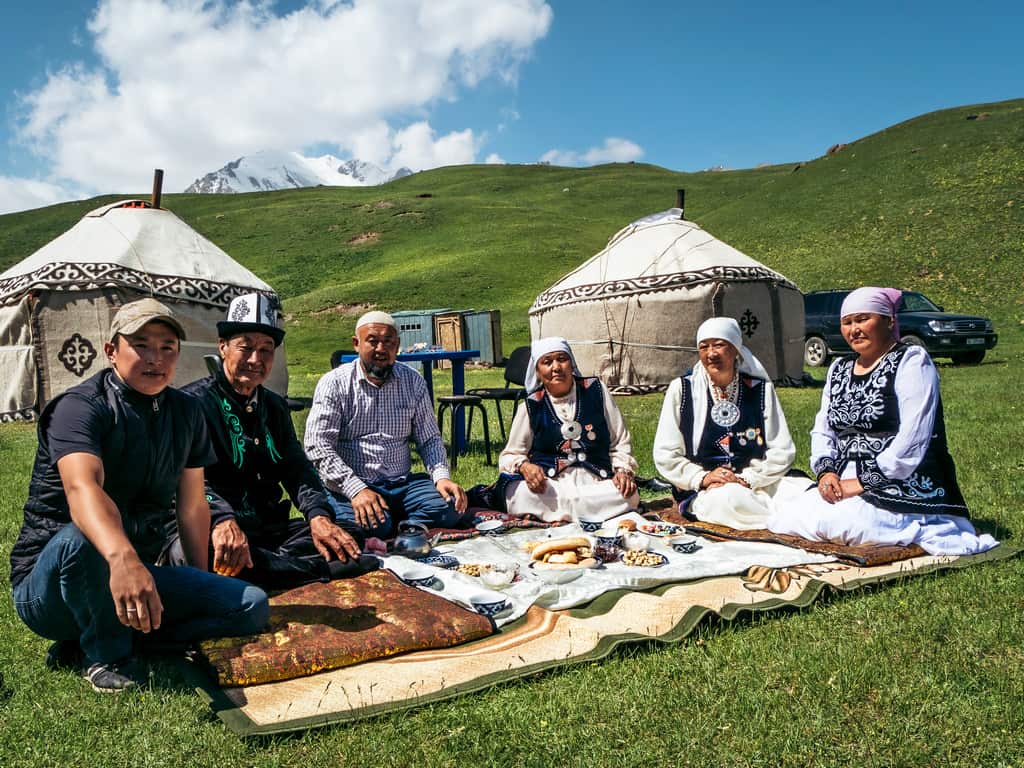
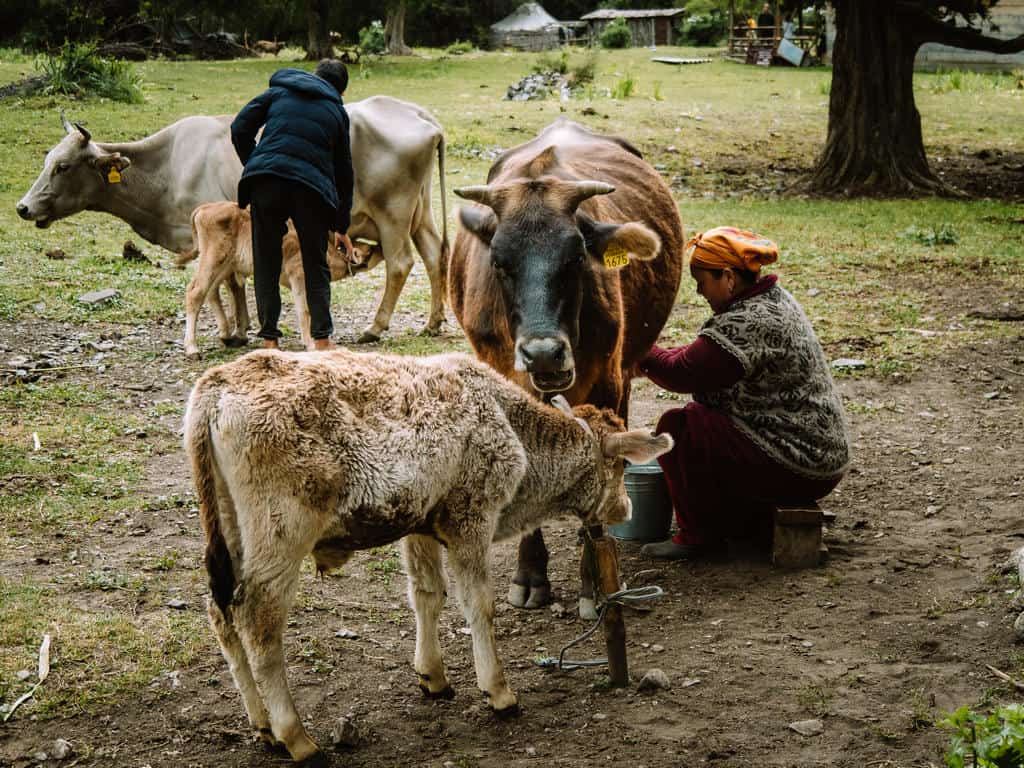
Summer is also the time of the year when the semi-nomads have their yurt camps set up in the jailoos (summer pastures) so their herds of sheep, goats, horses, and cows can graze freely in the wild. They often have an extra yurt available for travelers and tourists.
If you like to stay with a semi-nomadic shepherd family and learn more about their daily life in the mountains, then summer is the best time to visit Kyrgyzstan!
Many folkloric events and national festivals are being held during summer. The most popular ones are:
- The National Horse Festival in July during which skilled horsemen love competing in various horse games.
- The Birds of Prey Festival in August, during which Golden Eagle Hunters take part in contests. Horse games and folkloric shows are also part of the festival
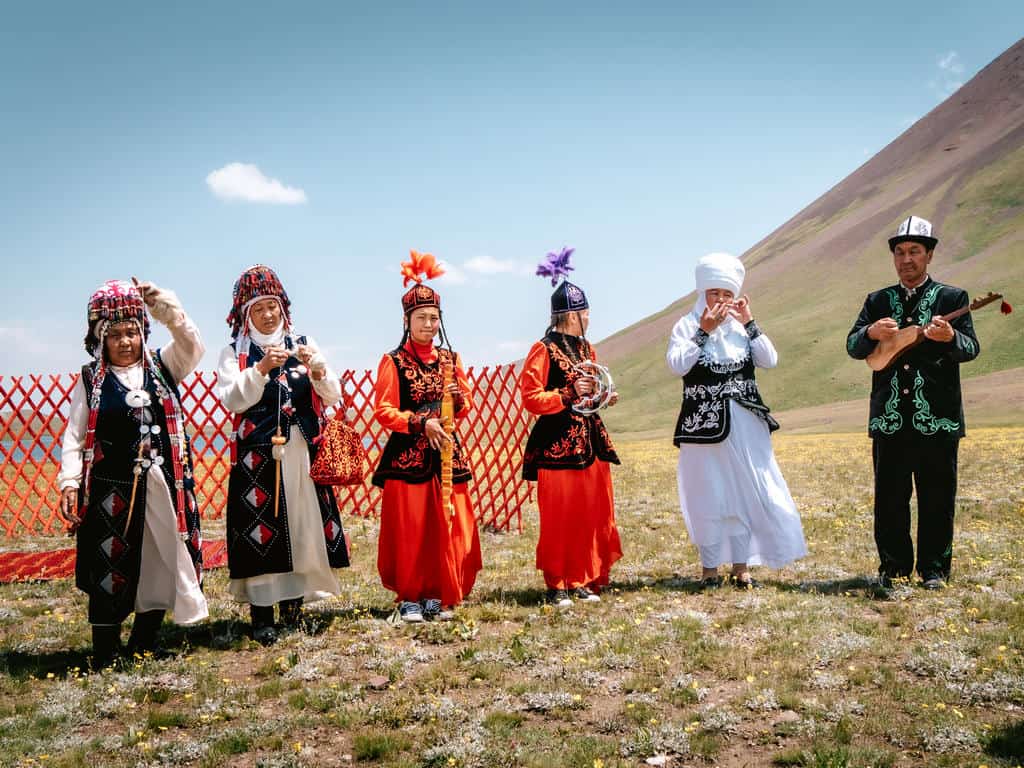
- The Kyrgyz Kochu Festival, also an event celebrated in August, marks the annual migration of the nomadic shepherds and their flocks from the high summer pastures to the lowlands in winter. Horse games, national games and folk music are the highlights of this festival.
3.2 Are spring and autumn a good time to visit Kyrgyzstan?
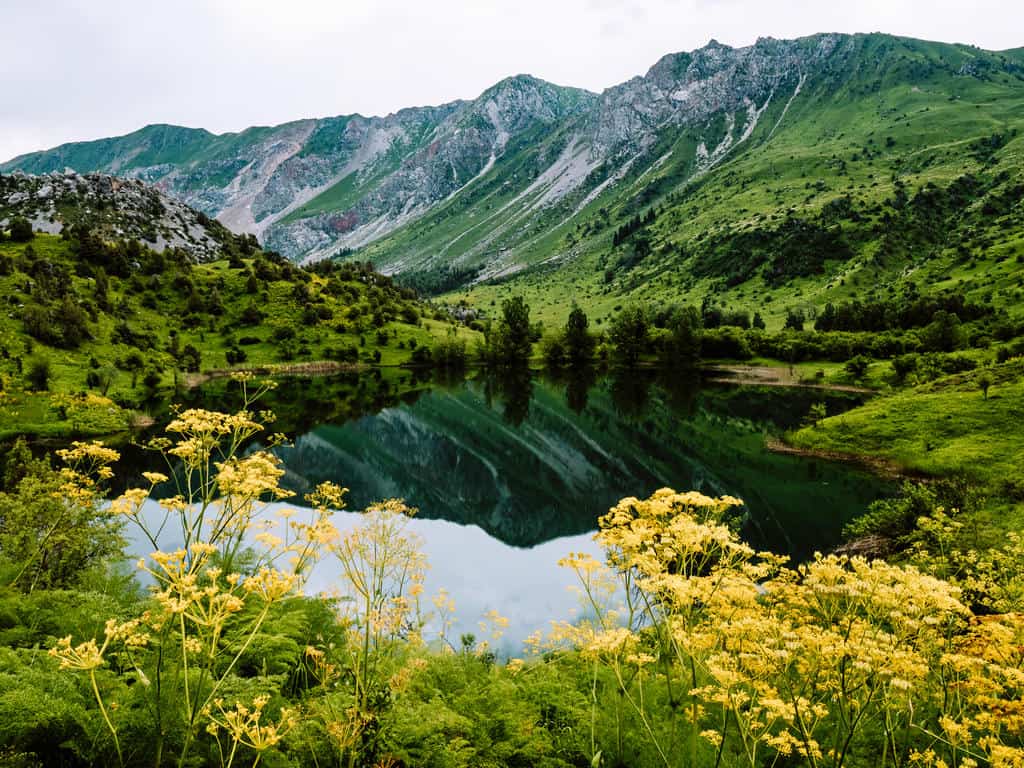
Late spring (end of April – June) and early autumn (mid-September – October) are also still good times to visit Kyrgyzstan.
Not all mountain passes will be accessible and you won’t see many yurt camps (only yurt camps belonging to local tour companies stay from mid-May to end-September) but you can still visit some beautiful places and go hiking in the lower mountains.
Places in Kyrgyzstan that are worth visiting in spring and/or autumn:
- The stunning lakes at Sary Chelek National Park
- Hiking or horse riding in the Lower Alay Mountains
- Participating in the walnut harvest in Arslanbob in October
- Enjoying the first (or last) summer vibes at Lake Issyk Kul
3.3 Should I visit Kyrgyzstan in winter?
Winter (November – March) in Kyrgyzstan is usually very cold (-25°C or lower in the mountains) and most mountainous places aren’t accessible.
But if you don’t mind cold and you love skiing and snowy landscapes, then traveling in Kyrgyzstan during the winter will be a unique and magical experience!

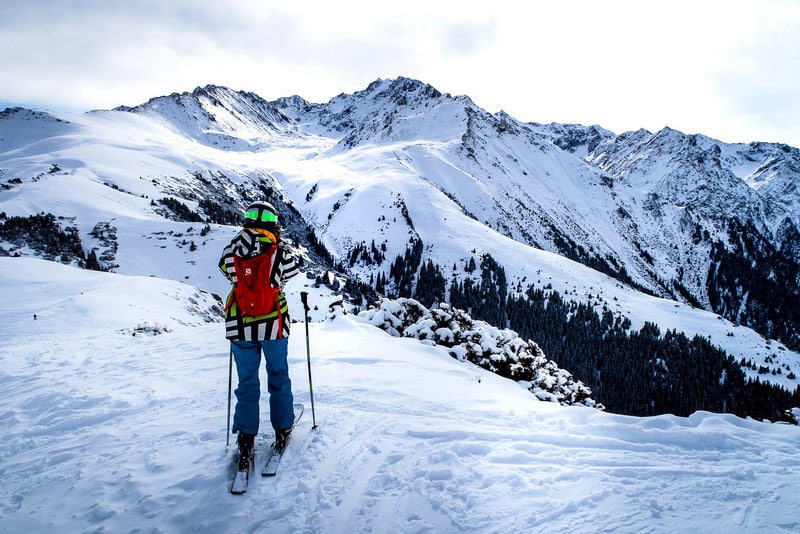
One of the top things to do in Kyrgyzstan in winter is skiing!
There are about 20 ski resorts in Kyrgyzstan with Karakol being one of the best ski resorts in Central Asia. For more information, read The Complete Guide to Skiing in Kyrgyzstan.
While some areas might be harder or impossible to access when it snows, it doesn’t mean that there’s nothing to do in Kyrgyzstan during the winter.
Here are some options:
- going on a horseback trek to Son Kul lake in winter
- bathing in the hot springs in Altyn Arashan
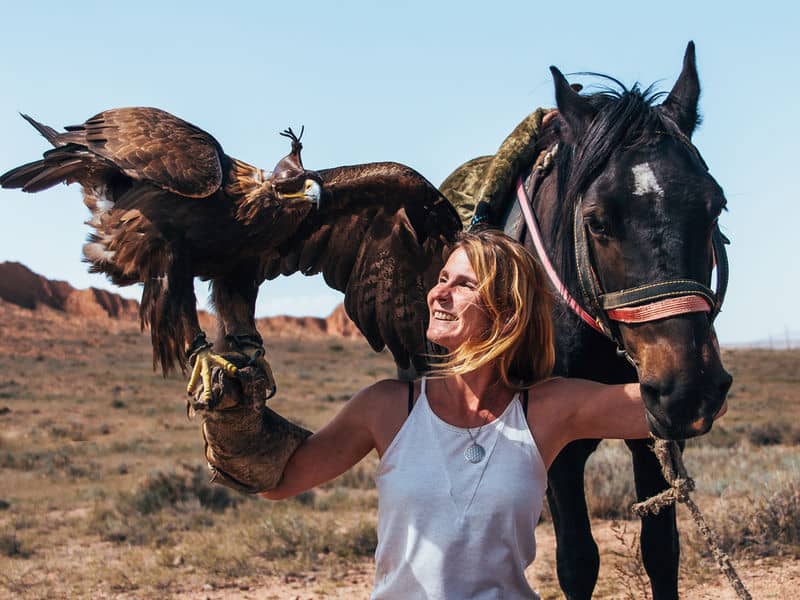
- witness the golden eagle hunters in full action as the hunting season starts in late October and lasts until the end of February
- go paragliding and cat skiing in Jyrgalan


If you want my help with planning a customized itinerary and activities suitable for the season you’re traveling to Kyrgyzstan, don’t hesitate to contact me!
4. Where should you go in Kyrgyzstan?
There are so many beautiful places to visit in Kyrgyzstan that you could easily spend months in the country! It also depends on your interests and preferences.
Kyrgyzstan isn’t a destination for urban exploration like its neighbor Uzbekistan. With the exception of Bishkek, Osh and Arslanbob, most towns and cities aren’t really that interesting to visit. The most interesting places are found in the countryside and mountains.
If you’re interested in historical and world heritage sites, then you should definitely visit Burana Tower, Tash Rabat, and Sulaiman Too Sacred Mountain.
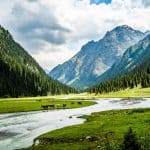

If you love nature, mountains, and alpine lakes, then you can’t miss out on the areas and lakes of Kel Suu, Son Kul, Ala Kul, Issyk Kul and Sary Chelek.
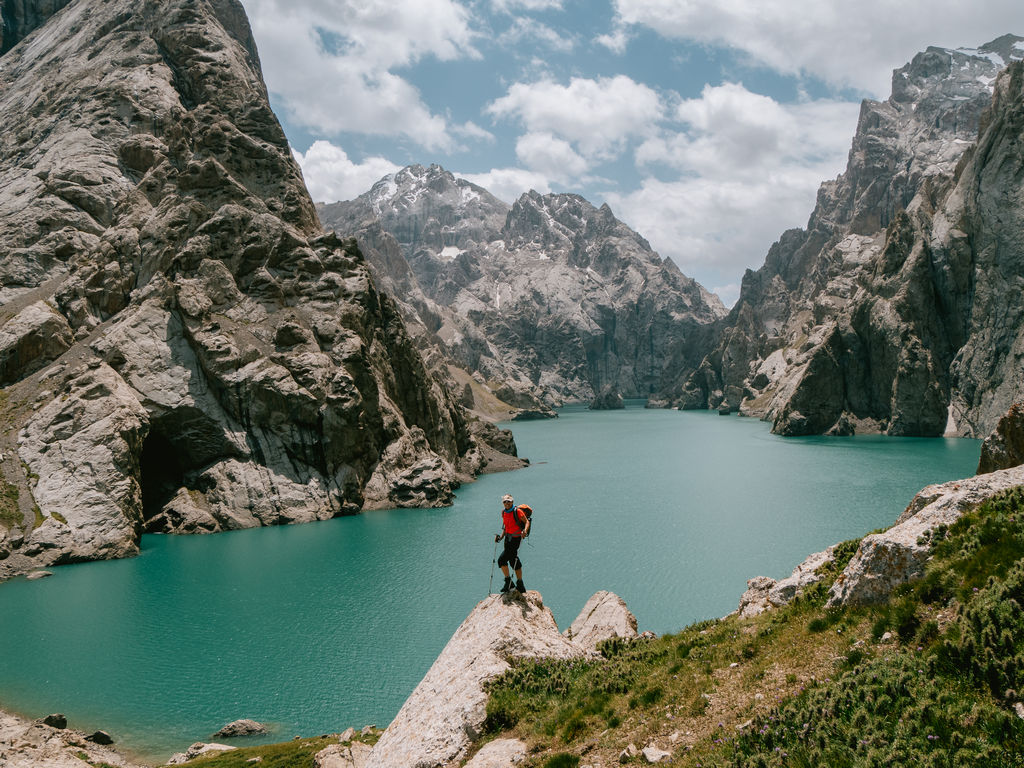
However, there are many more stunning places to visit in Kyrgyzstan than only the few I mentioned above.
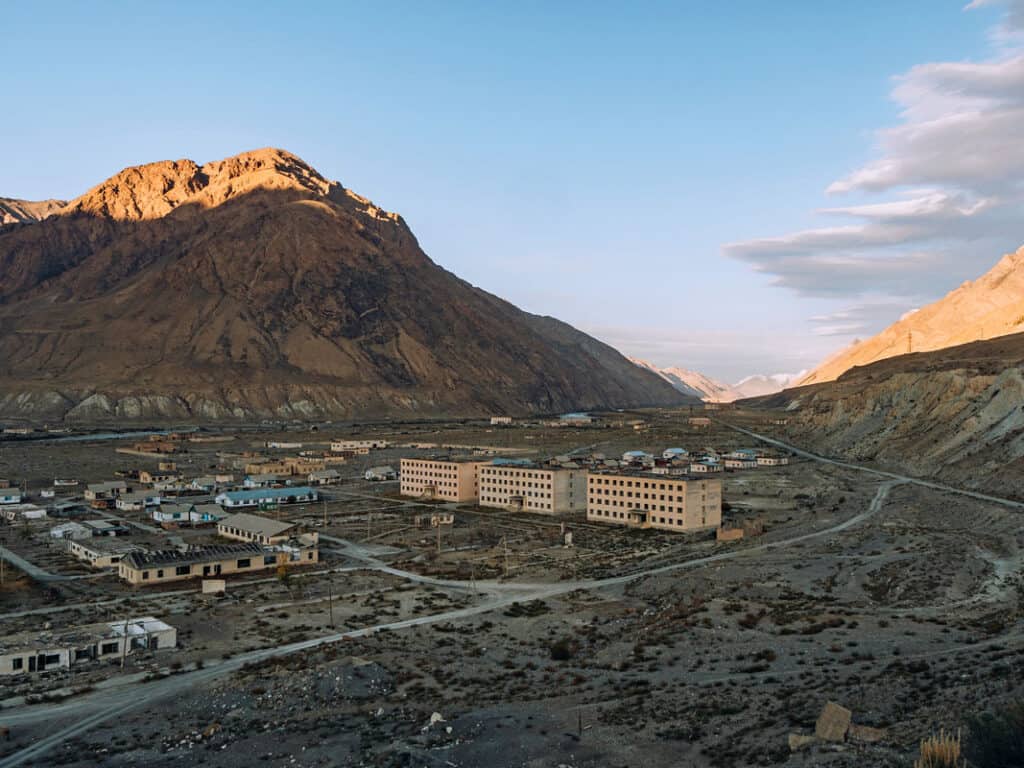
5. What are some fun things to do in Kyrgyzstan?
Kyrgyzstan offers a wide variety of cultural and outdoor activities. Try to put at least one of the following in your itinerary to experience what Kyrgyzstan is all about:
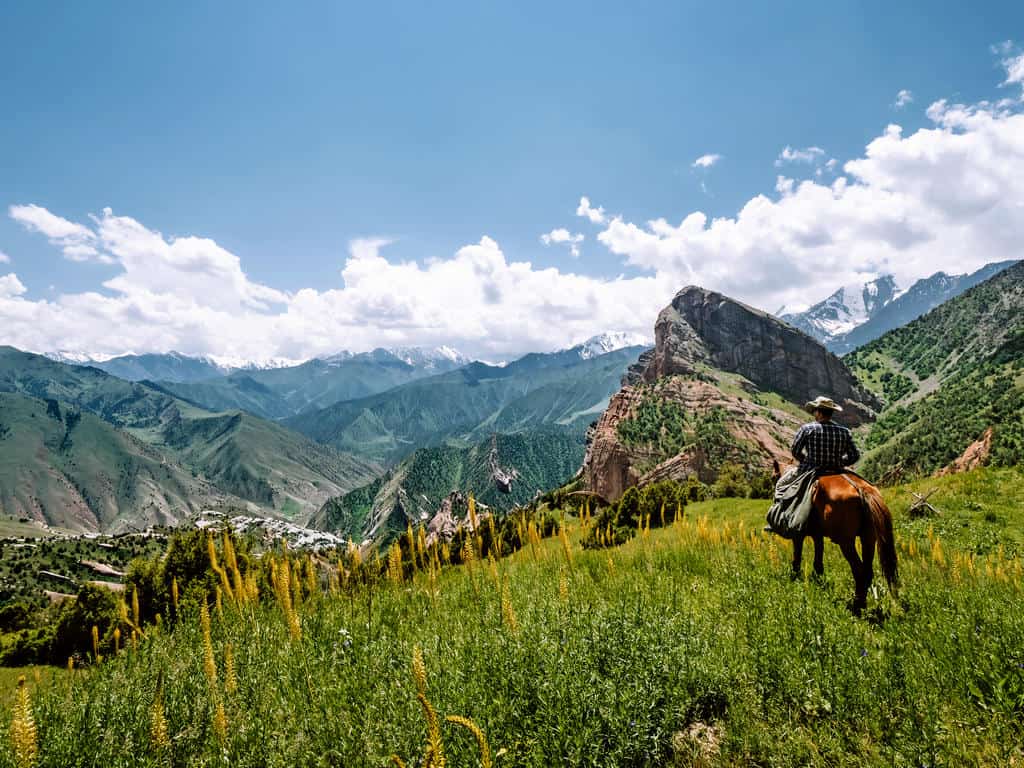
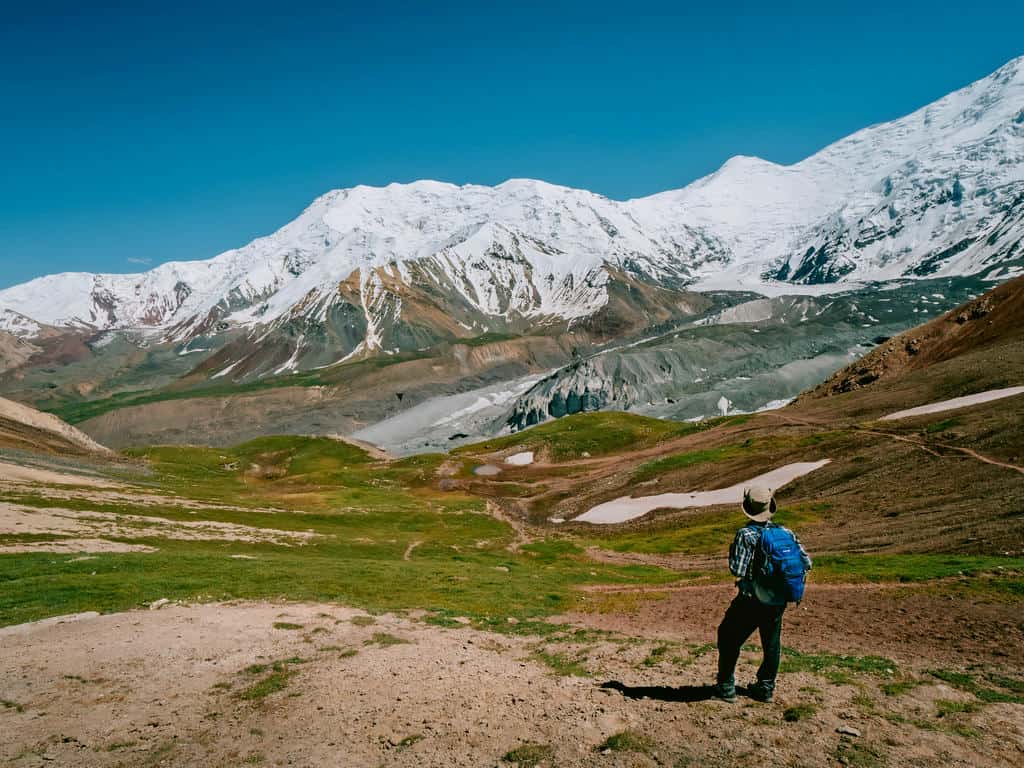
- Go for a hike in the mountains. Kyrgyzstan is one of the top trekking destinations in the world! Even if you’re not super fit, there are still some beautiful day hikes you can do without breaking too much of a sweat.
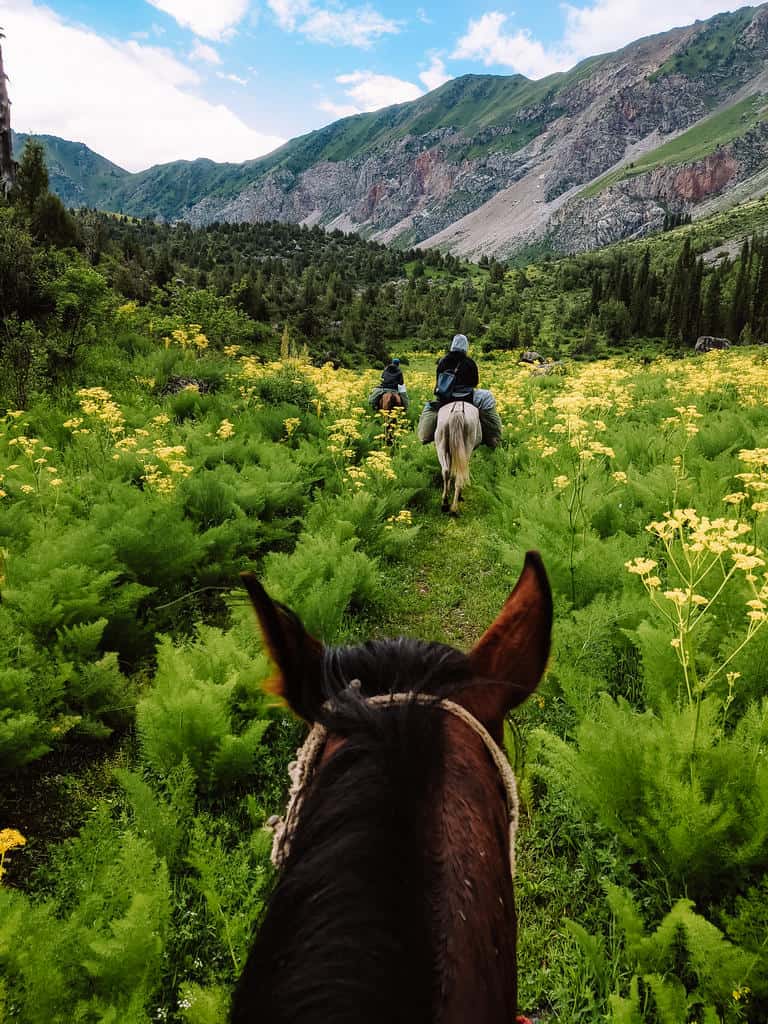
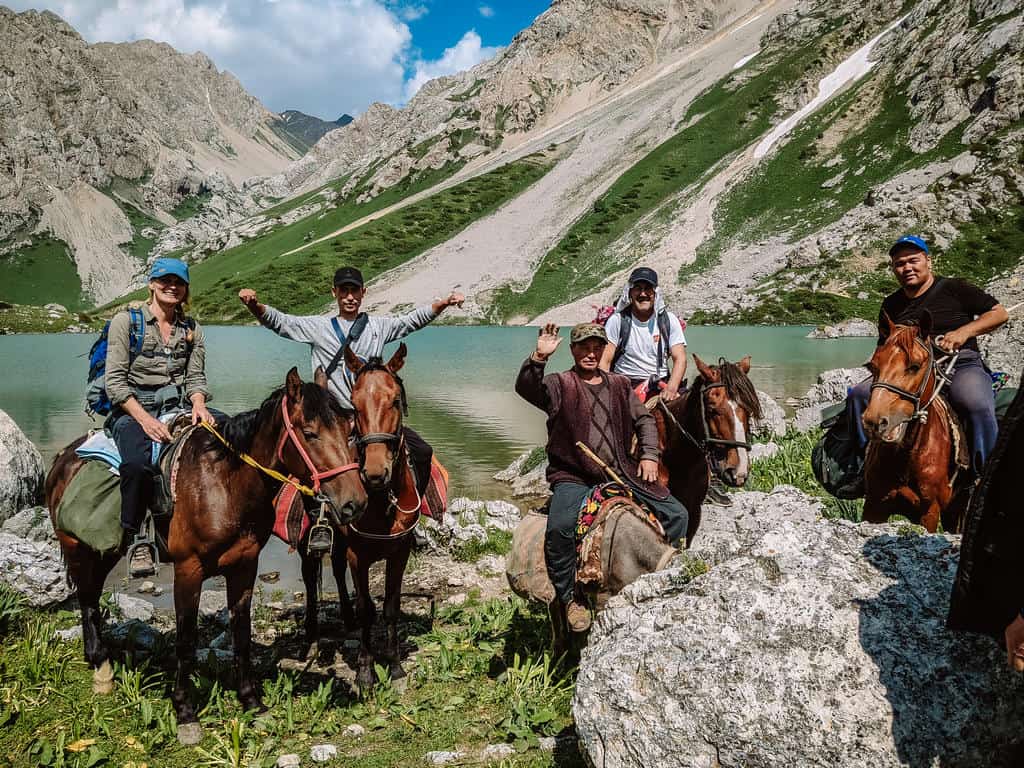
- Go horse riding. Horses play a central part in the daily life of the Kyrgyz people and horse treks are one of the highlights when traveling in Kyrgyzstan.
- Sleep in a yurt camp. Experiencing the nomadic life in Kyrgyzstan will be another highlight of your visit to Kyrgyzstan. I’ll share more details about staying at a yurt camp below in the section Where to stay in Kyrgyzstan
- Attend a folkloric festival with national horse games. The nomadic games in Kyrgyzstan are a must-see! However, it’s not always clear when or where these festivals are going to happen. I got lucky to be a few times at the right place on the right moment. The best place where you might get to see a spontaneous game of Kok Boru would be at Son Kul lake.
- Participate in a cultural workshop to learn more about yurt building, felting or cooking a traditional meal. The best place for this is on the southern shore of lake Issyk Kul.

6. Kyrgyzstan Travel Insurance
It’s not mandatory to have travel insurance to travel to Kyrgyzstan but I highly recommend getting one if you’re planning on hiking, skiing or horseback riding in the mountains.
An accident can happen fast and it’s better to be fully insured to avoid expensive medical costs.
I highly recommend the backpacker insurance provided by HeyMondo as it covers adventurous activities such as horse riding, skiing and trekking at high altitude. Read here for all info and details.
Need Travel Insurance for Central Asia? I use and highly recommend HeyMondo Travel Insurance. As a reader of Journal of Nomads, you get a 5% discount off your insurance plan!

7. How to get to Kyrgyzstan
7.1 Where do you fly into for Kyrgyzstan?
Kyrgyzstan has two international airports.
Manas Airport (BSZ) in Bishkek, the country’s capital city, is the largest international airport in Kyrgyzstan.
There are a number of airlines that fly into Bishkek. I recommend Turkish Airlines or Pegasus (via Istanbul) or Fly Dubai (via Dubai), depending on where you’re flying from. Search for the best deals here.
Osh Airport is a small international airport in the southwest of the country with about 30 international flights per week, mainly to and from Tashkent (Uzbekistan) and Moskow (Russia).
How to get from Bishkek Airport to the city
Bishkek airport is a 30-minute drive from the city center
The standard rate for a taxi from the airport to the center of Bishkek ranges around 1000 Kyrgyz Som (KGS) – $11 USD -, depending on the taxi company.
Most likely you’ll be welcomed by many taxi drivers who’ll be eager to give you a ride for double the standard rate. Insist on paying not more than 1000 som. If they don’t accept, walk away and you’ll find a taxi driver who will drive you to the city center for the standard price.
You can also look for a taxi company named BTaxi right outside the airport exit or Manas Taxi on the 1st floor of the airport. Those are both trustworthy companies that work with a fixed rate.
There are ATMs at the airport where you can withdraw the money needed for the taxi. You can withdraw more money or exchange currencies once you’re in Bishkek to avoid the expensive fees at the airport (see the section exchanging money in Kyrgyzstan).
You can also take the electric bus to Bishkek. This bus doesn’t stop at the airport parking but on the main road outside the airport. You need to walk there and wait for the bus to come. This bus runs every 20 minutes between 8 am and 8 pm. The price is 140 som per person.
You can also try to GoBus app to organize a minivan from the airport to Bishkek. Note: I haven’t tried this app yet, if you do, let me know your experience in the comments below.
How to get from Osh Airport to the city
Osh airport is a 10-minute drive to the city center of Osh. A taxi from the airport costs 300 KGS.
You can also take marshrutka #107a and #142a, the minibus that goes daily from the airport to the city center. It costs 10 KGS.
7.2 How to travel to Kyrgyzstan by road
You can enter Kyrgyzstan overland from China, Kazakhstan, Uzbekistan and Tajikistan.
You can usually enter Kyrgyzstan overland by bus, mashrutka (minivan), shared or private taxi or self-driving.
If you’re driving with your own vehicle, you need vehicle insurance and sometimes a special permit to cross borders. You also need to pay an eco-tax if you arrive from Uzbekistan, Tajikistan or China but you don’t need to pay import tax or have a customs-cleared document.
- Kyrgyzstan’s land borders with China are currently still closed for tourists. The land borders with Kazakhstan, Tajikistan and Uzbekistan are open.
From China
There are 2 open borders between Kyrgyzstan and China. The busiest and easiest border crossing is in Irkeshtam. Crossing at Torugart requires paying for an expensive, certified Chinese guide. This border is also often closed in winter.
From Tajikistan
There are 3 open borders between Kyrgyzstan and Tajikistan. The most popular one is in Kyzyl Art but you’ll need a GBAO permit to travel along the Pamir Highway. There are also borders in Kulundu and Isfara where you don’t need a permit.
From Uzbekistan
The easiest border to cross from Uzbekistan into Kyrgyzstan is at Dostyk, near the city of Osh. A mashrutka or taxi will drop you off at the border on the Uzbek side, you cross on foot and then you can take a taxi or mashrutka to Osh on the Kyrgyz side.
You can also travel directly from Tashkent (Uzbekistan) to Bishkek by bus or from Tashkent to Osh by train and bus.
From kazakhstan
There are 5 open borders between Kazakhstan and Kyrgyzstan. The easiest border to cross is at Kordai, near Bishkek. Here’s how to get from Almaty (Kazakhstan) to Bishkek by public transport.
There’s also a very small border at Karkyra near Karakol. This border is only open from May to October and most suitable if you’re self-driving.
There are no marshrutkas or shared taxis going to this border. Going there by private taxi easily costs $50 – $100 and you’ll be stuck at the Kazakh side unless you don’t mind hitchhiking.

8. Is Kyrgyzstan a safe country to visit?
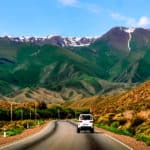
Kyrgyzstan is absolutely a safe destination for tourists!
I dislike how most websites from the Departments of Foreign Affairs advise against traveling to Kyrgyzstan as it’s supposedly dangerous and how there’s a chance for terrorist attacks and kidnapping…
Terrorist attacks can happen everywhere, even in Europe! Remember what happened in Paris and in Brussels a few years ago…
And yes, the Kyrgyz people might kidnap you into their homes and force-feed you. But you’re free to leave whenever you’ve finished your plate.
I have never questioned my safety in Kyrgyzstan before, not even while I was traveling as a woman alone.
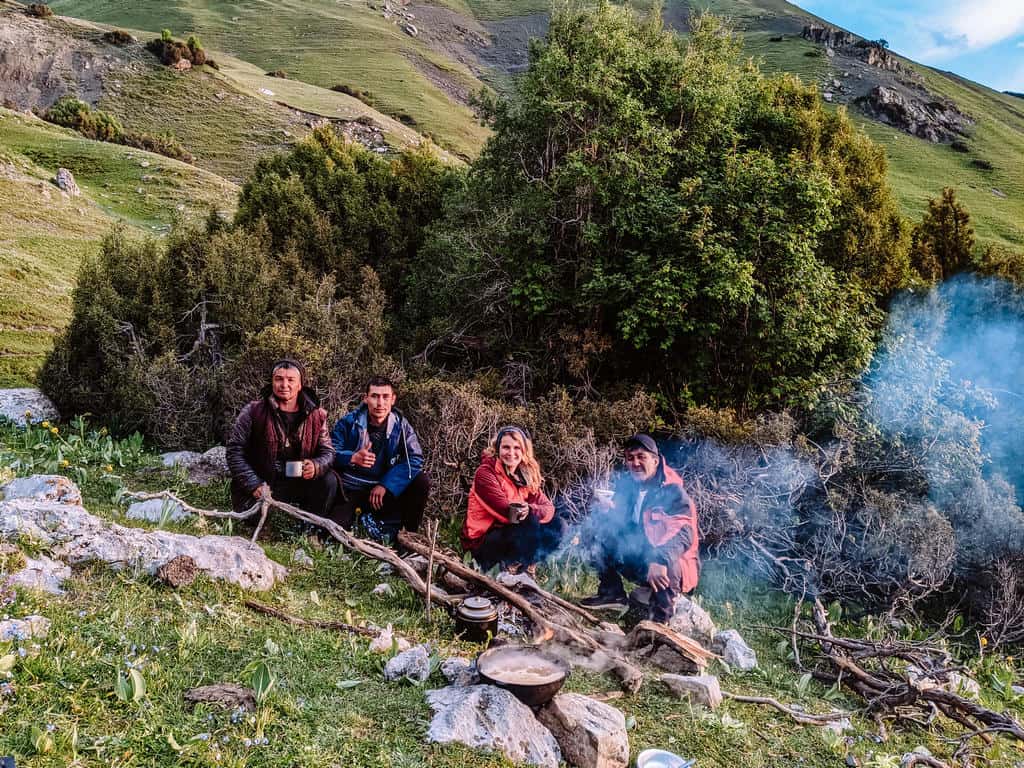
I went several times into the mountains with only male guides and companions. They cooked for me, helped me whenever I was struggling, they often checked if I was ok and some even called me “chef”. They cared for me like I was a princess.
If you’re a woman traveling alone or with a girlfriend, you’ll get approached by men (and women) asking if you’re married. 9,8 times out of 10 they don’t ask this because they’re after you.
Marriage and having children are very important in the Kyrgyz culture so it’s a very commonly asked question. The same as when people would ask about your job in Western countries.
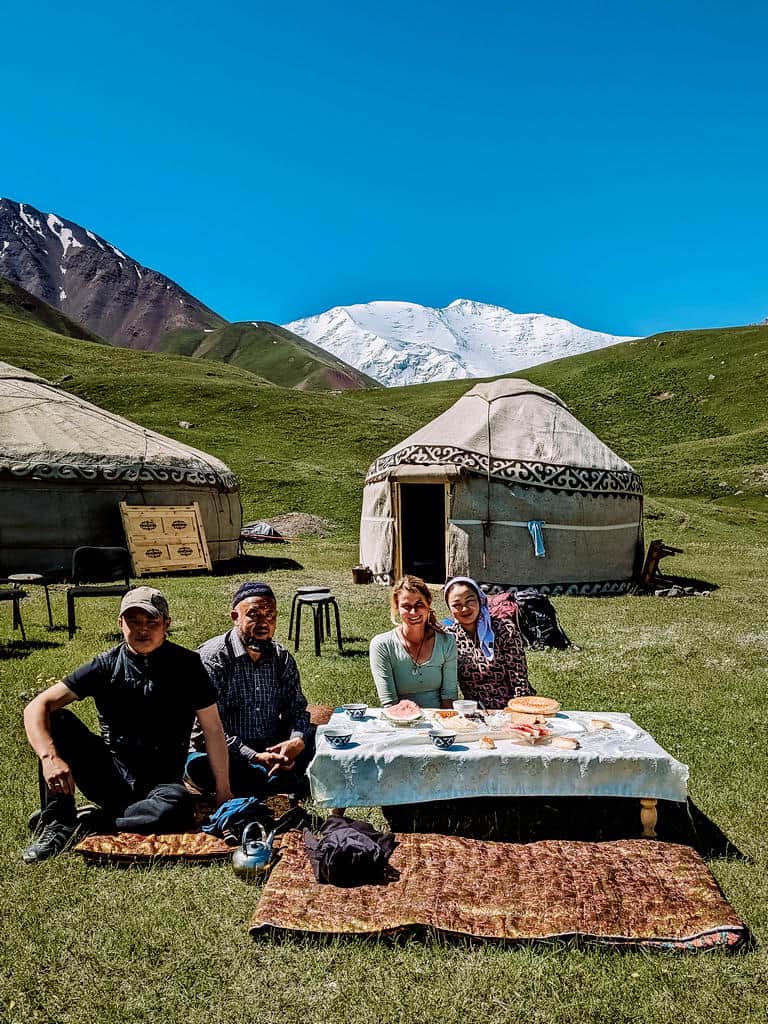
The men, and in general the people of Kyrgyzstan, are in my experience gentle, friendly, and kind. They also have big respect for women. There’s always an odd duck, but that is something you encounter in every destination.
You also don’t have to worry about scams. Most markets and shops have standard prices so bargaining is also not really a thing in Kyrgyzstan (but you could always try).
You only have to watch out for taxi drivers. They tend to higher their prices when they see you’re a tourist. Inform yourself about taxi rates beforehand and don’t be afraid to bargain or walk away if you have the feeling they’re ripping you off.

9. Money and currency in Kyrgyzstan
9.1 What kind of money do they use in Kyrgyzstan?
The official currency of Kyrgyzstan is the Kyrgyzstani Som (in Kyrgyz: сом), abbreviated to KGS.
- Banknotes circulating in Kyrgyzstan: 20, 50, 100, 200, 500, 1000 and 5000 som
- Coins circulating in Kyrgyzstan: 1, 10 and 50 tyiyn (cents) & 1, 3, 5 & 10 som
I always use the Xe.com app to convert and stay up-to-date with the current exchange rates. At this time of writing, the current exchange rates are:
- $1 USD = 89 KGS
- €1 Euro = 97 KGS
- £1 British Pound = 113 KGS
9.2 Which credit cards are accepted in Kyrgyzstan?
Visa is the most accepted credit card in Kyrgyzstan and you can use it in most restaurants, shops, and hotels in the larger cities in the country (Bishkek, Osh, Karakol, Jalal-Abad).
MasterCard and other credit cards are accepted in some places in Bishkek and Osh but you’re better off using Visa.
Cash is still king in Kyrgyzstan and you should definitely carry enough cash with you to cover your expenses when leaving the cities.
9.3 ATMs in Kyrgyzstan
You’ll find plenty of ATMs in the cities where you can withdraw KGS and in some cases USD. It’s not possible to withdraw other currencies. Most ATMs only accept Visa.
My go-to bank is Demir Bank as they accept both Visa and MasterCard and KICB.
Most ATMs have a withdrawal limit of 20.000 KGS or 200 USD. Fees may be added by your home bank.
9.4 Exchanging money in Kyrgyzstan
USD, EURO, and currencies from the neighboring countries like Uzbekistan and Kazakhstan are accepted everywhere, other currencies might be harder to exchange.
The best place to exchange currency in Kyrgyzstan is in Bishkek. There are many currency exchange offices in Bishkek but the ones with the best exchange rate are on Manas Avenue, between Sierra Coffee and Chuy Avenue. Those offices might look small and dodgy but they’re trustworthy.
You can also exchange currency in banks but they usually offer a lower rate and you’ll also need your passport as the banks ask for it.
You can also exchange currency in Osh. The best place in Osh to exchange currency is at one of the small exchange offices at the big market called Kelechek.
Tip: Use big 50 or 100 EURO or USD bills and make sure they are crisp and not damaged or wrinkled otherwise the offices will exchange at a lower rate.
9.5 How much money do you need in Kyrgyzstan?
Kyrgyzstan is a cheap country to travel and one of the cheapest in Central Asia.
If you’re backpacking on a tight budget, you can get by with a daily budget of 50 USD if you’re only taking public transport, staying in homestays, cheap hostels or camping, eating in local restaurants, or buying food at the markets and sticking to free activities.
If you’re a mid-range traveler, meaning you have a budget to cover additional activities and day tours such as horse riding and visiting historical sites and you want to combine public transport and private taxis, stay at guesthouses and yurt camps, and eat at budget and/or mid-range restaurants, you’ll get by with a weekly budget of 850 USD.
If you like to stay at a yurt camp, you’ll nowadays pay around 20 USD per person night, including breakfast and dinner.
9.6 Should you tip in Kyrgyzstan?
Tipping is not part of the culture in Kyrgyzstan and is therefore not required.
Restaurants in the larger cities usually include a 10-15% service fee in the bill.
When you go on a tour, you’re also not expected to pay an extra tip to the guide, driver, horsemen, or porters afterward. However, they will appreciate it as wages are low in Kyrgyzstan.
If you’re happy with the services of your driver, guide,…, and you like to tip them after the trip, I’d use the 10-20% rule as a tipping guide.
10. Transportation in Kyrgyzstan: How to get around in kyrgyzstan
You can get around in Kyrgyzstan by marshrutka (minibus), bus, (shared) taxi, train, and airplane.
10.1 Getting around Kyrgyzstan by minibus (marshrutka)
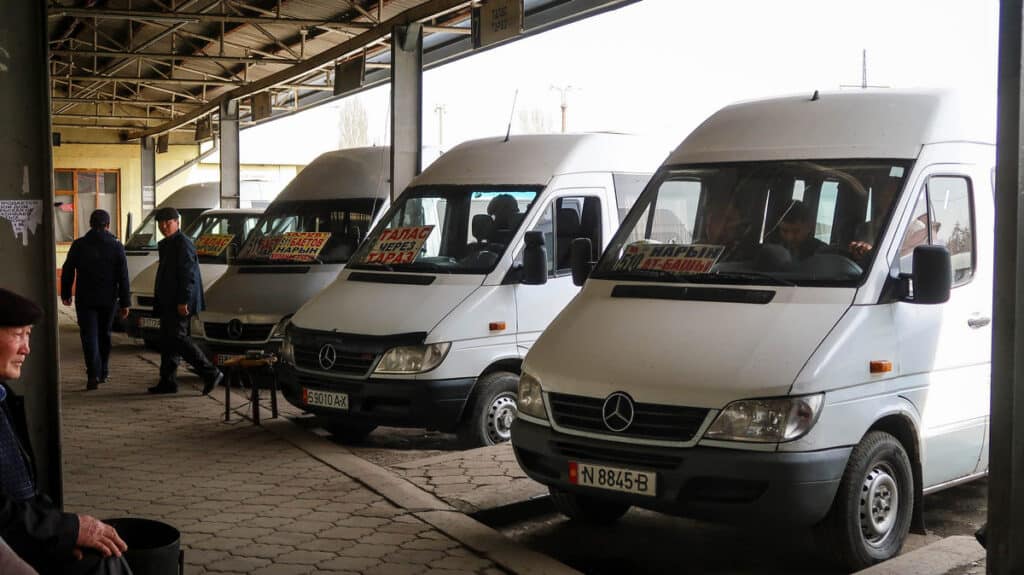
A marshrutka is a minibus that looks like a van and it’s the cheapest and most popular way for the locals to get around in Kyrgyzstan.
It’s very easy taking a marshrutka to get around in a city or town or to travel between two different towns. While it’s not the fastest way to get around as these minibusses stop everywhere, it’s definitely a cultural experience!
Taking a bus or marshrutka within a city
Every marshrutka has a number. It’s sometimes a little confusing which one you have to take so ask at your hostel or hotel which one you need or use the apps Bus.kg and Maps.Me to find your way around.
Bus.kg tells you the route of each marshrutka. Maps.me is easier to use as you just type in the name of your location and destination and it shows you which marshrutkas are going there.
Marshrutkas don’t have a fixed time schedule but you’ll find them everywhere! Just stand on the side of the road and wave them down. The driver will stop for you. You pay the driver as soon as you get in the van. The standard price for a ride within a city or town is 20KGS.
If you want to get off, move towards the front of the minibus (use your elbows if needed as it can get very crowded in there) and ask or sign the driver to stop.
Update: In 2024, most marshrutkas running in Bishkek have been replaced by “green” buses that run on liquified gas to reduce pollution in the city. You enter the bus from the front side, pay the driver and exit via the middle door. The fee is 20 KGS. You can pay cash or with a bus card.
Tip: When you see someone visibly older than you getting on the marshrutka, give up your seat voluntarily if you want to avoid a scene. Especially the old ladies can give you a lot of trouble if you don’t want to stand up for them. They might look old and sweet but they can be fierce!

The Kyrgyz women are the sweetest until you refuse to give up your seat for them…
Taking a marshrutka between towns and cities
If you want to travel between towns and cities, you can take a long-distance marshrutka. You can find them at the bus stations. Just go to the station and say where you want to go.
People will show you the ticket office where you have to pay for your ticket and they will also point you in the direction of the marshrutka you need.
The prices depend on how far you want to go and how popular the route is but the average price is around 500KGS for a 4-hour ride.
After paying for your ticket, you’ll receive a receipt that you have to show the driver before you get on the marshrutka. The minibus leaves when it’s full.
10.2 Getting around by shared taxi
Another common way to get around Kyrgyzstan is by shared taxi.
Sharing a taxi means that you share the car with other people and you split the costs so you pay per seat. It’s about twice or triple the price of a marshrutka but a faster way to get around.
Some taxi drivers like to double the rate for unwary tourists so if you don’t want to get ripped off, make sure that:
- you make it clear that you want to share the taxi (say ‘taxi sovmesti’) so you don’t pay the full price and
- ask your hostel/hotel about the rates or ask the other passengers how much they pay.
The standard price for a long-distance ride should be between 1000KGS and 1500KGS per person.
The best way to get from Bishkek to Osh (or vice versa) is by shared taxi. For this 12-hour ride, you pay around 1800KGS – 2000 KGS per person.
If you want to take a taxi within Bishkek and you can’t be bothered by bargaining for the price, install the Yandex Go app on your phone (only possible when you have a local SIM card). This app works similar to Uber.
10.3 Getting around by train
There are very few trains in Kyrgyzstan due to the mountainous terrain of the country. There’s a railway route that goes from Bishkek to Balykchy (Issyk-Kul).
It’s a very scenic train ride that brings you to the western shore of Lake Issyk-Kul but it’s very slow (5-6 hours) and only runs during the summer.
For prices and timetables, check with the train station in Bishkek.

10.4 Domestic flights in Kyrgyzstan
If you’re in a hurry and you don’t want to make the long drive from Osh to Bishkek or vice versa, then there’s always the option of taking an airplane between both cities.
There are daily flights between Bishkek and Osh, the flight itself lasts 45 minutes and a one-way ticket costs around $50. You can book tickets on this website.

10.5 Hitchhiking in Kyrgyzstan
Hitchhiking in Kyrgyzstan is quite common among the locals.
You’ll see a lot of people standing on the side of the road, waving cars down as a sign that they want to get a lift but it’s standard to pay the driver to share the costs of the petrol for the journey (very similar to taking a shared taxi).
So it’s not really hard to hitchhike in Kyrgyzstan, the challenge is in finding a FREE ride.
10.6 Driving in Kyrgyzstan
Self-driving in Kyrgyzstan is definitely an option if you want to travel to remote places. It’s often difficult to reach certain mountainous areas and alpine lakes by public transport.
The state of the main roads is generally good but as soon as you’re heading into the mountains, the condition of the tracks is variable. The roads can be deteriorated by potholes, bumps, and debris so drive carefully!
I recommend renting a 4×4 if you’re planning on driving in the mountains. Iron Horse Nomads and Travel Land Kyrgyzstan are the best car rental service to contact.
Note: some rental companies won’t allow you to drive to certain regions like Kel Suu lake as the road is in a bad state.
Driving rules in Kyrgyzstan:
- You need an international driver’s license and vehicle insurance.
- Drive on the right side of the road.
- The speed limit in towns or cities is between 40 and 60 km/h. The limit outside the cities is generally 80km/h.
- It’s mandatory to keep your low-beam headlights on, even during the day.
- Watch your speed as animals roam freely on the streets.
- Some police officers are still corrupt. If they’d fine you for speeding or any other reason, ask for a receipt first. You can also try to negotiate the price of the fine down to 1/4 or 1/2 but you won’t receive a receipt as the officer will pocket the money.

11. Tours in Kyrgyzstan
As you could read above, it’s possible getting around Kyrgyzstan by public transport but most places of interest in Kyrgyzstan are remote and can’t be reached by minibus or shared taxi.
If you have an adventurous spirit, you can try to reach these places by hitchhiking. But you’ll need time and patience as most places are so remote that there’s little to no traffic going there.
You can also try and find a private taxi to drive you and negotiate prices. But some destinations, such as Kel Suu lake, Altyn Arashan and Sary Jaz Valley simply can’t be reached without a 4×4. Even reaching the popular Son Kul lake requires arranging private transport.

Your best option is to arrange a private tour to get there.
Kyrgyzstan has a great Community-Based Tourism network, referred to as CBT, throughout the country. You’ll find a CBT office in nearly every major town that will connect you with local guides, drivers, homestays and yurt camps. The majority of their profit goes to the local communities.
While some CBT offices are great and professional, like the CBT in Osh and Arslanbob, others still require improvement when it comes to organization, availability and liability.
Some guesthouses also offer their own tours and guided (horse) treks so if you’re traveling independently and are interested in going on a small guided trip in the region, it’s worth consulting them as well.
There are also many independent tour guides and small local travel companies throughout the country that offer a wide variety of tours, from small trips to a certain area to fully-guided tours around the country.
If you don’t really know which one to contact, get in touch with me. Throughout my time in Kyrgyzstan, I worked with various small local travel companies and tour guides that were very professional and liable and I can connect you with the ones meeting your interests and needs.
And of course, I’m now briefly going to promote my own group tours in Kyrgyzstan.
Every summer, I organize a wide variety of tours, from Overland Road Trips and Adventure Tours to Trekking Adventures, Horse Riding Trips and Highlights of Kyrgyzstan Adventures, some of these tours guided by yours truly.
Dreaming of hiking through wild mountain landscapes, horseback riding across alpine pastures, sleeping in yurts, and exploring remote valleys by 4×4 with a small group of adventurous travelers?
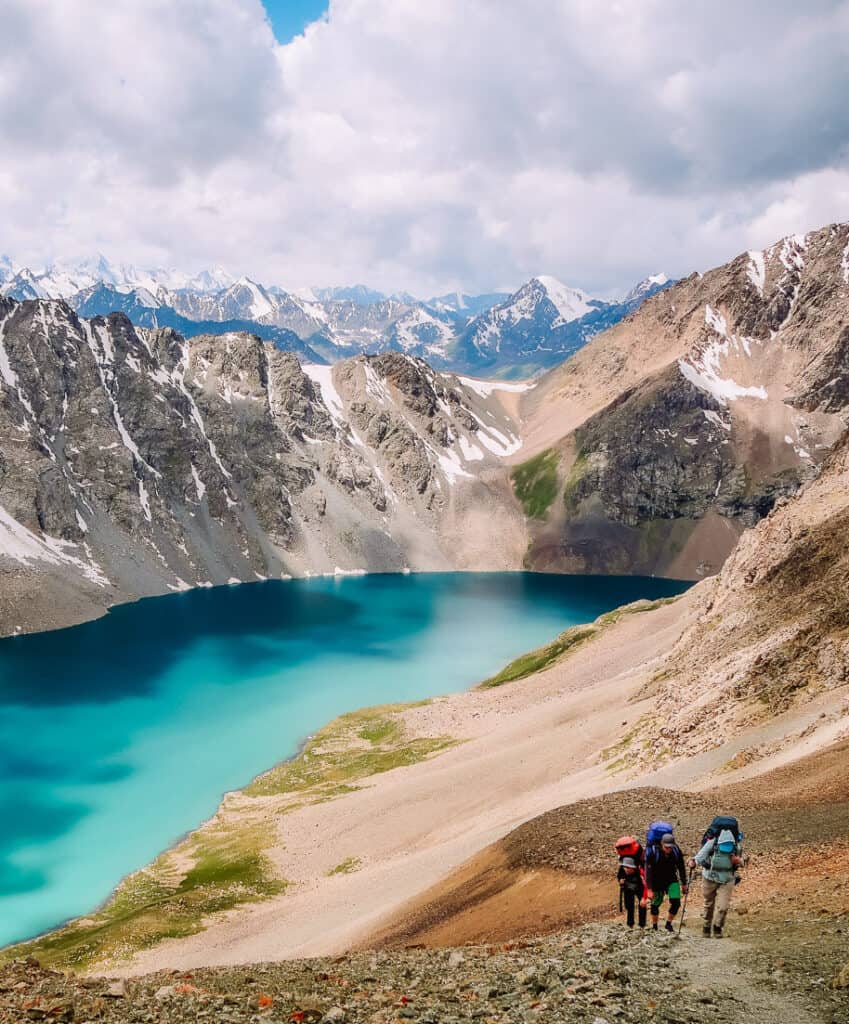

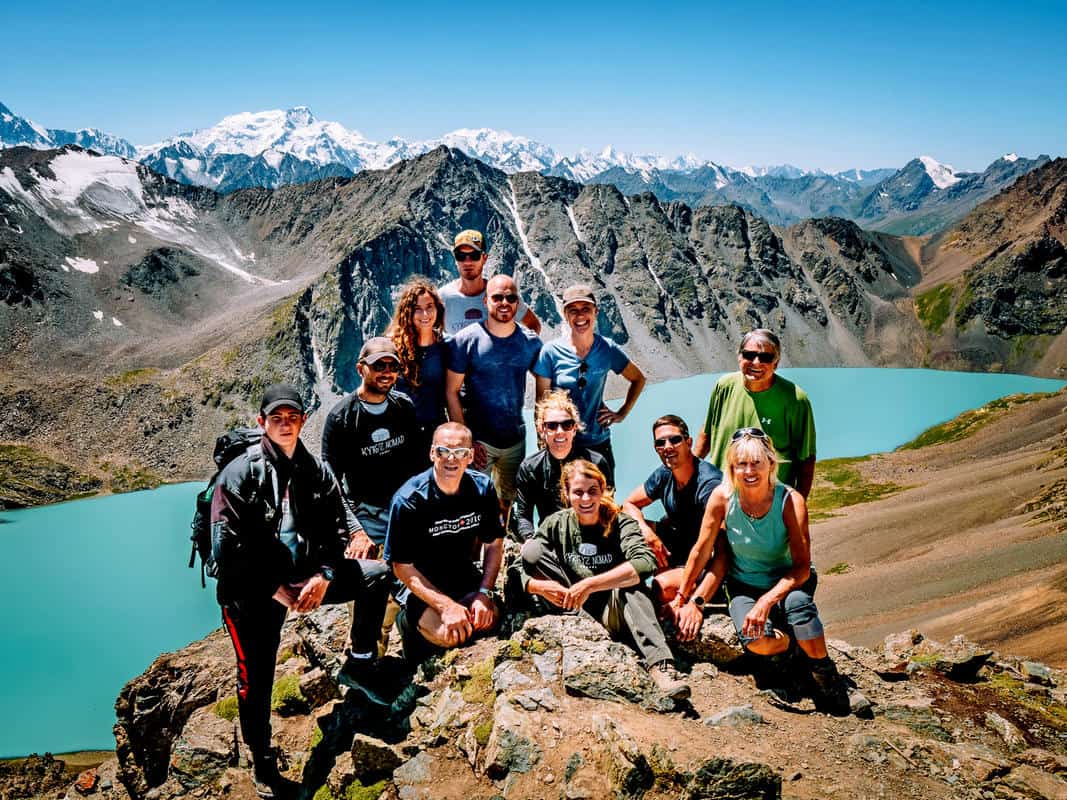
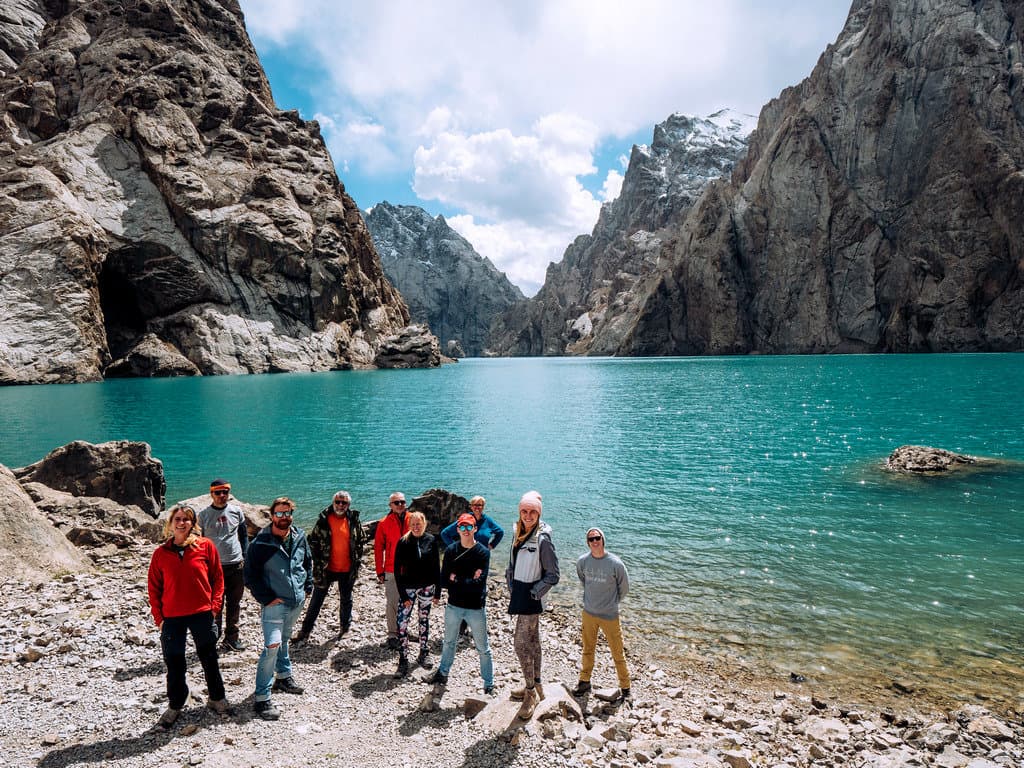
If group tours aren’t really your thing and/or you’d like to have a similar guided trip with your partner, friends, family or organization, I also offer tour planning services in Kyrgyzstan and/or can connect you to a suitable tour guide or local travel company.
12. Where to stay in Kyrgyzstan – Accommodation in Kyrgyzstan
12.1 Hostels, hotels and guesthouses in Kyrgyzstan
There are plenty of hostels, hotels, and guesthouses in the big cities and major towns in Kyrgyzstan.
Hostels are the cheapest option, starting from $8 per night for a bed in a dorm. You can also find a nice private room, starting from 12 USD per night.
There are also some really nice hotels and guesthouses in Bishkek, Osh and other major towns, from mid-range to luxury. The average price for a room in a mid-range hotel starts from $40 per night.
I always use booking.com to find the best hostel and hotel deals.
12.2 Homestays in Kyrgyzstan
Staying with a local family in a homestay is a great opportunity to learn more about Kyrgyz daily life!
Kyrgyz families open their homes to foreigners who can stay for a night or more in one of the shared rooms in exchange for a fee, which starts from 800 KGS per person per one night.
Don’t expect too much luxury, it’s after all a family home so it’s very likely that you’ll sleep on thick comfortable blankets on the floor like the Kyrgyz people do.
How to find these homestays?
Most homestays can be found through the CBT offices in the area. You can also just ask around in a town or village for a homestay (prozhivaniye v sem’ye) and the locals will bring you to one.
Nowadays, you can already book some of these homestays directly online: check out the homestays in Kyrgyzstan here.
Just remember that, even if someone invites you spontaneously to stay at their home, they will expect some kind of payment, whether it’s money or a gift.

12.3 Staying in a yurt in Kyrgyzstan
Yurts are one of the most essential parts of the Kyrgyz culture.
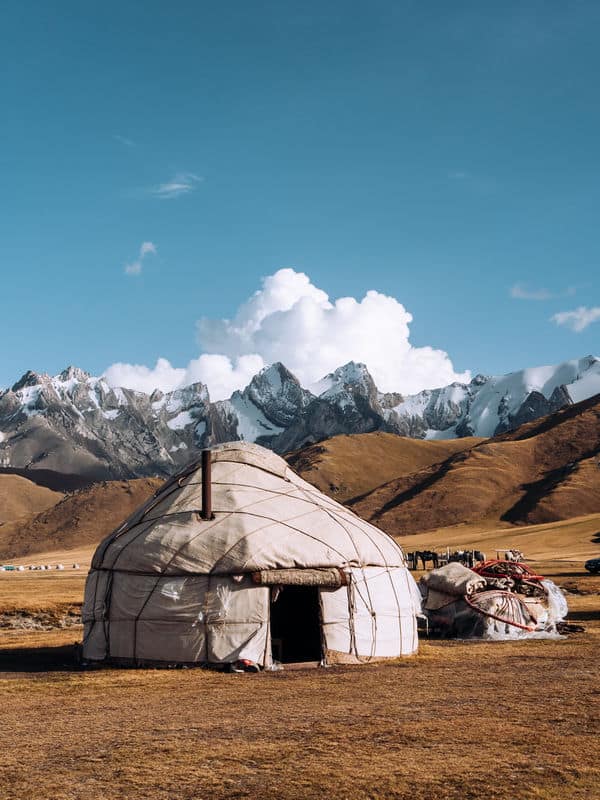
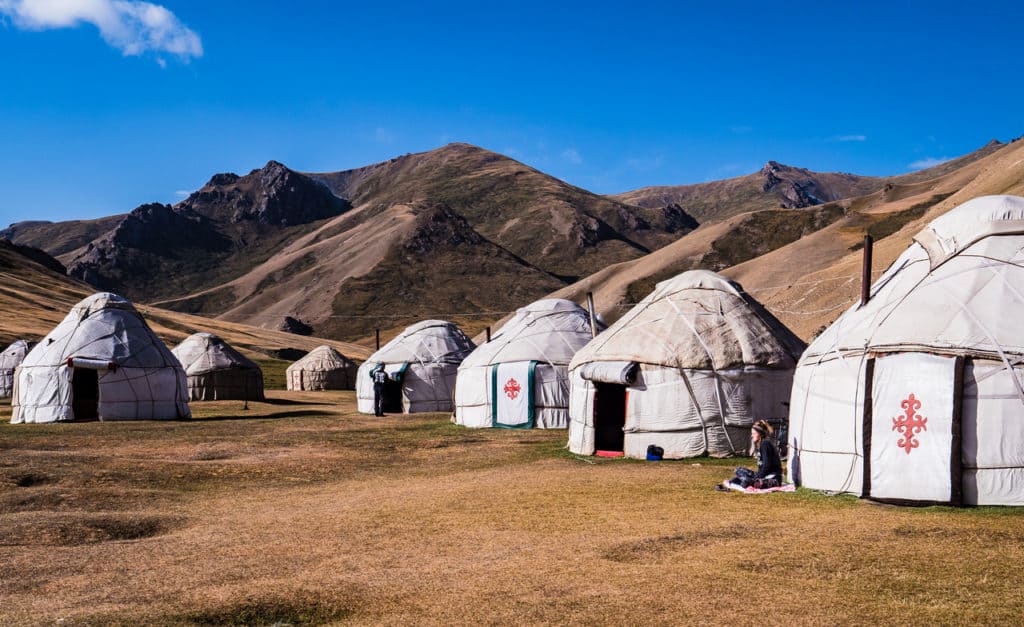
A yurt is a round tent, usually covered with felt or wool which are water repellent and warm and can be easily patched if needed. The top of the yurt is a wooden circle, called a tunduk, which forms one of the most essential symbols of family and the universe. The tunduk is also represented on the Kyrgyz flag.


While most of the Kyrgyz people nowadays live in houses or apartments, semi-nomadic shepherd families still move to the summer pastures during the warmer months where they live in yurt camps and tend to their herds.

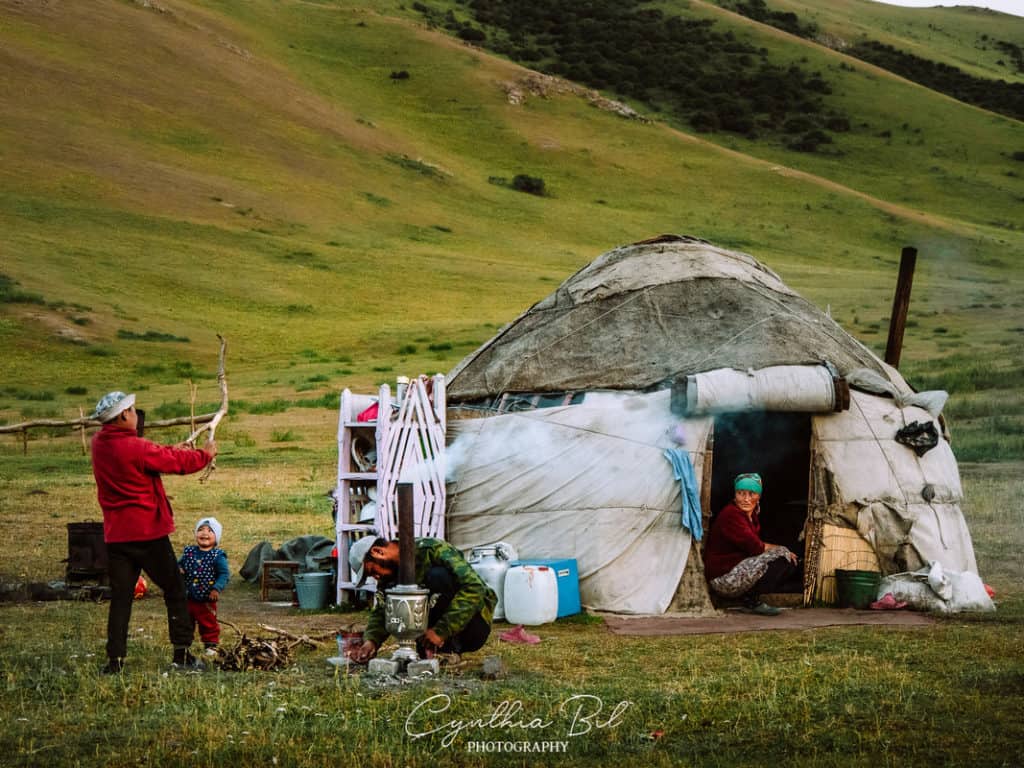
During summer you’ll find many yurt camps across the Kyrgyz countryside. Staying in one of these yurt camps is definitely a must-try experience when traveling to Kyrgyzstan!
Many yurt camps in popular places like Issyk Kul and Son Kul are nowadays specially made to accommodate travelers.
The small yurt camps are family-owned, serving as an extra way of making an income for the shepherd families and still offer a one-of-a-kind experience. Others have been created by small travel companies and offer a more “luxurious stay” (you’ll still have to poo in a hole tho…).
You don’t necessarily have to book your stay in advance. You can just arrive and ask if they have a yurt available.
Here are some yurt camps you can also find online:
- Feel Nomad Yurt Camp at Lake Issyk-Kul.
- Yurt Camp Ali-Nur at Lake Song Kul
- Jeti Oguz Winter Yurt Camp near Karakol
- Yurt Camp Lenin Peak near the Pamirsky National Camp
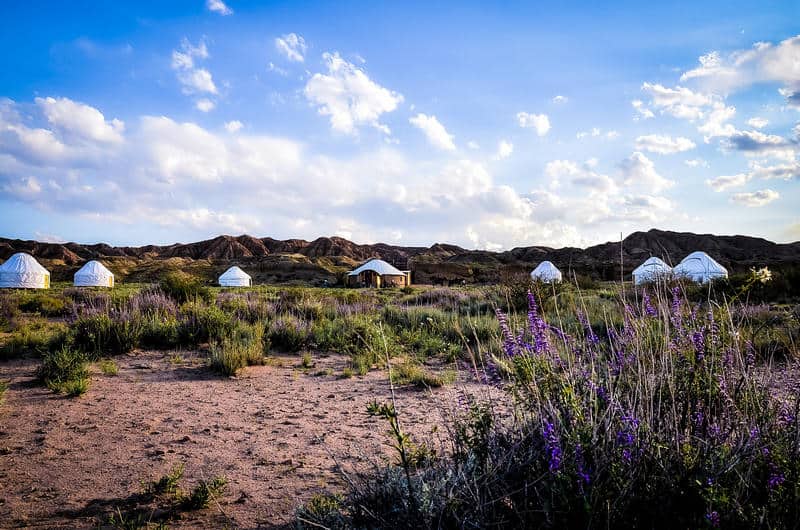
If you’re seeking a more “authentic” yurt stay experience and want to participate in the daily life of a Kyrgyz shepherd family, you’ll have to travel to less touristic places such as the Alay Mountains.
Just remember that, even if the family invited you over to stay at their yurt, you’re still expected to give some form of payment (money or useful gifts such as food) as a sign of respect.
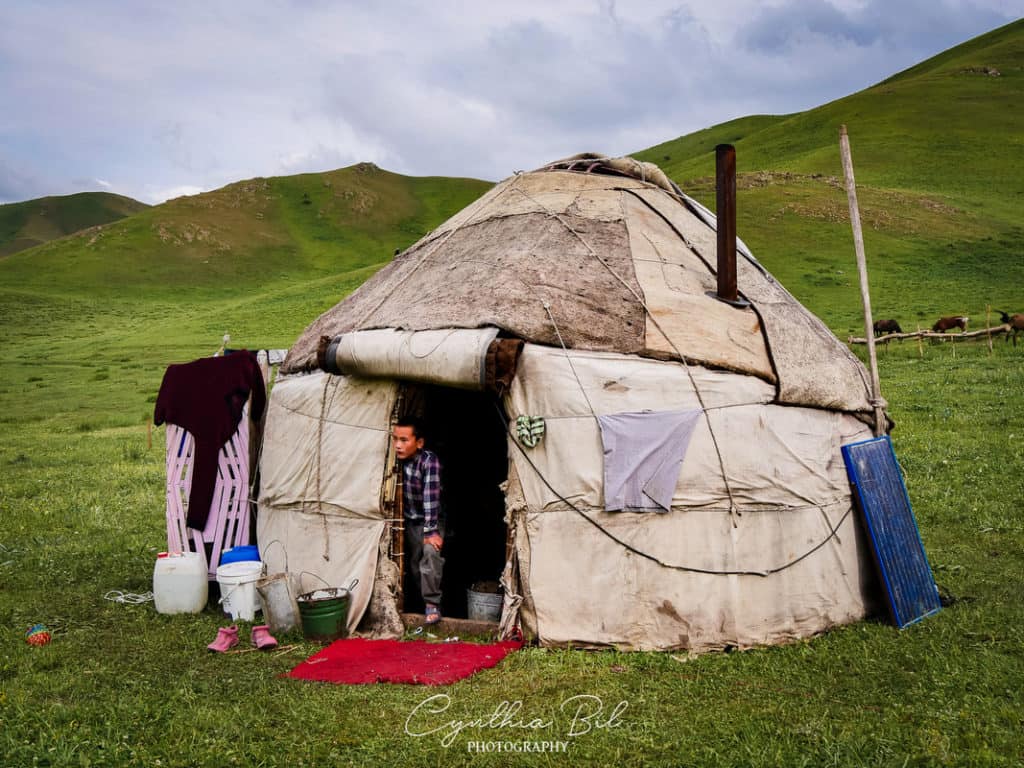
12.4 Camping in Kyrgyzstan
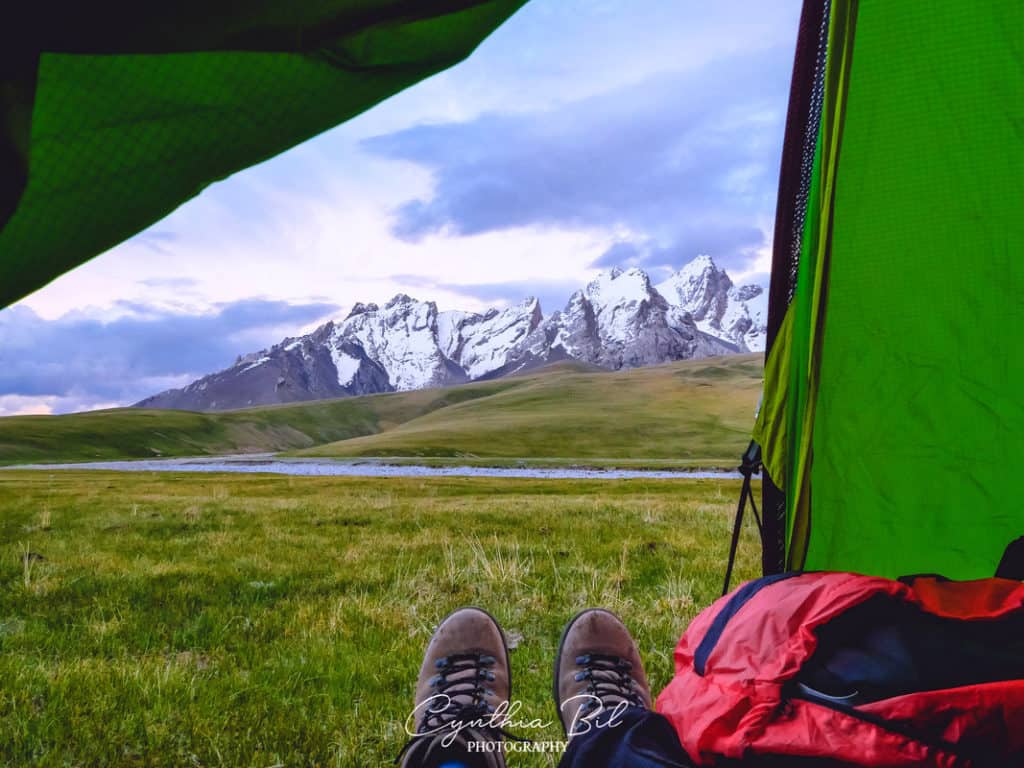
Wild camping is allowed in Kyrgyzstan as the camping spirit in the country is omnipresent, it’s the Land of Nomads after all.
You can set up your tent nearly everywhere and nobody will bother you. You also shouldn’t worry about any wild animals such as wolves, bears, or snow leopards unless you’re planning to go deep into the mountains. Just check with the local CBT to make sure…

In certain areas, such as in Arslanbob and Sary Chelek, you need to register at one of the local CBT (Community Based Tourism) offices and pay a small fee if you want to camp there.
However, don’t worry too much about this, just set up your tent and if you’re supposed to pay, someone will come and tell you.
13. Kyrgyzstan Food and drinks
Kyrgyzstan isn’t exactly a culinary destination like f.eg. Georgia. The food in Kyrgyzstan wasn’t love at first bite for me.
It’s not that it’s bad but I find often it a bit bland. Some dishes would be delicious with the use of extra spices.
However, you must know that the traditional dishes originate from the nomadic times and people had to manage with what was available, which was mostly meat and dairy products.
Nowadays, Kyrgyz food is a lot more varied, with lots of influences from China, Russia, Turkey, Tajikistan and Uzbekistan. Most meals consist of mutton, beef and chicken meat served in dumplings, noodles, rice, or alongside potatoes.
There are plenty of western and traditional restaurants in the major cities and local eateries in every town and village throughout the country. The food is mainly served with water or soft drinks. Soft drinks are served by the bottle, not by the glass.
Tea is available everywhere but if you’re a coffee-lover, you’ll have to be satisfied with instant coffee. You can find some good coffee bars in Bishkek, Osh and Karakol but expect to pay more when you order a proper espresso or cappuccino.
The best place to try Kyrgyz food is at a homestay where the family uses fresh ingredients and their own traditional family recipes.
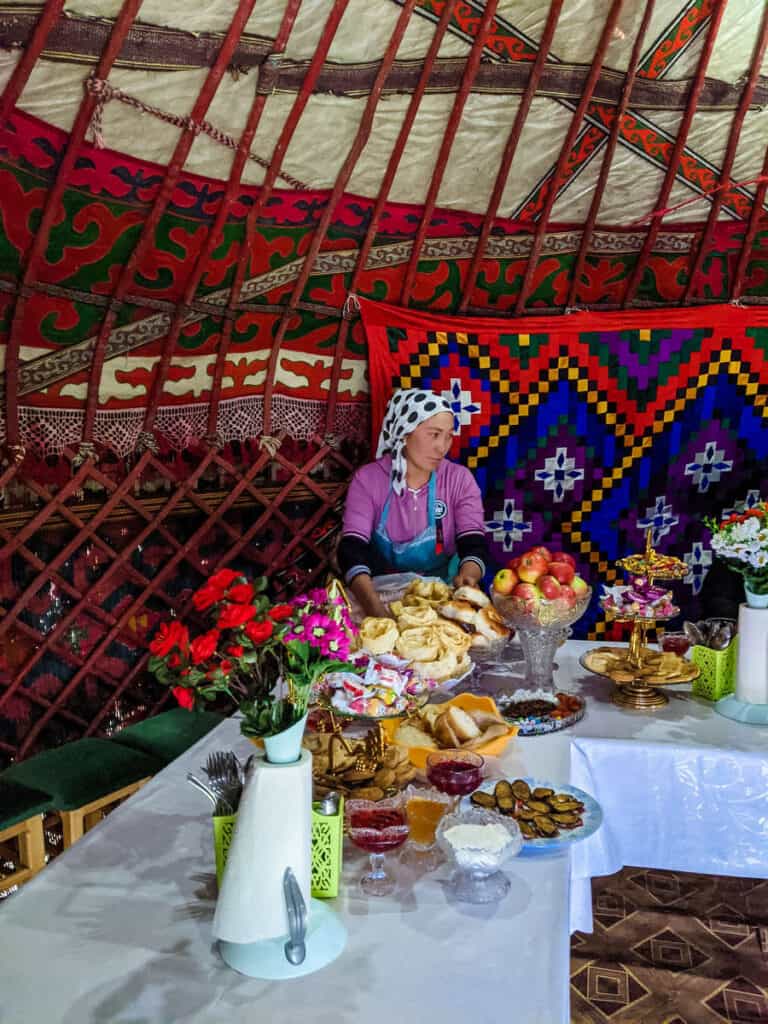
At nearly every homestay or yurt camp, you’ll find small bowls with sweets, biscuits, bread and dried fruits on the table. You should definitely try the homemade butter, jam and clotted cream when available!
If you’re traveling during summer, you’ll find your dose of vitamins in the wide variety of yummy fruits and vegetables on the markets and small stalls at the side of the road.
In wintertime, there’s less choice but you’ll still be able to find tomatoes, carrots, cucumbers, apples, pears, etc.
13.1 5 Kyrgyz Dishes you have to try
- Beshbarmak
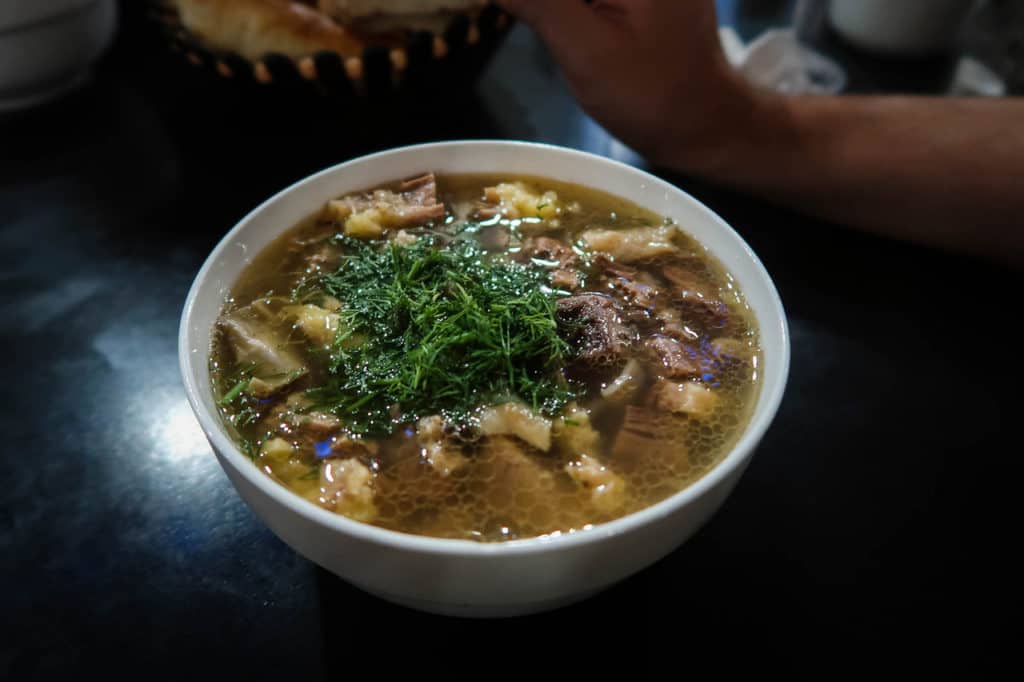
Beshbarmak is the national food of both Kyrgyzstan and Kazakhstan as it originates from their shared nomadic past. The name means ‘five fingers’ because nomads traditionally eat this dish with their hands.
Beshbarmak is usually made from chopped boiled meat (beef or mutton) mixed with noodles and chyk, an onion broth. Traditional beshbarmak is made from horse meat.
- Laghman
Laghman is an Uyghur dish made from meat, vegetables and noodles. Bozo laghman comes with fried noodles and gyozo laghman with boiled noodles and broth.
- Plov
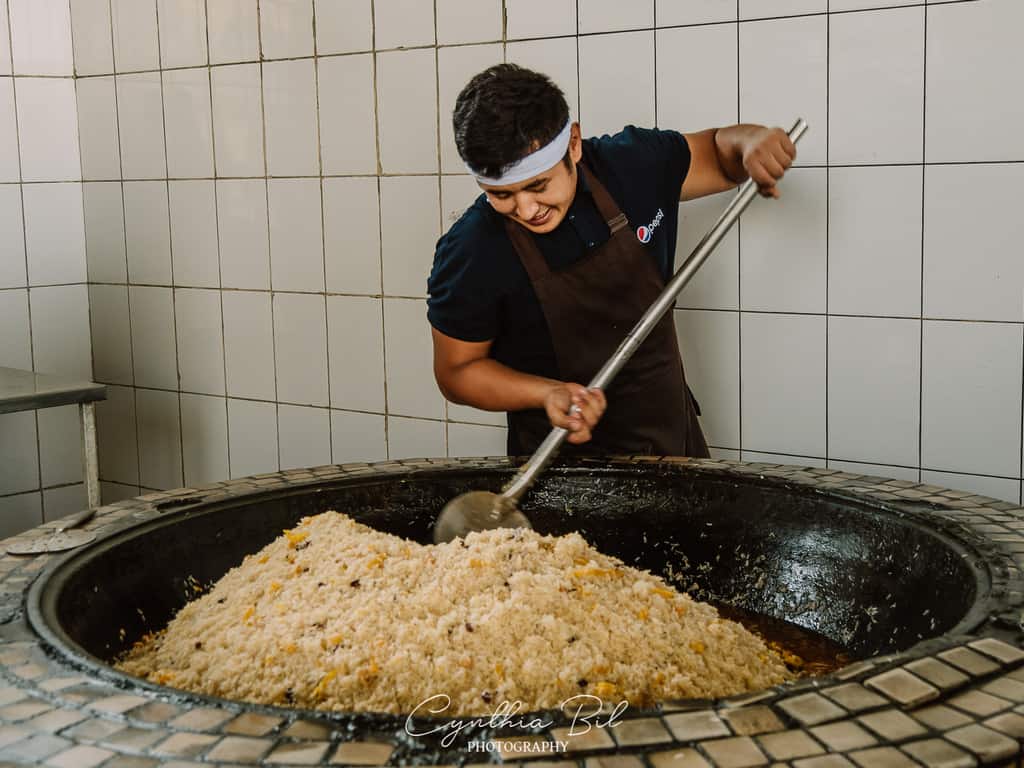
Plov is the most popular dish in Central Asia. While it’s considered to be Uzbekistan’s national dish, you’ll also find it everywhere in Kyrgyzstan.
Plov is made from rice, onions, carrots, spices and meat. You can also ask for the vegetarian option where the meat is replaced by dried raisins.
- Manti
Manti is another popular dish in Central Asia. Each region has its own version.
Manti are dumplings filled with ground lamb meat but in Kyrgyzstan, they also fill them with beef, cabbage, potato or pumpkin.
- Shashlik
Shashlik is grilled beef, mutton or chicken meat on a skewer. It’s a simple dish and you’ll find it everywhere in Kyrgyzstan.
13.2 Is vegetarian food available in Kyrgyzstan?
It’s nowadays not so hard anymore to find vegetarian food in Kyrgyzstan. You can eat almost all the traditional dishes. Just say “bez myasa” (without meat) when ordering.
Vegans, on the other hand, will have a harder time as nearly all the dishes contain animal products. My suggestion would be to stock up on fruits and vegetables at local markets and cook your own meals.
13.3 What is the national drink of Kyrgyzstan?
Don’t leave Kyrgyzstan without trying some kymys. It’s a very popular drink among the nomads and it’s made of fermented horse milk. It tastes very sour and it contains some alcohol.
Despite being a Muslim country, alcohol is omnipresent in Kyrgyzstan and especially vodka is also a very popular drink (Kyrgyzstan used to be part of the Soviet Union). It’s so cheap here that people even use it to defrost the windshield of their cars in winter…

14. Packing list for Kyrgyzstan
14.1 What should I wear in Kyrgyzstan
Kyrgyzstan has a continental climate with hot summers and cold winters but because it’s a mountainous country, the weather varies a lot depending on where you are.
It can be very hot in the summer (35°C) in the lower areas such as the capital Bishkek, but as soon as you go into the mountains, the temperature can go down to 10°C. If you’re at a high altitude, you might still get snow.

In the same way, winters at lower elevations are much milder (-5 to 0°C) while the temperature can get as low as or lower than -30°C in the mountains.
Pack appropriate clothes for the period in which you’re traveling.
In winter you should always bring warm clothes, a down jacket, a hat, a scarf, thermal underwear, warm boots and maybe a few lighter clothes for the mild days in Bishkek.
The summer in Bishkek and other cities located under 1000 meters can be very hot so bring light clothes.
If you’re planning on hiking and camping in the mountains during the summer, you should also bring warm clothing as the temperature at night can drop to 0°C!

Women shouldn’t wear miniskirts, short shorts, and revealing tops.
With the exception of the capital city where young people follow the latest Western fashion, most people are still very traditional and will take offense if you show a lot of skin.
T-shirts with short sleeves and knee-length skirts, dresses, and shorts are okay, except for when you visit religious buildings and sites. There you should cover your arms and wear a long skirt or trousers.
14.2 Travel essentials for Kyrgyzstan
The packing list that I mentioned above includes everything you need for traveling and trekking in Kyrgyzstan but here’s a brief overview of all the essentials:
- Water Filter Bottle: I highly recommend bringing a reusable bottle with a microfiltration decive. It allows you to safely drink the tap water and fresh mountain water from rivers and streams without becoming sick. When you drink water using a bottle like this, any dirt, bacteria or parasites will be trapped in the fibers of the filter, while the clean water passes through. I use and highly recommend the Lifestraw Water Filter Bottle. Another way to filter water is by using a steripen.
- Power bank: you won’t always have electricity available to charge your electronic devices, especially not when you’re planning on spending time in the mountains and staying in yurt camps. I use and recommend Anker Power Bank as it has a 20,000mAh cell capacity providing at least 5 full charges for my phone. I can even charge my camera batteries with it!
- International travel adaptor: the power sockets in Kyrgyzstan are of type C and F (the same as in Europe). The standard voltage is 220 V and the standard frequency is 50 Hz. In case you need an adaptor, I use and recommend this all-in-one Universal Travel Adaptor as you can use it worldwide.
- Biodegradable toilet paper: you’ll have to be comfortable using a squat toilet in Kyrgyzstan. With the exception of the guesthouses where you’ll have a western-style toilet, most toilets will be outside in the form of a separate small building with a hole in the ground. Sometimes there’s toilet paper but you should definitely bring biodegradable toilet paper with you. I mention biodegradable as the toilet paper disappears in the ground so we can keep it environment-friendly!
- Same goes for biodegradable wet wipes. Most yurt camps and some homestays don’t have showers so wet wipes are very handy if you want to refresh.
- Immodium (or any other anti-diarrhea medicine): a lot of the travelers eventually suffer from diarrhea at one point or another throughout their first trip to Kyrgyzstan. As prevention, I use activated charcoal (it helps your body get rid of toxins and unwanted substances, ask about it in your local pharmacy).
- Paracetamol: You’ll often be at altitudes of 3000 meters and above. You might feel slightly light-headed and have a little headache during the first day and evening if you’re not used to high altitudes. That’s why paracetamol (or other painkillers for headaches) can be useful. After that first day, you should be fine!
Read The Complete Packing List for Kyrgyzstan to know exactly what to pack!
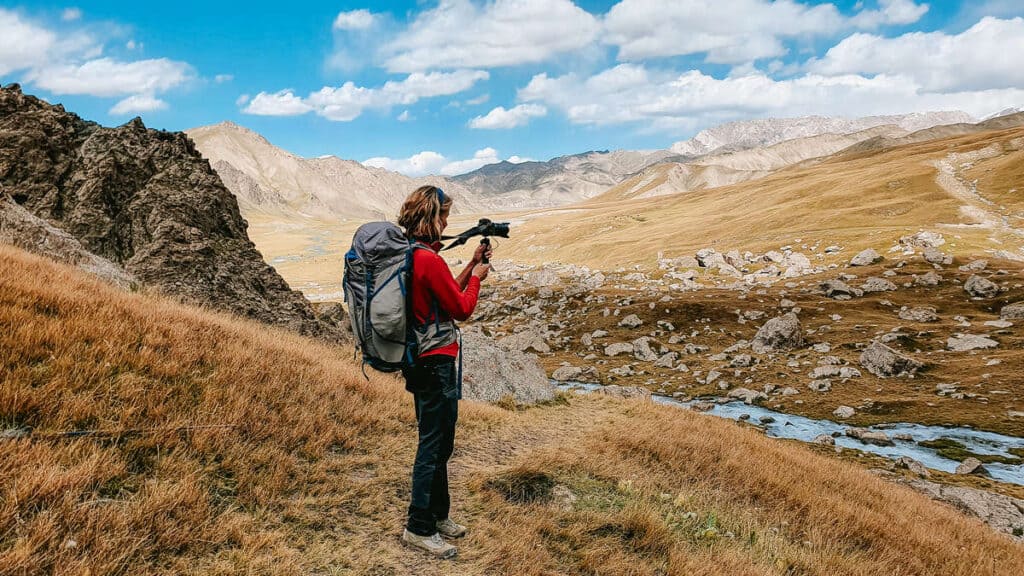
15. Are drones allowed in Kyrgyzstan?
Yes, drones are allowed in Kyrgyzstan!
There is some misinformation on the internet stating that your drone will be confiscated upon entry into the country. This is only the case in Uzbekistan.
I’ve been traveling to and around Kyrgyzstan with my drone since 2017 and I’ve never had any problems.
You can fly your drone everywhere in Kyrgyzstan, except near airports, border areas, military, and governmental buildings, and urban centers.
16. How is the internet in Kyrgyzstan?
High-speed wi-fi is available in all the big cities in Kyrgyzstan. If you’re a digital nomad like me and you need to work online, you can count on the internet in Bishkek, Osh, and Karakol.
All restaurants, cafes, hotels etc. offer a free connection for guests. If you rent an Airbnb or apartment, internet will be included. It might be a bit slower in some hostels but in general, it’s reliable and fast.
However, power cuts aren’t unusual in Kyrgyzstan, even in the capital city so I highly recommend buying a sim card to hotspot your phone if the power goes out.
Just keep in mind that only 25% of the country has mobile coverage (although, with Elon Musk’s Starlink this might change quickly). You won’t find much coverage in rural areas and none in the mountains.
If you’re planning on doing some treks, you should install a navigation app that can be used offline (see Recommended apps in Kyrgyzstan below).
16.1 Which is the best sim card in Kyrgyzstan and how to get one?
If you’re planning on traveling in the northern part of the country (in the regions of Chuy, Issyk Kul, Naryn and Talas ), Beeline KG will provide the best coverage.
If you’re planning on traveling to southern Kyrgyzstan (in the regions of Jalal-Abad, Osh and Batken), then Megacom will be your best provider.
You’ll find a Beeline and Megacom booth at the airport or at any of the shopping malls in Bishkek or Osh where you can buy a prepaid data SIM card. You’ll have to show your passport to register and pay a small signup fee (max 200 som).
They both offer weekly or monthly data plans and you can easily recharge your phone credit online. Check out the info and data plans for Beeline KG and Megacom and how to recharge online.
You can also recharge your credit by using a self-service terminal in a supermarket. You have to enter your mobile number and feed the booth with coins and notes. The language is mainly in Russian but it’s quite easy to figure out what you have to do with the help of the graphical elements on the screen.
16.2 Recommended apps for Kyrgyzstan
- Maps.Me: This is one of the most practical apps you could use to navigate in Kyrgyzstan. You download the map of the country so you can use it offline. It gives you very accurate directions (Google maps gets lost in Kyrgyzstan…) and shows you where you can find the nearest restaurants, bus stations, ATM, hotels, places with wi-fi, points of interest, etc. This is also a great app to use while hiking as it shows most of the trails.
- 2GIS: This is very similar to Maps.Me but only works for big cities such as Bishkek and Osh. You can download the map of the city for offline use. This app only works in Russian but it’s the most popular and accurate navigation app in Central Asia.
- Booking.com: You’ll need internet to use this app but it’s a great tool to find (last-minute) accommodation in the country.
- Bus.kg: Useful app to find out the routes of the city marshrutkas and where to catch these minivans
- Go.Yandex: Great app to use if you want to take a taxi in Bishkek or to and from the airport. It works very similar to Uber. Just enter your location and a taxi will arrive within 10 minutes. It also shows you how much the ride will cost.
- Google Translate: Translates written and spoken Russian or Kyrgyz. Only Russian is available to download for offline usage.
- Xe currency: very handy to check exchange rates, also works offline.

17. Culture and etiquette in Kyrgyzstan
The Kyrgyz people are descendants of ancient Turkic tribes and have been nomadic cattle breeders for centuries.
Nowadays, a large part of the population remains semi-nomadic, which means that they live in yurts during the summer months and return to their houses in the towns and cities during winter time.

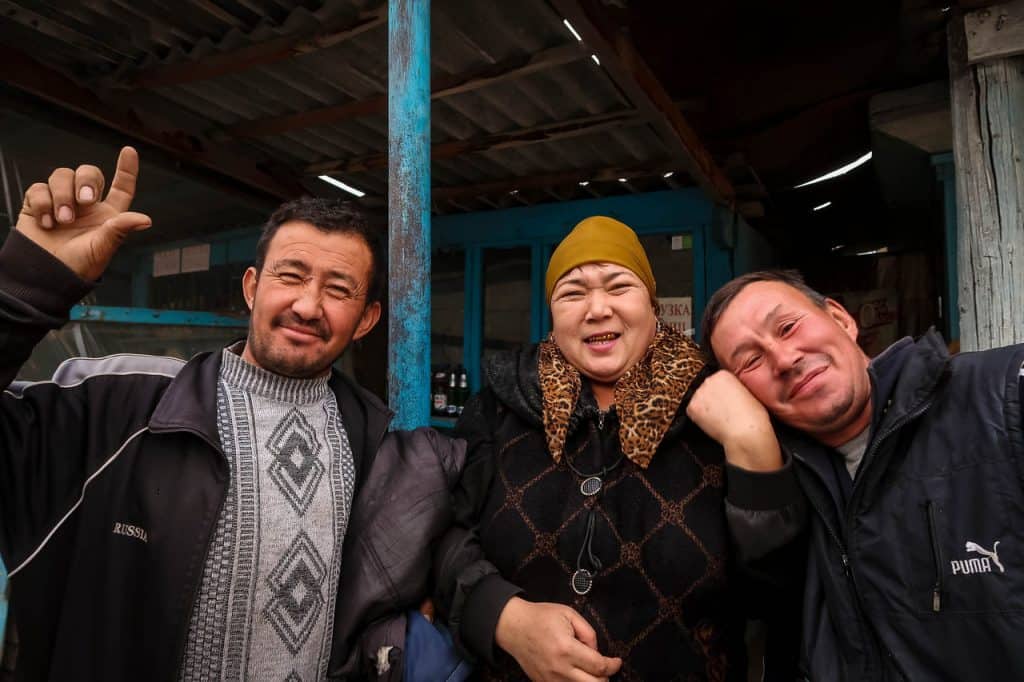
The Kyrgyz people are in general very hospitable people, especially in small villages where they aren’t used to seeing foreigners.
They will most likely invite you for a tea or a meal (bread and homemade jam are very popular) in their home and take plenty of selfies with you.
If you can, bring a small gift (sweets are always appreciated) and take off your shoes at the door. Eating and drinking are taken seriously and you’ll be overwhelmed with food.
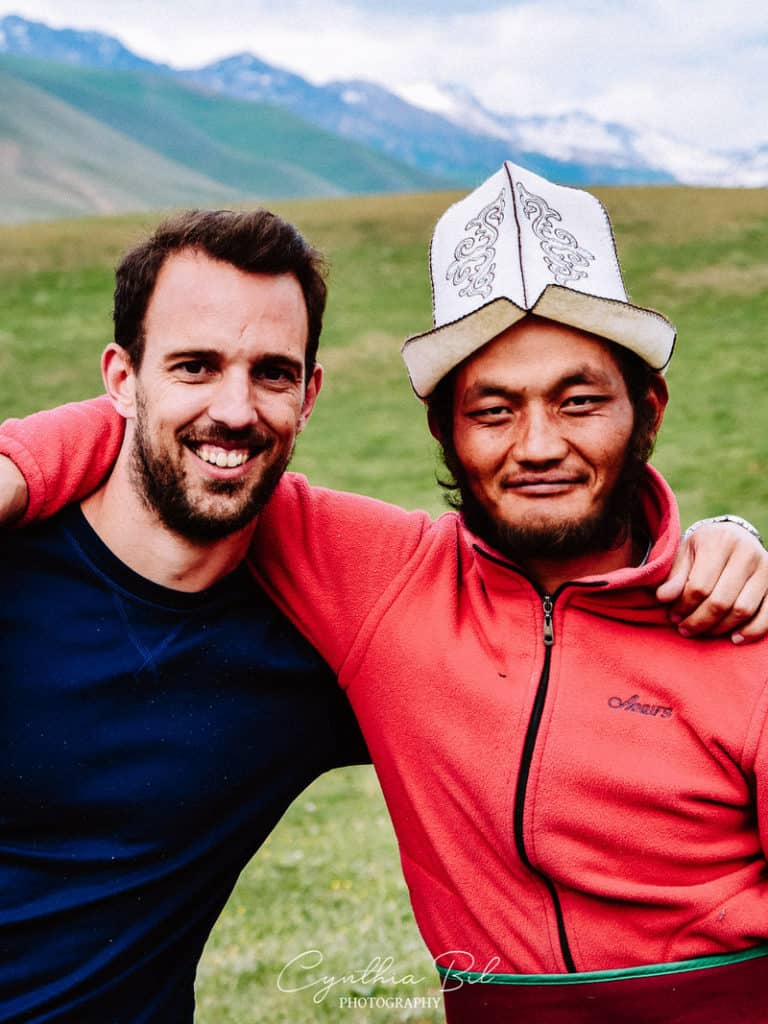
However, in more touristic destinations the people are used to being hospitable in exchange for money. They will welcome you in their home to spend the night but will expect payment in exchange.
Don’t feel offended or abused when this happens, see it as a way of helping out the locals.
The common greeting is a handshake but is used by men mostly. Men shake hands to greet and congratulate each other and also to say goodbye. Typically men do not shake hands with women.
If a man extends his hand first to a woman, a woman is supposed to shake it. If a woman extends her hand first to a man, the man will shake it but this is not a very common thing.
So if you’re a woman, just wait until a man initiates it, and don’t be offended if he doesn’t. It’s after all part of the culture.
Some more useful things to know:
- Always show respect towards older people by shaking their hand or offering your seat.
- Say thank you in the gesture of a silent bow: place your right hand on your heart and incline your head slightly
- After sharing a meal together, the Kyrgyz people give thanks by sharing some words of gratitude while having their hands open and then make a washing gesture by waving their hands over their faces.
- People don’t know how to queue in Kyrgyzstan. Don’t be surprised when someone jumps in front of you in a waiting line so dare to be assertive or you’ll never make your way to the cash register…
- You won’t find any knives on dining tables, only forks and spoons.
- Give or receive something by using your right hand. The left hand is considered “dirty” as it’s the one used in the bathroom
- Blowing your nose in public is considered to be rude but spitting on the floor is absolutely fine, except in ones house of course…
- If you need to go to the bathroom and there aren’t any toilets available such as when hiking in the mountains, hide yourself well (even guys!). If a local would see you squatting, he/she will be very offended by it!
18. What is the Religion in Kyrgyzstan
Kyrgyzstan is a multicultural and multi religious country. The vast majority of the Kyrgyz people are nowadays Sunni Muslims as Islam became the dominant religion in Kyrgyzstan in the 19th century.
The Islam practiced in Kyrgyzstan is often infused with the elements of the pre-Islamic traditions and tribal customs of the ethnic Kyrgyz people.
The people in the southern part of Kyrgyzstan are more conservative and traditional. They practice their religion more strictly, meaning you’ll see or hear them praying 5 times a day, alcohol is mostly a no-go (except when drinking kymys) and while women usually don’t wear a hijab (with the exception of Arslanbob), they always cover their heads.
The northern part of the country is less conservative and has more Russian and Western influences. You’ll see both Russian Orthodox churches as mosques and the people, even if they practice Islam, usually won’t say no to good shot of vodka.
19. Do people in Kyrgyzstan speak English?
Russian and Kyrgyz are the two official languages of Kyrgyzstan. It’s one of the two former Soviet republics in Central Asia that continued using Russian as the official language.
After the independence of the country in 1991, Kyrgyz was designated as the second official language and is now the most widely spoken language in the country. It’s a Turkic language and has a lot of similarities with Kazakh and Turkish.
English is spoken, but mainly by tour guides and the younger people who study in the cities. If you want to be able to communicate with the locals, I’d suggest you learn some Kyrgyz or Russian .
l study Russian by using the audio classes of Pimsleur. This is a great learning method to study a new language.

A phrasebook will definitely be useful. I recommend both the Lonely Planet Central Asia Phrasebook and the Lonely Planet Russian Phrasebook & Dictionary. I also recommend installing the Google Translate app and download the Russian language pack for offline use.
20. Recommend books about Kyrgyzstan
When traveling in Kyrgyzstan, I would recommend bringing a small pocket phrasebook like the Lonely Planet Central Asia Phrasebook & Dictionary as it contains some useful phrases.
I would also recommend reading one or more of the following books.


Lonely Planet Central Asia, is ideal if you’re also planning on visiting other destinations in Central Asia


Kyrgyzstan : a beautiful photography book that focuses on the costume and dress of Kyrgyz people, with stunning photos of Kyrgyz people in traditional settings.


The Silk Roads: A New History of the World: a journey through time, a revelatory new history of the world, connecting all the vast webs of roads to gain a greater understanding of modern history.
I hope you found all the info you were looking for to prepare your Kyrgyzstan trip and I’m wishing you a fantastic time in one of my favourite countries in the world!
If you still have questions about your upcoming journey, let me know in the comments below or send me an email.
Related Posts

Kyrgyzstan Itinerary: The Ultimate 7, 10, 14 & 21-Day Travel Guide
Why Visit Kyrgyzstan: 12 Reasons why I fell in love with this special country in Central Asia
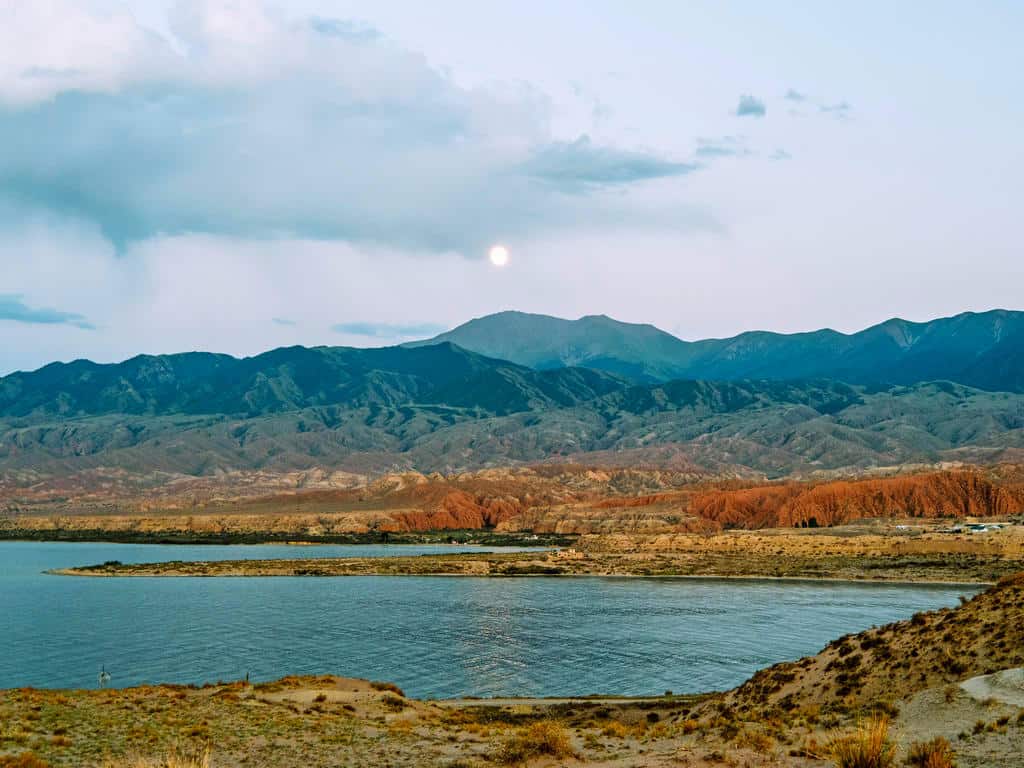
The best things to do around Issyk Kul Lake in Kyrgyzstan: Highlights, Hiking & one-week itinerary

The Complete guide to the World Nomad Games 2026 in Kyrgyzstan

Naryn Travel Guide: 12 Best Hikes & top things to do in Naryn Kyrgyzstan
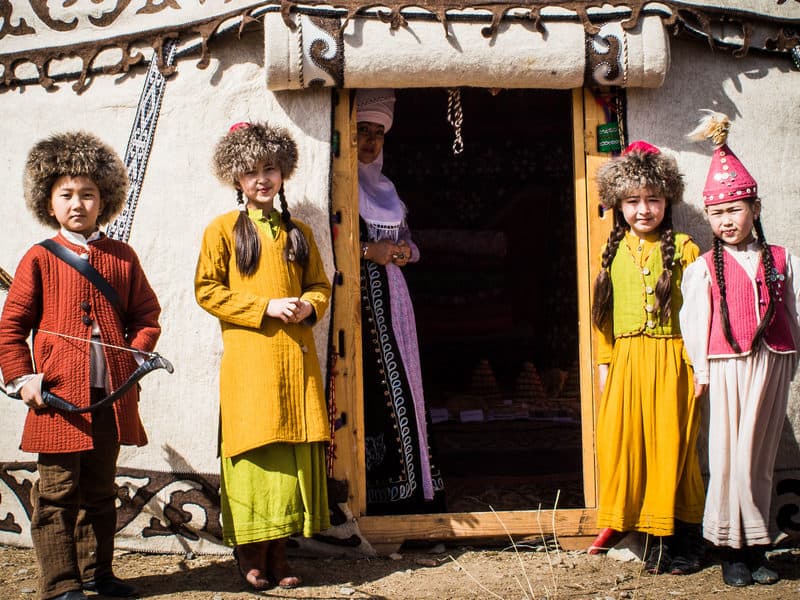
Kyrgyzstan Money Guide: Costs of Living and traveling in Kyrgyzstan in 2026
More Kyrgyzstan Travel Resources
- The Complete Travel Guide to Kyrgyzstan
- The 14 best hikes in Kyrgyzstan
- The 25 most beautiful places in Kyrgyzstan
- 8 beautiful lakes in Kyrgyzstan
- The 9 best horse riding destinations in Kyrgyzstan
- 15 useful safety tips for Kyrgyzstan
- The complete packing list for Kyrgyzstan
- 28 Things to do in Kyrgyzstan
- 13 Top Things to do in Bishkek – City Guide
- How to visit the Osh Bazaar in Bishkek
- 14 Top Things to do in Osh – City Guide
- 15 Best Things to do in Karakol – City Guide
- The 21 best hikes in Karakol and Jyrgalan
- Tash Rabat Travel Guide
- The complete travel guide to Kel Suu Lake
- The complete travel guide to Arslanbob
- How to visit Sary Chelek Lake and Nature Reserve
- Top things to do around Issyk Kul Lake, a one week itinerary
- Facts and legends of the Burana Tower
- Everything you need to know about horse riding to Song Kul lake
- A comprehensive guide to skiing in Kyrgyzstan
- 6 reasons why you should visit Kyrgyzstan in winter
- Visit Kyrgyzstan in winter by using this 10-day Kyrgyzstan winter itinerary
- Here are the 7 best hikes in the Alay Mountains near Osh
- Use this day-by-day itinerary to hike independently to Ala Kul lake
- Hike independently to Son Kul lake by using these 2 itineraries
- 8 great day trips and hikes near Bishkek
- Ready steady goat! An insight into Kok Boru, Kyrgyzstan’s unusual national sport
- Meet the Golden Eagle Hunters of Kyrgyzstan
Hi! Do you have any recommendation on what sim card data plan to get for travellers? I read that the data plans are rather complicated (or different) in Kyrgyzstan. Is there a fixed plan for a fixed amount of data for a fixed period? Or it goes by top up?
And I suppose it is easy to get them at the airport upon arrival?
Hi Dianshan, the data plans go by a fixed amount per month but you can always top up if needed. You can get them upon airport arrival or in Bishkek in any shopping mall.
Wonderful, just what we needed. My wife and I are going to trek for two weeks this summer i Kyrgyzstan. Your information and beautiful pictures make us look even more forward to visit the country.
All the very best
Johnny
Hi Johnny, thank you so much for your kind words! Wishing you a fantastic trip in Kyrgyzstan! Warm wishes, Cynthia
What a great article! We’re currently dreaming of going to Kyrgyzstan again – we’ve been there before and we love, love love it! Here’s to a year with loads of travel plans and new experiences!
– Veronika
Thank you Veronika! Are you planning on returning in 2023?
Thanks a lot Cynthia, it is really helpful and comprehensive, i am planning to go to Bishekek this weekend, and hopefully i enjoy it, I will definitly keep a print of this complete guide, my concern are villages and how to reach there and enjoy the nature.
Thanks again.
Amir
Manama – Bahrain
Hi Amir,
You might not be able to reach certain places at this time of the year due to snowfall. You might need the help of tour companies to get to certain areas. Please see my Kyrgyzstan winter itinerary as that one might help! If you can’t get to a place or village by public transport, you can always look for a taxi as well. Enjoy your time in Kyrgyzstan!
Hi Cynthia,
thanks for sharing your experience. It is very helpful and interesting for all of us that fancy going to this beautiful country.
I am planning to visit Kyrgyzstan next summer and it is not easy to see everything within 8-9 days. My main concern is about how to get around: do you recommend hiring a car (I have seen it is very expensive with a low standard, around 60-80usd/day)? or do you suggest using local means of transport (my concern is, if I want to go from a town to a village, then do some hiking there, how can I get another transport from this remote area to the next place? ).
Hope you can help
Gianguido
Hi Gianguido,
It really depends on which places you like to visit in Kyrgyzstan. If you’re planning on going to Issyk Kul and Son Kul, you’ll be able to get there by public transportation or by (shared) taxi. If you’re interested in hiking to Ala Kul, you can get a minibus to Karakol and a taxi to drop you off at Karakol Valley from where you can start the hike.
If you want to visit regions like Kel Suu, you won’t be able to get there by public transportation.
If you have a look at our posts like “Best places to visit in Kyrgyzstan” or “one week itinerary Issyk Kul”, we give information on whether or not it’s possible to get to these places by local transport. Hope this helps!
This is a great post, an enjoyable and informative read. I’m travelling solo to Kyrgyzstan for a month this summer so it’s nice to have so many tips about one of the more undiscovered parts of Asia. Thanks so much!
Hi John, I’m glad to hear you enjoyed reading this post. You’ll have a fantastic time this summer in Kyrgyzstan! We might cross paths as we’ll be there as well 🙂
Any particular places you already know you want to visit?
Very comprehensive, ultimate travel guide indeed, thanks for sharing Cynthia!
Sad to hear about the “corruption” with the traffic police, if we may add, also look out for fake police and pickpockets – reportedly common at the Osh Bazaar.
Wishing everyone a safe and fun trip in Kyrgyztan 🙂
Thank you David, glad to hear!
I haven’t heard or didn’t come across the fake police but yes, people have to watch out for pickpockets at the Osh Bazaar.
awesome
Thanks Jack! 🙂 Are you planning on traveling to Kyrgyzstan any time soon?